
Miyama Capital Geopolitical Macro Series, Article 13
Kuan H. Wang | 2026.03.28
This is Article 13 in Miyama Capital’s Geopolitical Macro Series analyzing the Iran conflict and its cross-asset transmission implications. Previous installments: Art. 10: The Prisoner’s Dilemma & Long Gamma, Art. 11: Prediction Scorecard Update, Art. 12: Exit Infrastructure.
Key Takeaways
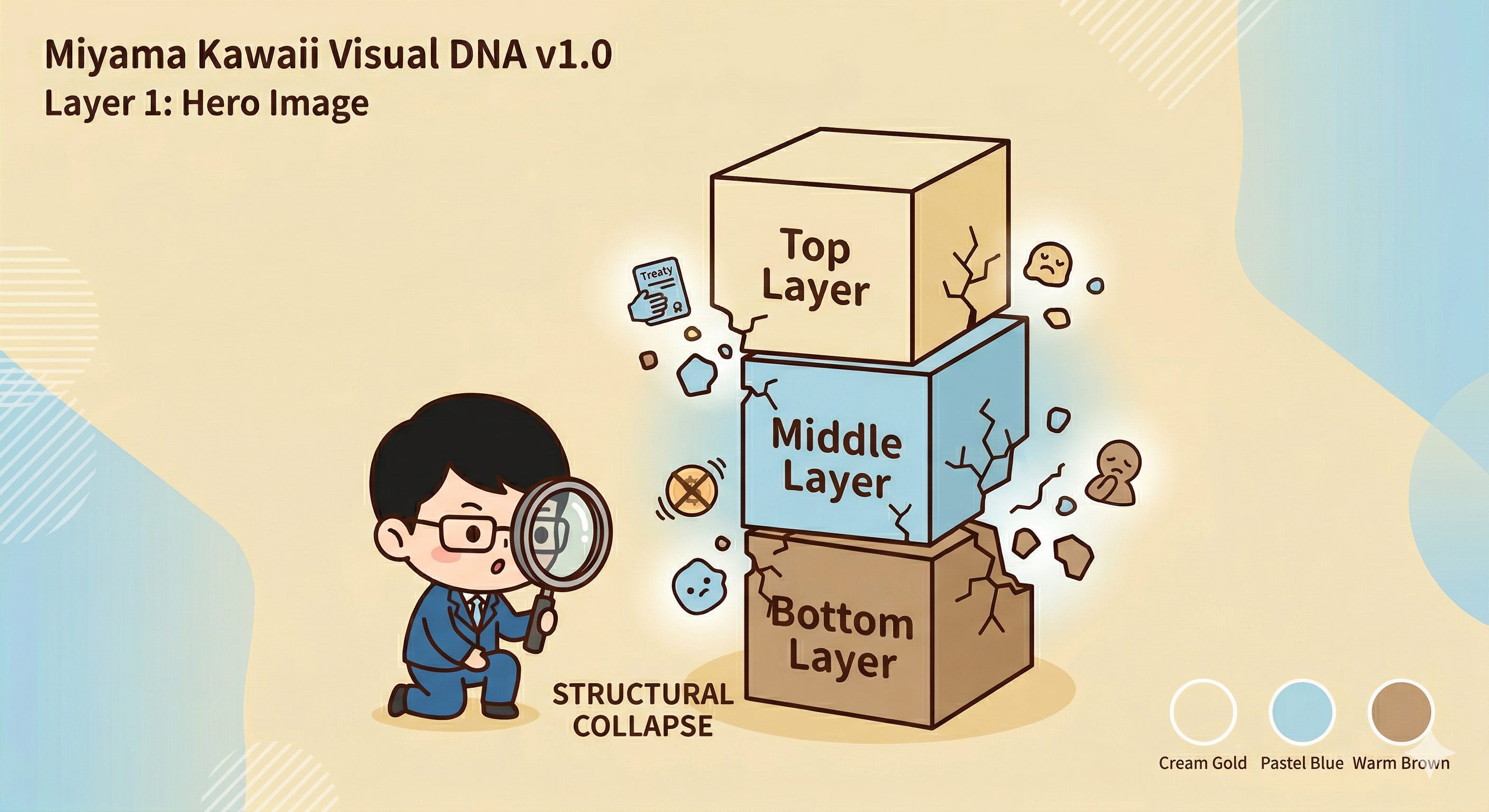
The Iran conflict will not end with a headline. It is ending through a gradual fade: IRGC is fracturing simultaneously from the top (targeted exemptions splitting leadership), the middle (pay and command chains severed), and the bottom (A-10/microwave suppression making resupply lethal). Portfolios priced for a binary event are mispriced.
Negotiations have moved faster than most observers realize. In seven days, Iran went from blanket denial to exchanging substantive terms (15 points vs. 5 points). Reports that Araghchi and Ghalibaf received temporary Israeli targeting exemptions, if accurate, signal that the negotiation channel has reached at least semi-institutionalized status.
All three paths to the April 6 deadline (framework agreement, limited strike then “mission accomplished,” or quiet extension) converge on the same destination: U.S. withdrawal, phased Hormuz reopening, oil prices normalizing. The difference is speed.
A-10 and Apache deployments along the Hormuz southern flank are severing IRGC’s truck-based resupply chain. This achieves near-occupation-level suppression of coastal launch capability without a single ground troop crossing onto Iranian soil.
Assumption failure trigger: IRGC demonstrates unified central command in a large-scale coordinated counterattack (simultaneous missile salvo, dense sea mine deployment, and fast-boat swarm within 72 hours). If that happens, the three-layer collapse thesis requires reassessment.
The Market Is Waiting for the Wrong Thing
The market wants a clean headline: ceasefire signed, war over, delete “geopolitical risk” from the dashboard.
I wrote in Art. 10 that this war has no USS Missouri signing ceremony. Now I am upgrading that assessment. The ending has already started as distributed system failure across three organizational layers. IRGC’s blockade capability is degrading through simultaneous fractures at the top, middle, and bottom of the organization. The correct mental model is a gradual fade, and it is already underway.
On the negotiation track, 15 points and 5 points are slowly converging. Hormuz daily transits will creep from zero to 6, then 15, then 30. U.S. sortie rates will taper from 500 per day to 300, then 100. Repricing will emerge through a sequence of smaller signals rather than a single headline. Months from now, you will realize it ended quietly on some Wednesday you did not notice.
The question facing allocators: is your portfolio priced for a binary event or for a gradual fade? The implications are completely different.
Seven Days of Bazaar Negotiation
The past week moved faster than most people realize.
On March 21, Iran’s official position was blanket denial. No negotiations, no conditions accepted, business as usual. Seven days later, both sides are exchanging substantive terms through intermediaries: 15 points versus 5 points.
That velocity is abnormal in Middle Eastern geopolitics.
To understand what is happening, apply the framework of bazaar negotiation (the Middle Eastern diplomatic tradition of staged bargaining) rather than Western diplomatic conventions. Bazaar negotiation moves through four stages.
Stage one is the opening bid. Both sides throw out extreme numbers. The purpose is not to close a deal; it is to probe the other side’s floor. The U.S. 15-point plan is an opening bid. Iran’s 5-point counter is an opening bid.
Stage two is probing. Intermediaries shuttle back and forth, relaying messages, testing boundaries. Oman and Qatar are doing this work now.
Stage three is the theatrical walkout. One side pretends to leave the table and raises the stakes. The U.S. escalates strikes. Israel declares all Iranian regime leaders legitimate targets. Iran increases harassment in Hormuz. This escalation is embedded in the bargaining mechanics.
Stage four is convergence. Both sides begin overlapping on real terms. The intermediary role shifts from message relay to draft text.
We are at the inflection between stage three and stage four.
The strongest evidence comes from targeting policy, not public statements. According to multiple media outlets, Araghchi (Foreign Minister) and Ghalibaf (Speaker of Parliament) reportedly received temporary targeting exemptions from Israel.
If those reports are accurate, consider what it means. Israel publicly declares all Iranian regime leaders as legitimate targets, then carves out exceptions for two specific individuals. Those two individuals happen to be the primary negotiation counterparts. The message is precise: we know who you are, we can kill you, and we are choosing not to, because you are still useful.
The negotiation has moved beyond diplomatic posture. If the exemption reports hold, the channel has reached at least semi-institutionalized status.
Rubio Said What We Have Been Writing
A brief aside.
Bloomberg reported on March 27 that the Trump administration communicated to allies that there are “no immediate plans to invade Iran,” while simultaneously deploying thousands of additional troops to the Middle East. On March 28, Secretary Rubio stated publicly: “We can achieve all of our objectives without ground troops. But we are always going to be prepared to give the president maximum optionality.”
Maximum optionality.
The framework I used in Art. 10 was long gamma: maintain maximum option space so that all paths converge toward the same directional outcome. The Secretary of State just used the same structure publicly.
Three scenarios were floated: occupying Kharg Island, seizing nuclear material, occupying coastline near Hormuz. But note the context. At this stage, these scenarios function as bargaining chips still being tested. Trump can change his mind at any point. Every card is visible, but nobody is told which one gets played.
The market implication is counterintuitive. Troop buildup headlines read as escalation (oil bullish, equities bearish), but structurally this deployment is a prerequisite for de-escalation because without a credible military threat, Iran has no reason to take the 15-point plan seriously and the entire bazaar negotiation framework collapses at stage two. The troop deployment gives negotiations teeth.
Military pressure escalation is a catalyst for negotiations accelerating. A market that reads only headlines and ignores structure will reach the opposite conclusion.
All Three April 6 Paths Lead to the Same Exit
April 6 is Trump’s stated deadline. Regardless of which path materializes, the destination is the same.
Path A: Framework Agreement (subjective scenario weight ~40-45%)
Both sides announce some form of framework deal on or before April 6. Likely a 30-day ceasefire with continued negotiations during the pause. Hormuz reopens in phases under the framework, starting with limited escort and expanding to full transit.
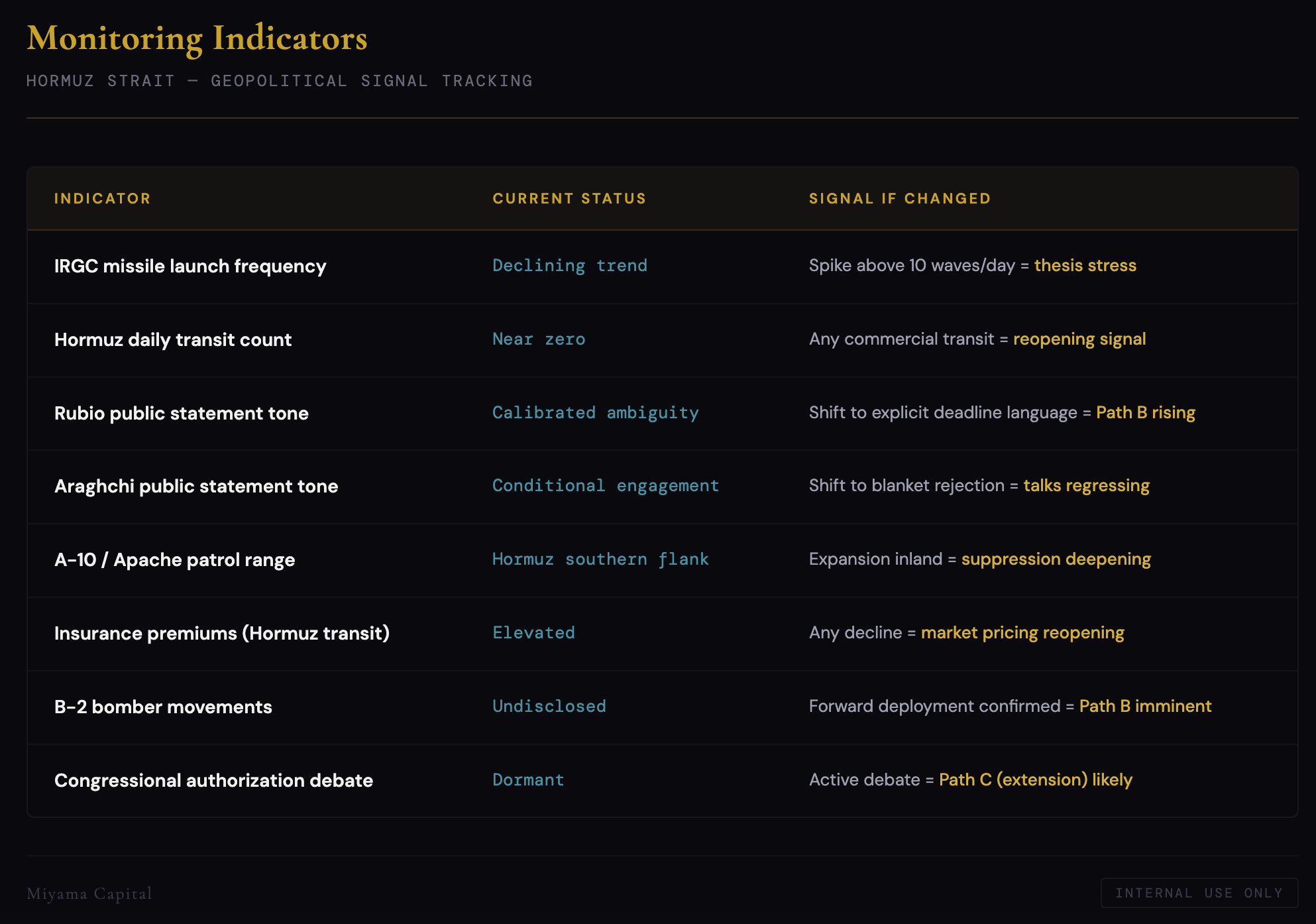
Observation indicators: tone shifts in public statements by Araghchi and Rubio; official travel schedules for Omani and Qatari intermediaries; whether Israeli strike intensity shows a gap exceeding 48 hours.
For allocators, this is the most bearish path for oil. Crude could retrace quickly within 48-72 hours of a framework announcement. But actual Hormuz reopening still takes weeks. Allocators who position early will be validated when the headline arrives.
Path B: Limited Strike Then Declare Victory (subjective scenario weight ~30-35%)
Trump orders limited strikes on Iranian power plants or nuclear facilities around April 6, then declares “mission accomplished” and pivots to a withdrawal narrative. Hormuz reopening logic stays intact; it just gains a political inflection point.
Observation indicators: B-2 bomber movements; anomalous satellite imagery activity around Fordow/Natanz; Trump’s Truth Social posting frequency and language.
Oil spikes on the day of strikes, then within 48 hours the market begins pricing “this was the last shot” and crude reverses. This path has the highest volatility, but the direction converges with Path A within 72 hours.
Path C: Quiet Extension (subjective scenario weight ~20-25%)
April 6 arrives with no framework, no power plant strikes, and no declaration. The deadline quietly slides. All parties continue at the existing tempo. This is the path the market finds most frustrating, because it waited for a catalyst that never showed.
Observation indicators: whether the White House begins softening “deadline” language around April 3; new Congressional authorization debates; allied statements shifting from “support U.S. action” to “call for diplomatic resolution.”
Oil does not collapse, but it stops climbing. The market enters a range-bound fatigue phase. The cost to allocators is time and opportunity.
All three paths terminate at the same point: U.S. forces leave, Hormuz reopens in stages, oil normalizes. The only variable is speed.
Military Checklist: Completion Is Already High
A quick battlefield update, because these numbers underpin the core judgment that follows.
According to CENTCOM public briefings and analysis from platforms including Janes and Army Recognition (data as of March 27): approximately two-thirds of Iran’s missile and drone production capacity has been destroyed. Naval vessel destruction rates reportedly exceed 90%. Cumulative military targets struck reportedly exceed 10,000. IRGC Navy Commander Tangsiri has been confirmed killed. Per Israeli Defense Forces statements, strikes on Iranian weapons factories accelerated over the most recent 48 hours.
The strike campaign is approaching completion. What matters now is the operational shift from destroying fixed assets to suppressing mobile capability along the coastline.
No Landing Required to Paralyze the Blockade
Here is a question I spent time working through in my own analysis: if the Iranian navy is destroyed, why is Hormuz still closed?
Because blockade capacity sits in the coastal resupply network: sea mines, shore-based missiles, fast boats, and geographic proximity. Naval surface vessels were the conventional warfare layer, already destroyed. The four remaining blockade tools share one vulnerability: all of them depend on truck-based resupply chains.
Sea mines require trucks to transport them from rear depots to coastal launch points. Shore-based missiles sit on mobile launchers that need ammunition resupply by road. Fast boats hide in fishing harbors and caves, but fuel and weapons arrive by truck. Drone teams assemble and launch from temporary coastal positions, with all materiel moving overland.
The operational response is already deployed. According to public remarks by General Caine (Chairman of the Joint Chiefs) and reporting by The Aviationist, A-10 attack aircraft and Apache helicopters have moved to the southern flank of Hormuz, conducting low-altitude patrol and strike missions. Per the Jerusalem Post, CENTCOM used 5,000-pound GBU-72 penetrator munitions against missile positions on the coastline near Hormuz.
That the U.S. is sending A-10s (slow, low-altitude) and Apaches (operating altitude 50-200 feet) to patrol near the Iranian coastline is itself an intelligence assessment. It tells you U.S. forces judge that Iranian coastal air defenses have been suppressed to minimal levels. You do not send two slow, low-altitude platforms into an area with effective air defense.
These assets are severing the truck-based supply chain.
The A-10’s 30mm GAU-8 cannon fires 65 rounds per second. One truck takes less than a second. Apaches use Hellfire missiles for targets sheltering in hardened positions. Together, they maintain continuous air patrol along the Iranian coastline: spot a truck, fast boat, or drone launch team, destroy it. No command chain approval required. No satellite imagery analysis delay. Real-time detection, real-time kill.
This model achieves effects approaching ground occupation at a fraction of the cost and political risk. You do not need a single American soldier to set foot on Iranian soil. You just need “going outside to resupply = death” to become the daily reality for IRGC coastal units.
Once the supply line breaks, ammunition at coastal launch sites depletes without replenishment. Blockade capability decays like a battery draining. Slowly, then all at once.
IRGC Is Fracturing From Three Directions Simultaneously
This is the core judgment of this article.
In Art. 10, I described IRGC’s bottom-up collapse mechanism, focusing on how C2 (command and control) decapitation shifts local commanders’ dominant strategy toward passive execution. Now I am upgrading that framework. The fracture extends beyond bottom-up mechanics. It is happening simultaneously across top, middle, and bottom layers, each reinforcing the others.
Top Layer: Targeted Exemptions Are Splitting Leadership
Israel has declared all Iranian regime leaders legitimate targets. Araghchi and Ghalibaf have reportedly received temporary exemptions.
This creates a precisely engineered incentive structure: willingness to negotiate correlates with survival. Refusal correlates with becoming the next Tangsiri.
Not every senior leader needs to defect. Enough need to calculate that aligning with the negotiation faction is safer than standing with the hardliners. That calculation has already been preset by U.S.-Israeli lethal pressure.
A self-reinforcing cycle is now running: senior leaders are killed in targeted strikes, which makes remaining leaders more desperate to secure exemptions, which increases their willingness to cooperate with negotiations, which further isolates hardliners, which makes isolated hardliners easier to identify and target, which makes more people want exemptions. Each rotation of this cycle expands the negotiation faction’s leverage.
Middle Layer: Pay Severed, Command Vacuum
IRGC controls an estimated 30-40% of Iran’s GDP. But Kharg Island’s oil facilities have been hit. International sanctions remain. Hormuz toll revenue is unstable. Central funding is shrinking.
Simultaneously, the central command chain is riddled with gaps. The intelligence minister, internal security chief, Basij commander, and navy commander have all been killed. The C2 decapitation analyzed in Art. 10 is materializing: central leadership can neither issue pay nor enforce orders, and nobody is monitoring what regional commanders actually do.
The rational choice for regional commanders is clear. Hoard resources, cease proactive attacks, preserve manpower and materiel. In plain terms: become a warlord. They may not intend to defect. But with central authority collapsing, this is the optimal survival strategy.
Bottom Layer: “Going Outside = Death” Is Destroying Execution Willingness
You are an IRGC drone operator or fast-boat pilot. Your commander dispatches you to Hormuz to execute a blockade mission.
Your commander has not paid you. Your command chain has been severed several levels above. The team next to yours went out last week and never came back. The A-10’s 30mm cannon: one truck, less than a second.
And you are hearing about a new weapon system. According to reports, the U.S. is accelerating deployment of high-power microwave systems (Leonidas and similar platforms) that can down an entire swarm of drones simultaneously at near-zero marginal cost, powered by electricity alone. Your team spent days preparing a drone batch that may be neutralized within minutes of launch.
The rational calculation at the individual level favors non-compliance.
The “going outside = death” signal propagates faster than the actual kill rate. The defection threshold analyzed in Art. 10 is being systematically lowered by A-10 hunting and microwave weapons. Complete defection is unnecessary. Enough operators choosing to stay put drains the blockade of execution capacity from the inside.
Three Layers Operating in Concert
The three layers form an accelerating feedback loop. Leadership splits deprive the middle of direction; the middle vacuum deprives the bottom of pay and orders; bottom-layer passive execution undermines the hardliners’ claim that “the front line is still fighting.” Each cycle tightens the others.
IRGC’s blockade capability will decay without anyone “announcing” that Hormuz is reopening. The blockade will end the way it began: ambiguously. You will notice, after the fact, that commercial vessels started transiting again, that insurance premiums started declining, that oil prices quietly returned to a normal range.
Hormuz Reopening Roadmap
Hormuz reopens in phases, each lowering the risk threshold for the next.
The first phase is already underway. A-10 and Apache suppression of coastal threats establishes air superiority along the strait. Mine-clearing operations have very likely entered the planning stage; whether they have commenced awaits further public signals. This is the most time-consuming step, but also the component where allied participation (per the 22-nation joint statement) is most probable.
Next, U.S. Marines organize escort convoys. According to public deployment data, the 31st Marine Expeditionary Unit (MEU) and 11th MEU have moved into positions capable of supporting Hormuz escort operations. The significance of escort is that it elevates the threshold for Iranian attacks on commercial shipping from “hitting a tanker” to “firing on U.S. military forces.” That is a completely different escalation calculus.
Then comes multilateralization. The UAE ambassador has publicly stated readiness to join an international initiative to reopen Hormuz. Saudi Arabia and Bahrain, both struck by Iranian attacks, have motivation to participate. Qatar has reportedly downed two Iranian fighter jets. If accurate, this represents Qatar’s shift from mediator toward direct security participation.
A layered participation structure is forming: U.S. and Israel lead offensive operations; Gulf states provide defensive and logistics support; then gradually join escort rotations. The more nations participating in escort, the higher the escalation cost for Iran to attack any single convoy vessel.
The final phase is declaration of a safe corridor plus declining insurance premiums. The U.S. can provide real-time escort along a swept and patrolled shipping lane. Iranian consent is not required. What is required is that commercial vessels trust the escort capability. When insurance underwriters begin recognizing the corridor and reducing premiums, Hormuz is effectively reopened.
One counterintuitive angle within this roadmap: Iran’s parliament is legislating a toll on Hormuz transit. This is actually encouraging. Tolling means Iran has chosen to monetize the strait’s traffic rather than block it. Analogous to Suez Canal tolling, the blockade was a means, not an end; the real objective is revenue. As long as the toll mechanism does not threaten transit safety, it can function as a face-saving compromise acceptable to both sides.
Prediction Scorecard Update
Continuing series convention, below is the status of verifiable predictions as of this article. All probability figures are the author’s subjective scenario weights, not statistical model outputs. They express relative conviction levels, not precise forecasts.
P1-P8: These cover predictions on strike escalation trajectory, Hormuz closure duration, oil price range, IRGC command fragmentation, and coalition formation. Tracking continues; see Art. 11 and Art. 12 for full tables. Only material changes noted here.
P6 (from Art. 11): U.S. establishes Hormuz escort capability before early April. Status update: per public deployment information, Marine MEUs are now in position. A-10 and Apache assets have deployed to Hormuz’s southern flank. Escort capability formation is ahead of original expectations. Judgment maintained; conviction upgraded from 65% to 75%.
NEW P9: Some form of framework agreement reached around April 6. Subjective weight ~45%. Basis: bazaar negotiation has entered the stage three to four transition, and the Araghchi/Ghalibaf exemption (if accurate) implies the negotiation channel has been institutionalized.
NEW P10: IRGC missile launch rate falls below 5 waves per day by mid-April. Subjective weight ~70%. Basis: three-layer collapse mechanism combined with A-10/Apache supply chain severance is suppressing coastal launch capability.
NEW P11: Hormuz daily transit volume recovers to double digits by end of April. Subjective weight ~60%. Basis: escort capability in position plus multilateral patrol forming progressively; safe corridor announcement possible by mid-April.
Monitoring Indicators
Three Paths for Allocators
The following scenarios and illustrative parameters describe an analytical framework, not a recommendation. Actual implementation depends on individual risk tolerance, instrument access, and market conditions. Nothing below should be read as a solicitation or specific trade advice.
Path A: Position early for the gradual fade. Begin adjusting now under the assumption that Hormuz reopens in stages. Reduce energy-related hedging positions. Gradually increase exposure to assets that benefit from Hormuz reopening. The cost: if April 6 produces a surprise escalation (Path B’s “final strike”), you absorb short-term volatility. Suited for allocators with stop-loss plans in place and a quarterly-plus time horizon.
Path B: Wait until after April 6. Maintain current positions unchanged. Adjust only after the April 6 outcome is visible. The cost: if de-escalation signals emerge before April 6 (Path A’s framework), you miss the first wave of repricing. Suited for allocators whose current exposure is already light, or whose conviction on the Middle East situation is low.
Path C: Use options to lock in downside, preserve upside. Buy crude oil puts to protect existing exposure while retaining upside participation. The cost: time value and premium. Suited for allocators who have a derivatives toolkit and are willing to pay for optionality.
Which path you choose matters less than understanding what you are giving up. Path A sacrifices short-term safety for first-mover advantage. Path B preserves safety but forfeits repricing opportunity. Path C pays premium for optionality. The direction is the same across all three; the difference is speed and price.
Coda
The ending will be visible through operational fade before it is visible in headlines. Hormuz’s reopening has already begun in the details allocators should be watching: insurance premium quotes, escort convoy departures, declining sortie counts.
Assumption Failure Conditions
If any of the following conditions materialize, the core judgments in this article require reassessment:
IRGC demonstrates unified central command in a large-scale coordinated counterattack (simultaneous missile salvo, dense sea mine deployment, and fast-boat swarm occurring within 72 hours). If this happens, the three-layer collapse thesis requires revision.
U.S. ground forces invade the Iranian mainland. This invalidates the foundational assumption of the exit framework.
After April 6, there are no power plant strikes, no framework agreement, no extension, and U.S. forces begin withdrawing from the region. The entire timeline framework requires recalibration.
Disclaimer
This article reflects my personal investment philosophy. It is not investment advice. Make your own informed decisions.
Miyama Capital manages proprietary capital only and does not solicit external investors.
This memo represents the author’s personal views on macroeconomic conditions, interest rate environments, and asset allocation as of the date of writing. It does not constitute a solicitation, recommendation, or guarantee regarding the purchase or sale of any security, fund, bond, or other financial instrument. Investing involves risk; bond prices, interest rates, foreign exchange rates, and economic/policy conditions may materially affect asset values. Scenarios and instruments discussed may become inapplicable as market conditions change. Readers who make investment decisions based on this memo do so at their own risk, and the author accepts no liability for any gains or losses arising from the use or citation of this material.
Kuan H. Wang Founder & CIO Miyama Capital
Military and diplomatic intelligence cited in this article is current as of March 28, 2026, and may have changed since publication.