
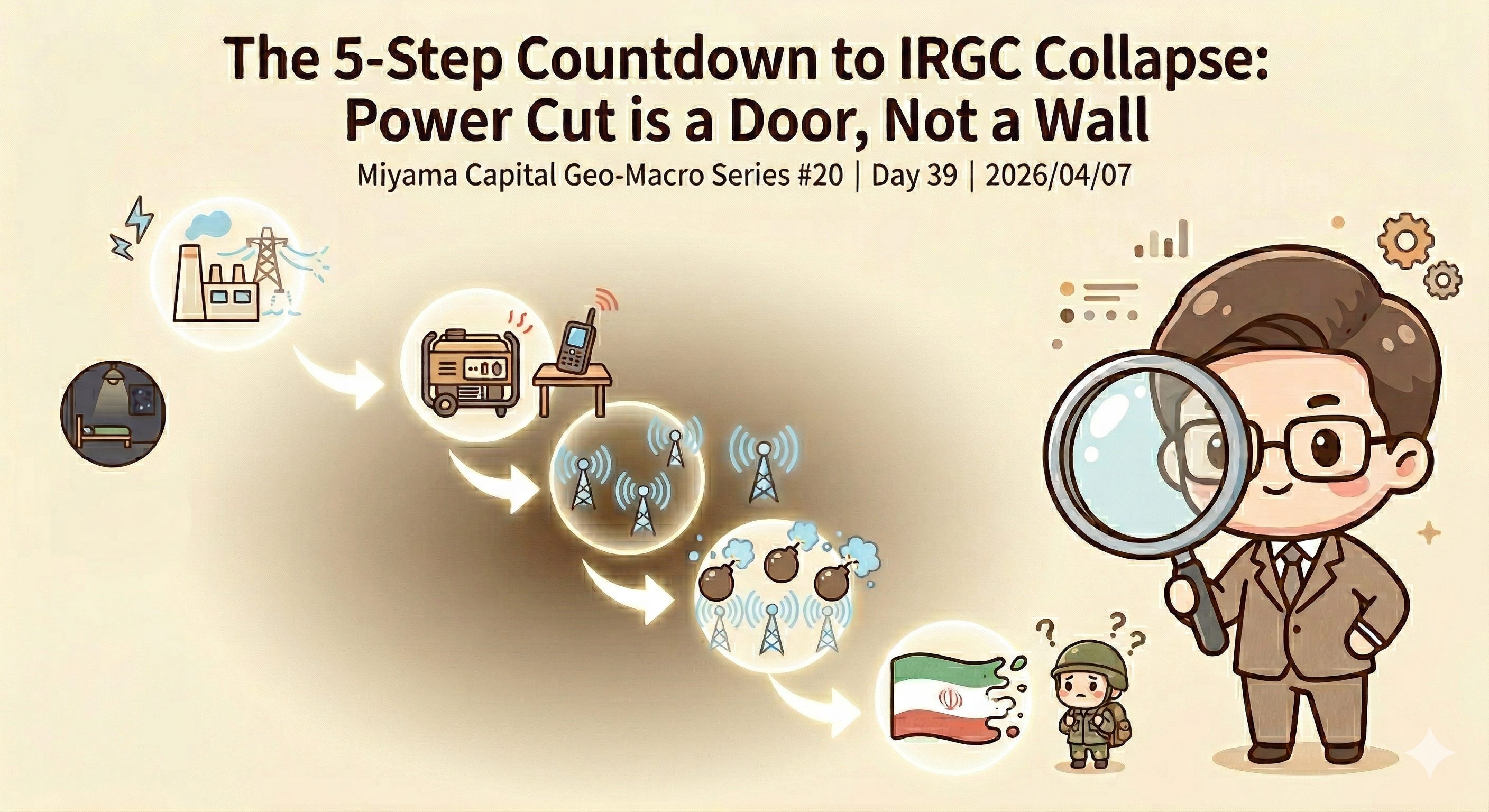
Miyama Capital Geopolitical Macro Series #20 | Day 39 | 2026/04/07
Key Takeaways
Trump’s 4/6 press conference was not a threat. It was an operational briefing: every power plant down within four hours. The question is not “will they strike.” The question is what happens in hour five.
Destroying Iran’s grid is not punishment. It is a trap. Once civilian electromagnetic background drops to near-zero, every backup system IRGC activates becomes a self-locating beacon.
IRGC faces five communication options post-blackout. All five converge on the same outcome: organizational exposure followed by simultaneous strike. This is checkmate by design.
The market is pricing a binary “strike or no strike” bet. The real alpha is in the speed of IRGC disintegration, which determines how fast the Strait reopens and risk premium unwinds.
Two falsification triggers are set. If the US does not strike grid infrastructure within 48 hours of the deadline, or if IRGC sustains coordinated multi-regional operations 72 hours post-blackout, I will publicly revise the framework.
Everyone is asking the wrong question.
On 4/6, Trump stood in the White House press room flanked by his Defense Secretary, the Chairman of the Joint Chiefs, and the CIA Director. He said: “The entire country can be destroyed overnight, and that night could be tomorrow.”
Analysts and media worldwide are debating whether a strike will happen. Trump himself said four hours is enough.
Four hours is not the point.
I care about a different question. What happens in hour five, hour six, day two, day three? This article answers that.
The Coercion Ladder framework I introduced in Article 17 has reached its logical terminus. The power grid is the last rung. Article 18 established that Iran has played its last cards. Article 19 deconstructed DFC insurance as a financial instrument for post-war Strait control. This piece asks: what happens when the ladder hits the ground.
The Darkroom Effect: Why Killing the Lights Is Not Punishment
Under normal lighting, you cannot see anyone’s flashlight. Too many light sources. Too much background noise. Every flashlight drowns in ambient light.
Turn off every light in the room, and each flashlight becomes the only visible point. You do not need to search for it. It tells you where it is.
Iran’s power grid is that ambient light. IRGC military communications hide inside the electromagnetic environment of 88 million civilians. Under normal conditions, NSA and Israeli SIGINT systems must filter military signals from millions of cell phones, hundreds of thousands of Wi-Fi routers, and countless base stations. The signal-to-noise ratio is terrible. Needle in a haystack.
Blackout reverses everything.
Civilian base stations go dark. Civilian networks go offline. The electromagnetic background drops to near-zero. Now, any device still transmitting (a backup generator powering a radio station, a satellite phone, even a single charged cell phone) stands out like a flashlight in a dark room.
The signal-to-noise ratio flips from “needle in a haystack” to “the needle is glowing.”
I will be direct: this is a pattern any engineer recognizes instantly. In IC testing, defects hide in background current under normal power conditions. Change the power supply conditions, and the defective transistor produces anomalous current that exposes its location. Blackout is the changed test condition. IRGC’s backup communications are the anomalous current. Each anomalous signal equals a targetable coordinate.
The purpose of blackout is not to inconvenience IRGC. It is to make IRGC visible.
Five-Step Countdown
The following timeline is inference from public information, not intelligence. Time windows are rough estimates. Actual pace depends on battlefield conditions.
Step 1: Grid Zero (Hour 0–4)
Trump’s four hours. Tomahawk cruise missiles and JDAM precision-guided munitions hit multiple power plants simultaneously, targeting transformers and control rooms.
One detail most analysts are missing: calibrated destruction. The strikes avoid turbine bodies and hit transformers. Turbines can be repaired, but a repaired turbine still needs a transformer to connect to the grid. Transformers are custom-manufactured products with lead times measured in years. The plants are not “destroyed.” They are “shut down,” and the shutdown duration is determined not by Washington but by the global transformer supply chain.
The country goes dark. Cell towers lose power. Internet switches go offline. Water pumps stop.
IRGC’s wired communications (landlines, fiber optics, military hardwire networks) all go dead. Not severed. Unpowered.
This step is known. Everyone is analyzing it. It is only the beginning.
Step 2: Forced Migration (Hour 4–12)
IRGC will not sit still. They will switch to backup systems.
Backup generators spin up. But generators need fuel, and diesel generators produce thermal signatures that are extremely conspicuous against a nationally dark background. One infrared satellite sweep and every running generator’s location is visible. Where the generator is, the command post is.
Satellite phones come online. But the relay satellites they route through are almost entirely within US intercept range. NSA can capture call content and precisely geolocate each terminal.
Radio networks resume. But frequencies and encryption patterns have been extensively analyzed during 36 days of war. Based on public reporting around the WSO rescue operation, CIA deception operations successfully misdirected IRGC forces, which suggests the US may already have the ability to inject into IRGC communication channels.
Every “backup” is a known geolocation tool. IRGC is not “restoring communications.” It is self-tagging.
Step 3: Simultaneous Exposure (Hour 12–24)
The key is patience.
The US does not need to start hitting command posts in the first hour. Wait 12 to 24 hours. Let every command node across the country complete its switchover. Let every flashlight turn on.
Then run one nationwide thermal imaging sweep. Every generator heat source equals every still-functioning military facility.
Run one full-spectrum SIGINT scan. Every active transmission equals every still-commanding node.
These coordinates feed in real time to Israeli Air Force and US strike assets.
And on the eve of this window, IRGC intelligence chief Khademi was killed on the night of 4/5–4/6. The person responsible for counterintelligence is gone. The person who decides “which communication channels are safe” is gone. IRGC does not just have an infiltration problem. The person who investigates infiltration no longer exists.
Step 4: Simultaneous Strike (Hour 24–48)
Not sequential elimination. Simultaneous.
The September 2024 pager operation provides the reference point. Israel embedded explosives in Hezbollah’s communication device supply chain. Thousands of pagers detonated simultaneously. That operation demonstrated both the capability and the willingness to execute synchronized strikes far beyond conventional expectations.
Same logic here. You do not hit one command post and watch others react. You wait until all command posts are exposed, then strike every one within the same time window. No one has time to shut down, relocate, or send a warning. Simultaneous strike requires sufficient strike assets pre-positioned in theater; this depends on carrier strike group sortie generation capacity and regional basing. Given current force concentration in the Middle East theater, this condition appears largely met.
This is the deeper meaning of Trump’s “four hours.” Not just four hours to take down the grid. Four hours for the grid, then four hours for the next phase. Two cycles.
Step 5: Organizational Dissolution (Week 1–4)
No power. No communications. Command posts destroyed.
Rank-and-file IRGC soldiers face the simultaneous disappearance of three prerequisites for cohesion: they do not know who they are fighting for (senior commanders keep getting decapitated), they cannot trust that anyone is commanding (communications are compromised, orders may be fabricated), and they do not know if their peers still exist (the adjacent garrison may already be gone).
Combat requires organization as its carrier. When the organization disappears, the will has nowhere to attach.
IRGC does not fragment into guerrilla cells. It is more likely to fragment into individuals going home. A 125,000-person organization degrades into 125,000 individuals who do not know what to do.
CIA’s ground networks, validated during the rescue operation, serve their maximum function at this stage. Not fighting. Providing alternative structure. Contacting cooperative local forces. Establishing basic order. Trump mentioned for the first time at the press conference: “We might even help them rebuild the country.” That is not goodwill. It is a preview.
Physics completes the rest. No one needs to “overthrow” IRGC. Blackout plus time equals natural dissolution.
Checkmate: Five Roads, One Destination
Lay out IRGC’s options:
Option one: do not communicate. Command paralysis. Units lose direction. The organization disintegrates on its own.
Option two: activate backup generators. Thermal signatures exposed against a nationally dark background. Infrared satellites pinpoint locations. Air strikes follow.
Option three: use satellite phones. NSA intercepts call content and geolocates terminals. Call logs go to strike units in real time.
Option four: use radio. Frequencies have been mapped over 36 days of war. CIA has demonstrated the ability to inject false commands. Any order received might come from the enemy.
Option five: send human couriers. The speed of human delivery on a modern battlefield is functionally equivalent to no communication. By the time the order arrives, the battlefield has changed three times.
Five roads. One destination. This is the definition of checkmate. Not that there are no moves left, but that every remaining move leads to the same result.
Historical Echoes
This pattern is not new.
Iraq, 1991. During Desert Storm, the coalition severed Iraq’s military communication network. Iraqi forces were forced to use civilian telephones for command and control. NSA monitored every call. Every call became a strike coordinate. But 1991 technology was analog. Intercept-to-strike latency was measured in hours. In 2026, it is digital. It is real-time.
Crypto AG, 1970–2018. CIA and BND secretly controlled Swiss encryption company Crypto AG. Dozens of countries purchased their encryption machines, believing their communications were secure. CIA read every encrypted message for nearly 50 years. The key insight: the most effective intelligence operation is not breaking the enemy’s communications. It is making the enemy voluntarily use a communication channel you control.
The pager operation, September 2024. Israel embedded explosives in Hezbollah’s communication supply chain. Not interception. The communication device itself became a weapon. From Crypto AG to the pager operation to the blackout trap, the evolutionary logic is clear: control the channel, weaponize the channel, eliminate the channel to force migration.
My read: the 2026 blackout is the next step on this evolutionary path. No longer infiltrating the enemy’s system. Eliminating it entirely, forcing migration to yours.
Implications for Allocators
The 4/7 oil price spike is a known event. Everyone is pricing “strike or no strike.” During Trump’s press conference, Brent and WTI crude both jumped in real time. That price movement reflects a binary bet.
The real alpha is not in “strike or no strike.” It is in the speed of IRGC disintegration after the strike.
Each step in the countdown has observable indicators:
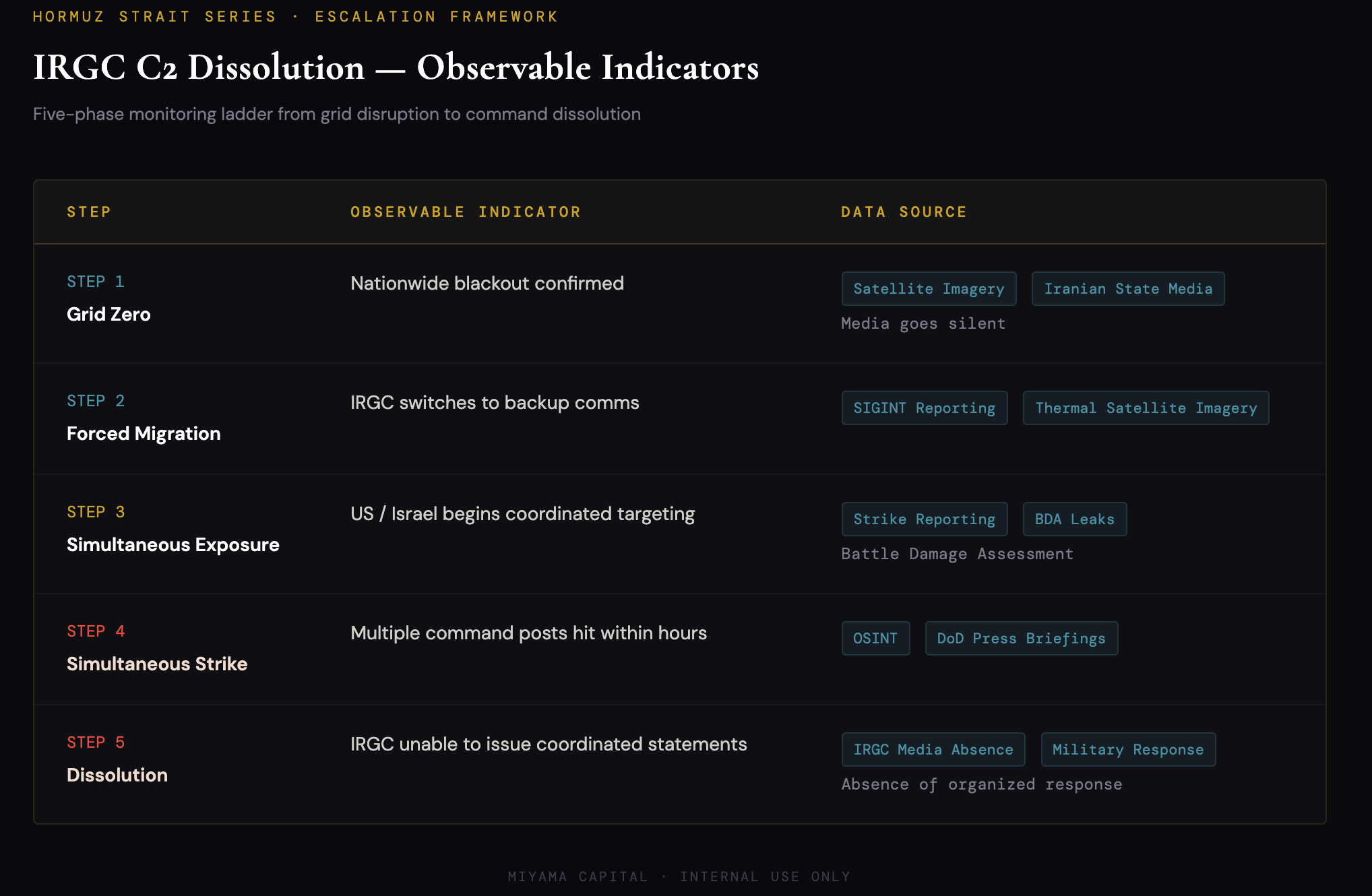
Faster disintegration means faster Strait reopening, faster oil price normalization, faster risk premium removal.
What allocators should watch is not “what happens on the night of 4/7.” It is “whether IRGC can still issue a single coordinated statement on the morning of 4/8.” If it cannot, the five-step countdown has started.
The Strait, Oil, and Shipping: Look Past the Blast Radius
I analyzed DFC insurance as a post-war Strait control instrument in Article 19. This round, the focus is not the immediate oil price impact of a strike. It is the speed at which Strait transit conditions change afterward.
Several key variables:
AIS vessel tracking data. Daily transit volume through the Strait of Hormuz is the most direct read on Strait accessibility. Pre-war normal runs approximately 60–80 tankers per day. If transit volume begins recovering within 72 hours of blackout, IRGC’s Strait-blocking capability is collapsing.
War risk premiums. London market war risk rates are the market’s real-time pricing of Strait risk. Premiums have surged several multiples from the pre-conflict level of roughly 0.3%. When premiums peak and begin declining matters more than the oil price itself, because it reflects institutional consensus on Strait reopening timelines.
DFC insurance issuance terms. The US Development Finance Corporation’s $40 billion war risk facility is critical post-war Strait infrastructure. When DFC begins issuing actual policies, and at what premium, is the official signal for “how safe does the US consider the Strait.”
Iranian crude export disruption. Iran exports approximately 1.5–1.8 million barrels per day. If grid collapse shuts down refining facilities, exports go to zero short-term, creating a global supply gap of roughly 3–5% of OPEC capacity. But if IRGC disintegration is fast, OPEC+ spare capacity can fill the gap within weeks.
The market is currently trading a binary “strike or no strike” scenario. I believe the real pricing inflection is “how fast does the Strait reopen after the strike.” That is the timetable for risk premium removal.
Scenario Analysis
Base Case (my probability estimate: ~70%)
The US launches large-scale but limited strikes on Iranian power infrastructure after the deadline. The five-step countdown activates. IRGC command chains suffer partial paralysis within one to two weeks. Observable indicators: Strait AIS transit volume begins recovering 5–7 days post-strike; war risk premiums peak and reverse; DFC issues initial policies. Operationally, Strait risk premium spikes then fades. Oil prices spike short-term, then return to pre-conflict range within weeks.
Risk Case (my probability estimate: ~20%)
Grid strikes are delayed, incomplete in scale, or IRGC backup communications prove more resilient than expected. Observable indicators: IRGC issues coordinated statements within 72 hours post-strike; Strait blockade intensity does not decline meaningfully; war risk premiums continue climbing. Operationally, the market trades prolonged disruption. Oil stays elevated. Allocators need a longer wait.
Tail Case (my probability estimate: ~10%)
One of two extremes. Either the deadline passes without a grid strike and the market, having already priced one in, sees oil drop sharply on disappointed expectations. Or the US strikes but IRGC coordination does not collapse as anticipated, producing a second leg up in oil and premiums. Observable indicators: IRGC executes synchronized multi-regional military operations post-blackout, or 48 hours pass after the deadline with no large-scale strike. Operationally, the two tails point in opposite directions, but both share one feature: volatility spikes hard.
Three Paths, Each With a Price
Path A: reduce sensitive exposure first. Before the strike is confirmed, cut positions with direct Middle East energy and shipping exposure. The cost: if disintegration is faster than expected, you miss the rapid oil-price recovery. Suited for allocators with tight liquidity constraints who cannot absorb short-term drawdowns.
Path B: keep core positions, hedge with instruments. Maintain existing allocation. Manage tail risk through options or futures. The cost: premium and time-value decay. In the Base Case, those hedging costs become sunk costs. Suited for allocators with a derivatives toolbox who can absorb premium erosion.
Path C: skip the event spike, wait for Strait confirmation. Make no adjustments before or immediately after the strike. Wait for AIS transit volume and war risk premiums to give clear Strait recovery signals before acting. The cost: your entry point may be worse than the Base Case trough. Suited for allocators with longer time horizons who do not need to react on a weekly basis.
No path is categorically correct. The choice depends on your time frame, your exposure profile, and the price you are willing to pay.
Everyone is watching the moment the bombs fall. But the real endgame begins after the lights go out.
Falsification Triggers
I set two explicit conditions under which this framework fails:
First: if 48 hours pass after the 4/7 Tuesday 8pm ET deadline without a large-scale US strike on Iranian power infrastructure, the premise of the five-step countdown does not hold. I will publicly revise the framework.
Second: if IRGC sustains coordinated cross-regional command operations within 72 hours of blackout (not sporadic attacks, but multi-regional synchronized organized action), the “simultaneous exposure” hypothesis fails. This would suggest IRGC possesses backup communication systems I have not accounted for. I will publicly revise my assessment.
Disclaimer
This article reflects my personal investment philosophy. It is not investment advice. Make your own informed decisions.
Miyama Capital manages proprietary capital only and does not solicit external investors.
This memo represents the author’s personal views on macroeconomic conditions, interest rate environments, and asset allocation as of the date of writing. It does not constitute a solicitation, recommendation, or guarantee regarding the purchase or sale of any security, fund, bond, or other financial instrument. Investing involves risk; bond prices, interest rates, foreign exchange rates, and economic/policy conditions may materially affect asset values. Scenarios and instruments discussed may become inapplicable as market conditions change. Readers who make investment decisions based on this memo do so at their own risk, and the author accepts no liability for any gains or losses arising from the use or citation of this material.
Kuan H. Wang, Founder & CIO, Miyama Capital