
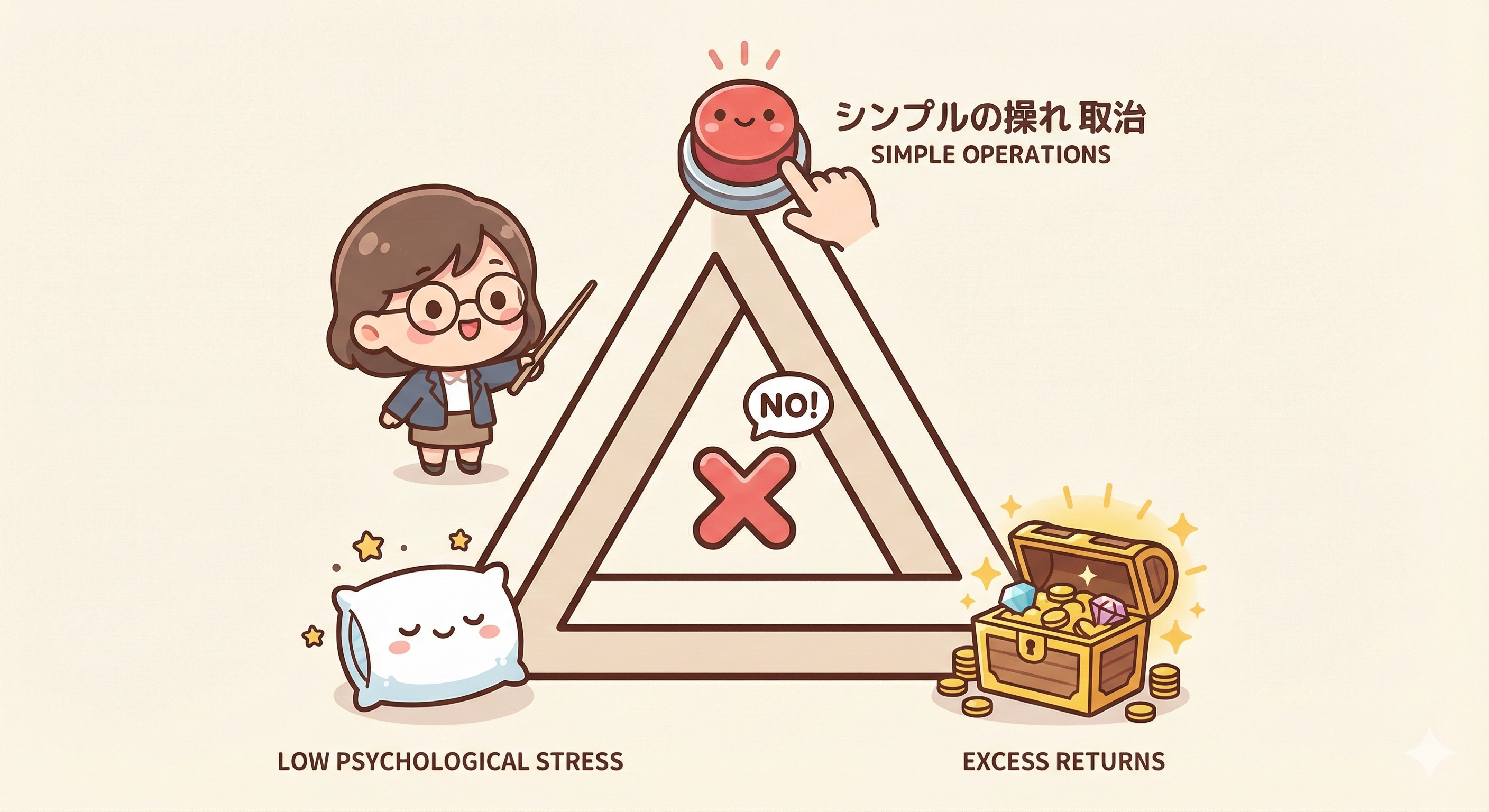
In investing, everyone is chasing the Holy Grail: easy money, high returns, and low risk.
But the longer you stay in the market, the more you realize the truly brutal part is this:
the market is fair.
It follows an invisible law—an “impossible triangle”:
Easy execution × emotional comfort × sustainable outperformance — you can only choose two.
I’ve come to believe in another formulation of the same truth:
All sustainable outperformance must be paid for with some form of pain.
If you refuse to suffer in one dimension, you usually end up paying more in another—volatility, time, information disadvantage, liquidity, or the discipline and emotional control it takes to stay in the game.
I call this phenomenon the “Conservation of Pain.”
Most investment strategies also obey a simple formula:
The lower the Skill requirement (technique/execution), the higher the Will requirement (belief/psychological stamina)—and vice versa.
If you want to survive in the market long-term, the first question was never “Which strategy is best?”
It’s: “Which suffering are you willing to carry?”
Pain #1: Low skill barrier, high psychological torture
(The Path of the Monk)
The signature strategies here are Buy & Hold, indexing, and deep value investing.
On the surface, the barrier to entry is minimal.
You don’t need to code. You don’t need to master indicators. You don’t need to stare at screens all day. You just buy a high-quality ETF or business—and then do… nothing.
But that “nothing” is the hard part.
The pain in this path is slow, long, and deeply anti-human:
Enduring boredom: When markets are calm and others are bragging about quick wins, your portfolio crawls forward like a turtle. The constant feeling of “Am I missing something?” grinds you down over time.
Fighting fear: When a bear market hits and you’re down 30% (or more), you need conviction strong enough to override survival instinct. You’re not making a decision—you’re wrestling yourself.
The defining feature of this path is simple:
Execution is easy. The psychological requirement is brutal.
This is delayed gratification taken to the extreme.
Pain #2: Lower emotional burden, extreme cognitive and execution demands
(The Path of the Warrior)
This path includes short-horizon discretionary trading (swing/day/systematic), quantitative strategies, statistical arbitrage, and high-frequency trading.
Its advantage is that it relocates the pain.
Because holding periods are short and risk controls are explicit, you don’t have to carry positions overnight in a state of dread. You don’t have to sit on long, ugly drawdowns.
But the price you pay is different: it’s closer to war.
High-intensity intellectual labor: You study models, market microstructure, and risk management—while competing against other people who are also evolving. There is no finish line.
Zero-hesitation execution: You must cut losses when you’re supposed to—every single time. Many people don’t lose because their strategy is wrong, but because they can’t execute it cleanly.
A note on HFT: the extreme form of the Warrior’s path
Many people hear “high-frequency trading” and think it just means “buying and selling very fast.”
That’s not the real barrier.
The real barrier is that you must squeeze every possible edge out of technology:
How to discover signals. How to validate they’re real. How to model costs down to tiny decimals. How to automate risk controls so your brain isn’t the bottleneck. How to monitor systems 24/7—and fix failures in seconds. If any link in that chain breaks, your edge gets eaten immediately.
More brutally: HFT often isn’t “the best model wins.” It’s “the best resources get to play.”
Your network must be milliseconds faster—requiring expensive hardware and colocated infrastructure. Queue position matters because priority affects fills. Fee schedules and rebates matter, but you need scale to negotiate. Even the exchange’s rule design can determine whether the game is beatable.
So HFT is not merely “maxed-out skill.”
It’s Skill + resources + deep understanding of the rules of the game—maxed out at once.
And even outside HFT, the Warrior’s path has a clear, shared cost:
learning, competition, and near-error-free execution.
The “Zero-th Path”: the fatal illusion of the middle ground
(The Path of the Victim)
Most retail-investor tragedies come from trying to break the Conservation of Pain.
They don’t want to pay the price of skill (they don’t want to study).
They also don’t want to pay the price of will (they don’t want to endure volatility).
So they go looking for a fantasy strategy: easy execution, emotional comfort, and high long-term returns.
That brings us back to the hidden “impossible triangle”:
Easy execution × emotional comfort × sustainable outperformance — you can only pick two.
When you insist on getting all three, the ending is usually one of two:
You become prey for scammers: People love believing what they most want to be true—“effortless high returns, low risk, just relax.” That greed is exactly what attracts predators.
You become market fodder: In bull markets you feel like a genius. When the regime flips, you have neither the skills to manage risk nor the temperament to survive drawdowns—so you capitulate at the worst possible moment.
The market doesn’t offer free lunches.
If you feel no pain at all in a strategy, there’s a good chance you are the lunch.
The Master’s realm: unity of breath and blade
(The Path of the Master)
You might ask: “Can I have both? What about a core-satellite portfolio—core for long-term, satellite for active trades?”
Yes—but the risk is far higher than most people think.
The best investors can approach a kind of “unity”—what modern portfolio practice often calls a Core-Satellite approach:
Core: ~70% of capital rides beta, endures boredom, and captures long-run economic growth.
Satellite: ~30% of capital seeks alpha, scratches the itch to act, and attempts to generate excess returns.
It’s an attempt at dynamic psychological balance: long-term exposure with a controlled channel for action.
⚠️ But unless you’ve already mastered one path to stable, repeatable profitability, don’t try this.
This approach is for players who have both skill and will close to maxed out.
For most people, mixing the two doesn’t produce the best of both worlds—it produces the worst:
Split-brain decision-making: You run two opposing logics simultaneously. One second you’re Buffett thinking in decades; the next you’re Soros thinking in days. Most people drift into incoherence.
Stacked suffering: You carry the anxiety of long-term drawdowns (core) and the fatigue of constant monitoring (satellite).
The most common deaths: You “average down” by turning satellite losses into core positions. Or you panic-sell the core as if it were a satellite.
Trying to fight with both hands before you’ve built the internal strength usually ends the same way: you blow yourself up.
An investing lens on the Conservation of Pain: Beta and Alpha
If you speak the language of finance, you can reinterpret the Conservation of Pain through beta and alpha:
The Monk earns beta: the market’s compensation for bearing volatility. If you can simply stay invested, economic growth does the heavy lifting. You’re earning the “growth of the system.”
The Warrior seeks alpha: returns above the market produced by skill. This is closer to a competitive game—you often profit from others’ mistakes. You’re earning the “errors of opponents.”
The Master tries to earn both: core captures beta; satellite hunts alpha.
The tragedy of the Victim is double loss:
They lack the temperament, so they panic-sell near the bottom and fail to earn even beta.
They lack the skill, so they trade frequently and get harvested into negative alpha.
The darkest irony is that they pay the labor required to chase alpha—only to lose even the beta that was available for free.
Closing: honesty is the ultimate strategy
Investing isn’t about finding a invincible strategy.
It’s about choosing the pain you can endure.
If you’re steady and emotionally insensitive to fluctuations, take the Monk’s path and cultivate conviction and patience.
If you’re fast, disciplined, and enjoy competition, take the Warrior’s path and cultivate skill and execution.
As for the perfect-looking “fusion path”—unless you’ve already matured in one domain, stay humble and stay away from the temptation.
Knowing your own circle of competence matters more than predicting the market.
Kuan | Miyama Capital
Disclaimer: This article is for informational and educational purposes only and reflects my personal opinions as of the date of publication. It is not investment advice, a recommendation, or an offer/solicitation to buy or sell any securities or financial instruments. Investing involves risk, including the possible loss of principal. Past performance is not indicative of future results. You should do your own research and consult a qualified professional before making any investment decisions.