
Preface
As markets cheer the “peace dividend” implied by a weakening Iranian threat, the prevailing narrative often misses a far more dangerous grey rhino. Many assume that as Iran’s deterrence fades, the Middle East risk premium will evaporate and the oil market will return to calm.
But that conclusion may be premature. Once Tehran’s deterrence meaningfully declines, the fragile alignment between Riyadh (Saudi Arabia) and Abu Dhabi (the United Arab Emirates, UAE)—held together largely by a common adversary—could begin to unravel.
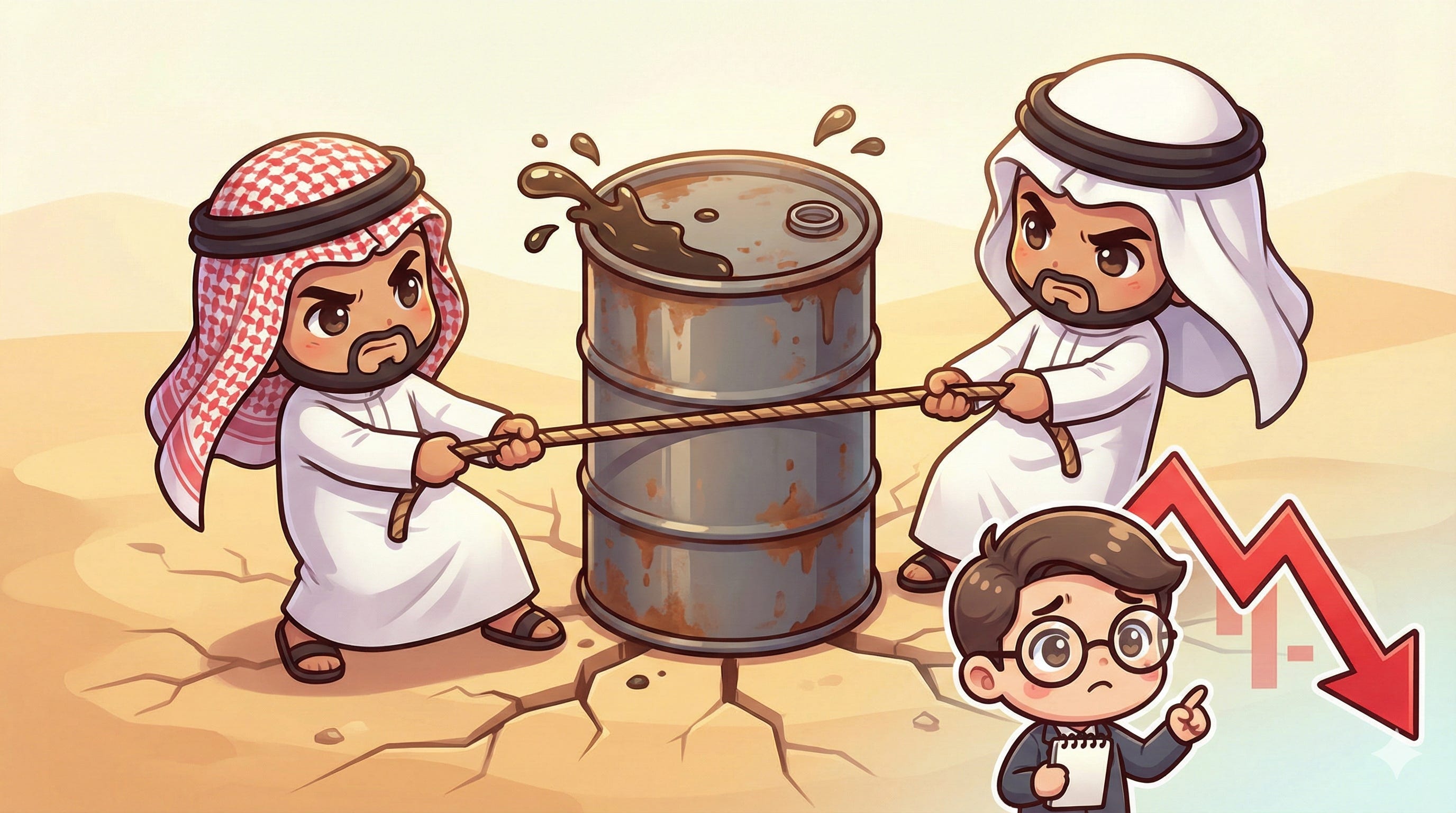
The next “war” in the Middle East may not be fought with missiles, but with barrels: a renewed oil price war.
1) When the Common Enemy Disappears, Rivalry Returns
Over the past decade, Saudi Arabia and the UAE have tolerated frictions—over Yemen, Sudan, and economic leadership—not because of deep trust, but because Iran’s external threat provided the minimum glue for cooperation.
When that threat recedes and Gulf security anxiety eases, long-suppressed competition naturally resurfaces:
Who is the real leader of the Gulf?
Who sets the rules within OPEC+?
Who controls capital and narrative power in the post-oil era?
History suggests that in a world without a common enemy, tolerance toward allies declines and the contest for leadership becomes unavoidable. The long-running divergence in worldview between Saudi Crown Prince Mohammed bin Salman (MBS) and UAE President Mohammed bin Zayed (MBZ) is moving from backstage to center stage.
2) A Misaligned Economic Clock: Vision 2030 vs. Monetization Urgency
The root of a potential price war is structural: the two countries view oil’s future through fundamentally different time horizons.
The UAE: Monetize Faster, Win on Volume
Abu Dhabi National Oil Company (ADNOC) has accelerated upstream investment and capacity expansion, treating growth as a strategic priority and targeting a milestone of 5 million barrels per day. The logic is straightforward: the global energy transition is not reversible. Oil assets must be monetized before they lose value—turning underground barrels into financial assets while demand still exists. The UAE does not want to be constrained by OPEC+ quotas; it wants to sell more, and sell sooner.
Saudi Arabia: Protect Price, Fund Transformation
Saudi Arabia’s Vision 2030, the NEOM project, and a broader slate of giga-projects require a relatively high and stable oil price as fiscal support. Saudi Arabia can tolerate “selling less,” but it cannot easily tolerate a price collapse.
This creates a near-term structural contradiction: the UAE leans toward “more and faster,” while Saudi Arabia leans toward “discipline and price.” As Iran’s threat diminishes, the incentive for the UAE to overproduce—or to challenge OPEC+ quota constraints—rises materially.
External Supply Pressure: Why Cooperation Becomes Harder
The game is not a two-player match. Continued supply growth from non-OPEC+ producers (e.g., the United States) raises the cost of maintaining discipline inside OPEC+: every barrel you hold back can be quickly replaced by external supply. That accelerates market-share erosion, thins the payoff from cooperation, and amplifies the short-term incentive to “cheat” via incremental overproduction.
3) Saudi Arabia’s Option Set: A Scorched-Earth Strategy
If the UAE opens the taps, Saudi Arabia is unlikely to stand still. Historically, Riyadh tends to respond to challenges with “action signals” rather than verbal compromise. Saudi Arabia’s large and rapidly deployable spare capacity becomes a weapon.
To maintain credible deterrence and prevent the quota system from losing authority—and also to squeeze the survival space of U.S. shale—Saudi Arabia could reprise the 2020 playbook: initiate a price war. In a scenario where demand weakens or inventories build quickly, this raises the tail risk of oil falling toward the $40 range.
Saudi Arabia would take fiscal pain in the short run, but the strategy can force the UAE back to the negotiating table and re-establish Riyadh’s leadership position inside OPEC+ in the post-Iran era.
4) A Price War Isn’t Emotion—It’s Enforcement in a Repeated Game
Many interpret price wars as irrational retaliation. In reality, they are often the coldest—and most effective—tool in a repeated game: accept short-term pain to preserve long-term order.
OPEC+ discipline relies on a simple deterrence logic:
If you respect quotas → everyone enjoys higher prices.
If you quietly overproduce → I use spare capacity to break the market and make you lose more.
If the UAE crosses the boundary and Saudi Arabia simply absorbs it, the market learns that quotas are not rules—they are suggestions. The next round of overproduction becomes larger, and the coalition deteriorates faster. That is why the most likely Saudi response, when discipline breaks, is to use market mechanisms: punish via price to restore the credibility of the system.
Could oil fall to $40?
No major producer wants an outright collapse. The goal of a price war is usually to restore deterrence and force a return to negotiation—not to destroy the market.
But if OPEC+ discipline weakens, overproduction expands, and non-OPEC+ supply continues rising, the $40 level can shift from “unthinkable” to a plausible tail scenario. The 2020 episode offers a reminder: when major producers simultaneously ramp supply while demand faces headwinds, prices can fall sharply and rapidly.
5) Great Powers: Concerned, but Limited “Enforcement Capacity”
Even if external powers care about stability, they may not be able—or willing—to provide meaningful constraints.
The United States
Washington may dislike open conflict among partners, but lower oil prices help contain domestic inflation. More broadly, U.S. incentives are complicated: it must weigh ally stability against the macro benefits of disinflation, and its mediation motivation may not be strong. Strategically, the U.S. focus may also lie elsewhere than policing intra-Gulf quota disputes.
China
China is the largest buyer, but that does not translate into security leverage. Beijing can influence flows and discounts, yet it lacks the security architecture needed to impose discipline. Buyer power alone is unlikely to rebuild OPEC+ order.
As a result, this game is more likely to be resolved by regional players using the most primitive market tool available: supply and price.
Conclusion: A Repricing of Global Assets
If you think this is merely a matter of regional pride, you are missing the transmission mechanism.
If oil rapidly drops toward the $40 range amid supply conflict, inflation expectations and the market’s implied path of policy rates could be repriced sharply—triggering a broader revaluation across rates and credit, with volatility rising materially.
The decline of Iran’s deterrence is not the end of risk. It is the beginning of a new game. Investors should not be lulled by a “peace illusion”: the most violent moves in the oil market may still lie ahead.
🔍 Miyama Watchlist
Signals that the market may be shifting toward a price-war regime:
OPEC+ negotiation gridlock: delays or lack of consensus on baselines or quotas
UAE export/production data: exports/production running above quotas for multiple consecutive weeks, with widening gaps
Saudi pricing signals: repeated OSP cuts or deeper discounts to Asia, shifting from verbal warnings to action
Futures curve: a move from backwardation to contango—or deepening contango—signaling growing oversupply
Non-OPEC+ supply growth: acceleration that further erodes the incentive to defend high prices
Disclaimer: This article reflects the author’s personal views and does not constitute investment advice, an offer, or a solicitation. The price scenarios and geopolitical analysis are based on current information and historical reasoning and involve substantial uncertainty. Financial markets—especially oil and derivatives—are highly volatile. Past performance does not predict future results. Readers should assess risks independently and seek professional advice when necessary. The author assumes no responsibility for any direct or indirect losses arising from the use of this content.