
Executive Summary
June payrolls missed badly, but the signal worth watching is at both ends of the yield curve. The front end fell on “fewer hikes.” The long end barely moved.
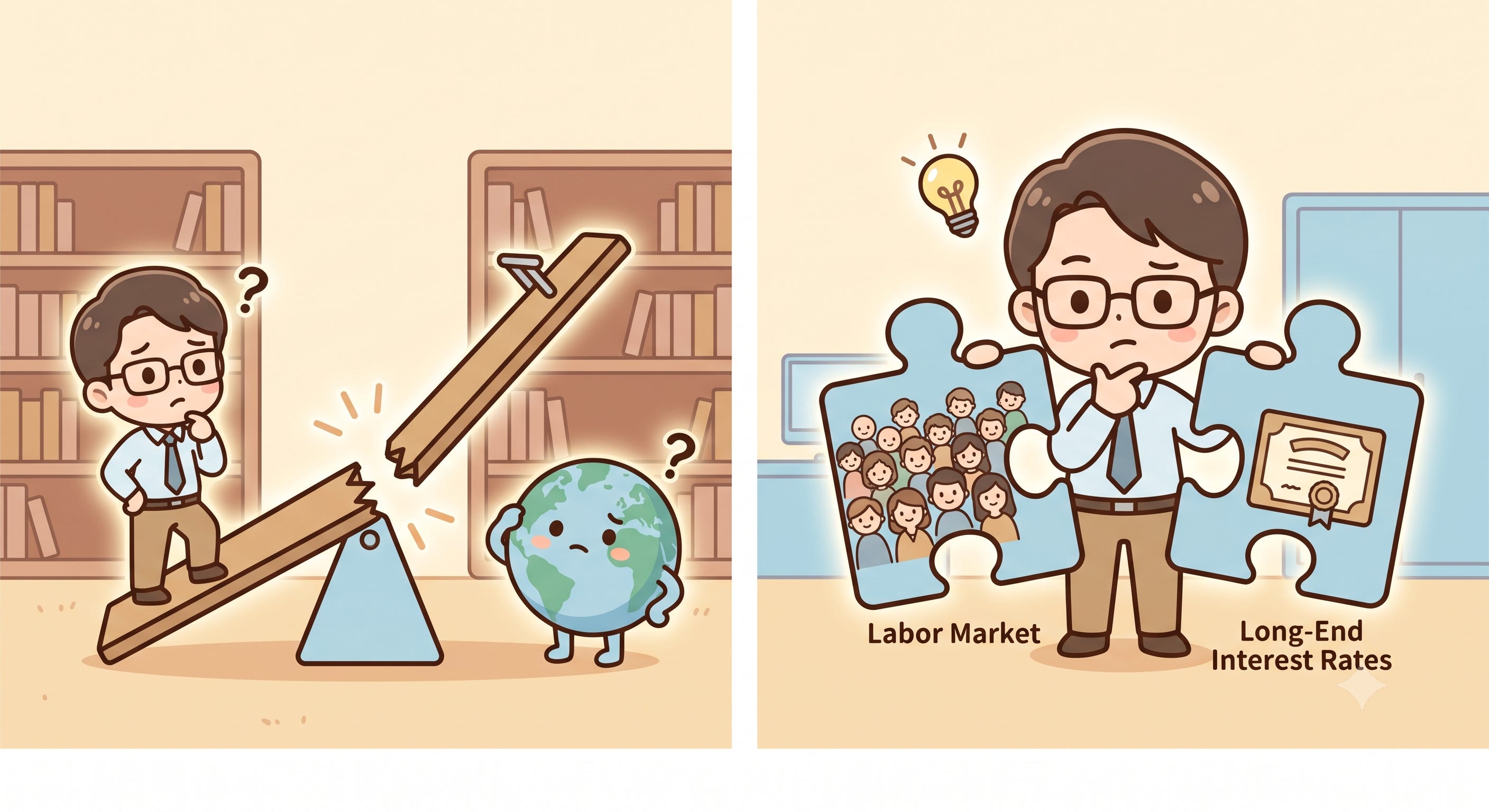
My read: this repricing is a front-end “fewer hikes” story, not a “disinflation confirmed, long end rallies” story. The chain that runs from soft labor data to a lower long end is broken somewhere in the middle right now.
Where I could be wrong: if inflation cools quickly on falling oil and the long end follows, then today’s break is just a lag that closes on its own.
Watch list: core in the next CPI/PCE print, whether the long end stays anchored after soft data, whether the long end keeps climbing while oil stays low, and the direction of term premium.
Falsifier: if the next core inflation print cools clearly and the long end rallies in lockstep, my “broken transmission” call is dead.
The front end moved. The long end didn’t follow.
When June payrolls hit, the market took July hike odds down to roughly 20% (market-implied) within a few hours. No surprise there. The surprise was the gap between the two ends of the bond market, and I think that gap matters far more than the jobs number itself.
As of my writing on July 3, 2026, intraday, the front end dropped clearly: the 2-year yield fell about 5bp. The long end barely came along. The 10-year slipped only about 1bp, and the 30-year sat near 5%, already off its mid-May high of roughly 5.2%. This is only the first leg of repricing after the print, and I wouldn’t extrapolate it to the close or to where things settle later. Same data. The front end read it as “the Fed hikes less,” and the long end acted like it didn’t happen.
That divergence is the signal to watch over the next few weeks. Why does a weaker labor print move the front end but not the long end?
The unemployment rate “fell,” and it was the bad kind of drop
Let me break the data down quickly, because the point isn’t here.
June payrolls added about 57K, well under the market-implied consensus of roughly 115K (BLS Employment Situation, establishment survey, seasonally adjusted). The unemployment rate actually “fell” to 4.2%. The problem is why. The participation rate dropped 0.3pp to 61.5%, near a multi-year low. People left the labor force, and that’s what “improved” the rate. This is the bad kind of drop.
The household survey looks worse: employment fell by roughly 507K on the month, against +57K in the establishment survey. The two surveys disagree. And the prior two months were revised down by a combined 74K. Single-month payrolls are easy to revise after the fact, and this month is a textbook case.
Don’t read seasonal noise as fundamentals
Inside that ugly print, the line most likely to be over-read is leisure and hospitality, down 61K.
Most of this is timing, not a sector falling apart. The World Cup pulled hiring forward. This category added about 70K in May, staffing up before the tournament. The BLS seasonal-adjustment model “expects” a normal summer hiring ramp in June; when the hiring happens early instead, the seasonal adjustment prints it as a decline. On this, the BLS itself only reports that the category saw a slower-than-usual pace of seasonal hiring. The World Cup pull-forward and the timing mismatch are the market’s reading, and Trading Economics’, not a BLS conclusion. Goldman had reportedly pegged a World Cup boost of around 40K; it didn’t show up, and then some.
There’s a discipline point here. The World Cup and the seasonal-adjustment story explain the establishment survey. They don’t explain the ugly household number. Those are two separate things, and a clean World Cup narrative shouldn’t quietly paper over the household weakness. Cut the other way, the household survey is volatile month to month, so that 507K may well give back half of itself next month, which means “don’t read too much into one print” applies just as much to the household side.
Why soft data can’t drag the long end down
The front end fell for an obvious reason: the market pulled near-term hike odds out, and the 2-year followed. What’s worth analyzing is that the long end didn’t move with it. The thing pricing the long end right now has changed. What the long end fears at this moment is inflation and fiscal supply.
A weaker labor print cuts growth expectations. It doesn’t touch inflation expectations. So it moves the front end, which is tied to growth and the policy path, and it doesn’t move the long end, which is tied to inflation expectations, term premium, and fiscal supply.
That comes back to bite a piece of logic a lot of people take for granted: the idea that “the long end does the Fed’s tightening for it.” That only holds cleanly when the long end is being pushed up by term premium and real rates. When the long end is driven mainly by inflation expectations, up when oil rises, down when oil falls, the causality reverses. A Fed that sits still, or leans dovish, can let inflation expectations un-anchor and push the long end higher. Left alone, that isn’t necessarily bullish for the long end.
San Francisco Fed President Mary Daly recently said this spring’s inflation came mostly from oil, and that pressure should start to ease as prices fall with the ceasefire. But in the same breath she explicitly kept the hike option open, saying she’d act decisively if inflation proved stickier than expected. That’s a deliberately two-sided message meant to preserve flexibility, and it shouldn’t be read as “inflation has peaked.” New Fed Chair Kevin Warsh’s signal similarly shouldn’t be compressed into a single dovish or hawkish label. The market reads him as relatively calm on the labor market but still waiting for further confirmation on inflation, which means he’s kept his policy optionality and hasn’t handed the market a one-way path. Going into the print, the market had already read the new chair as leaning hawkish, so a dovish surprise got its repricing amplified.
Positioning also sits on the long end’s side. Per Schwab’s 2026 Mid-Year Fixed Income Outlook, the market is holding below-benchmark duration, on the view that fiscal supply, term premium, and global yields keep pushing up on the long end. The takeaway: the upward pressure on the long end has structural sources, and it doesn’t vanish because one soft print landed.
Leave a falsifiable call on the table
Without a testable condition, a call can’t be scored. A prediction needs a date and has to be able to get proven wrong. Here’s the judgment I’m leaving as of today, July 3, 2026, with its falsifier attached.
The call: the repricing after June payrolls is driven by the “front-end fewer hikes” layer. As for the “disinflation confirmed, long end starts to rally” story, the market hasn’t bought it. The transmission from soft labor data to a lower long end is broken right now.
The falsifier: if the next CPI or PCE shows core inflation cooling clearly, and the long end rallies in lockstep (10s and 30s moving lower together), then the “broken transmission” call is overturned.
Watch signals. First, when the next soft print lands, does the long end stay anchored or does it follow lower? Second, oil stays low and the long end still climbs. If that’s what happens, the main driver is term premium and fiscal supply, and a passive Fed is a negative for the long end, not a positive.
This is a market-level call and has nothing to do with any position. What it tests is the transmission mechanism itself.
Don’t read “the Fed turns dovish” straight into “add long-end duration”
Back to the people building allocations. The easiest mistake in this move is to read “the Fed won’t rush to hike” straight into “extend duration, add long-dated Treasuries.” The second leg is missing.
A Fed that doesn’t hike mainly helps the front end. For the long end to rally, you still need the second leg: oil staying low, with no fiscal or term-premium flare-up. Without that leg, you can be dead right on the Fed and watch the long end not budge, or move the wrong way.
Following the signal down, allocators have roughly three ways to read this, each with a cost. The cleanest is to treat the two ends separately: soft data helps the front end, the long end carries its own structural pressure, and you stop trying to make one story explain the whole curve. The cost is giving up the comfort of a single narrative, and it suits anyone who’d rather decompose the transmission and manage the risk in segments.
The second is to bet the transmission is only a lag, that disinflation eventually pulls the long end down and today’s break is just delayed. That one carries a sharper cost: if the long end is really driven by fiscal supply and term premium, the delay can outlast your endurance. Then there’s the option of simply waiting for the next inflation print. You stake nothing on one Daly sentence and let CPI/PCE supply the evidence. The price is that by the time the signal is clean, the market has usually moved partway there.
None of these is categorically right. The difference is whether, before you choose, you see clearly what you’re actually betting on: the Fed, or the source driving the long end.
Disclaimer
This article reflects my personal investment philosophy. It is not investment advice. Make your own informed decisions.
Miyama Capital manages proprietary capital only and does not solicit external investors.
Legal Disclaimer
This memo represents the author’s personal views on macroeconomic conditions, interest rate environments, and asset allocation as of the date of writing. It does not constitute a solicitation, recommendation, or guarantee regarding the purchase or sale of any security, fund, bond, or other financial instrument. Investing involves risk; bond prices, interest rates, foreign exchange rates, and economic/policy conditions may materially affect asset values. Scenarios and instruments discussed may become inapplicable as market conditions change. Readers who make investment decisions based on this memo do so at their own risk, and the author accepts no liability for any gains or losses arising from the use or citation of this material.
Additional note for this article: The discussion of duration and the yield curve here is solely an analysis of the interest rate transmission mechanism and does not constitute a recommendation to extend, shorten, or adjust any bond duration allocation.
Kuan H. Wang Founder & CIO, Miyama Capital