
Miyama Capital | Hormuz Series | Scenario Memo
📋 Executive Summary
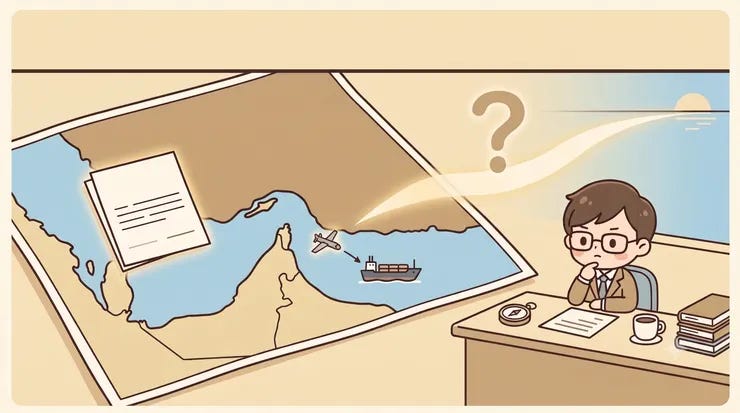
What changed in Hormuz this week, in my reading, is the source of the risk. The MOU still holds and Iran’s president still wants to talk. Attacks escalated through the week, then paused under an ambiguous stand down. The question has shifted from “what is Iran bargaining for” to “which Iran can make the attacks stop.” Markets price oil flow and shipping cost relatively easily. Intent is harder, but still visible. Command control is the missing variable, and if the structural dispute keeps heating while the MOU survives, that discount may be far too thin.
My base case: the retaliation spiral escalates to a point and then de-escalates, which is what the late-week pause may be starting to show. The floor sits on an underpriced tail: a failed de-escalation attempt, where the leadership wants to dial back but cannot. De-escalation remains the main path. The tail just got fatter. Where I could be wrong: if the three mediators’ leverage is stronger than I think, the cooling holds faster than I expect, and the current risk premium is overpriced.
Watch List: whether the president, the Supreme Leader’s office, and the IRGC align their messaging; the attack curve (stabilizing / still climbing / crossing a threshold); whether third-party mediation moves from “statements” to “actual constraint”; whether Iran restarts toll collection after the MOU’s 60-day free safe-passage window expires; UKMTO/JMIC threat levels and the pace of shipping normalization.
Falsifiers for my assumptions: a formal MOU breakdown, or a single attack hitting a U.S. asset and causing casualties. At that point the problem changes category. It becomes ceasefire failure, and shipping and oil risk premia have to be repriced across the board.
The discipline here is simple. This memo allocates probability rather than claiming certainty. For allocators, the first task is clarifying whether you carry bargaining risk or command ambiguity risk, and how exposed you are to the underpriced de-escalation-failure tail.
1. What Happened This Week
On 6/25, according to CENTCOM, the Singapore-flagged M/V Ever Lovely was struck by an Iranian one-way attack drone while transiting Hormuz, with no casualties. On 6/26, U.S. forces cited this as grounds for strikes on Iranian missile and drone storage and coastal radar sites. From 6/27 to 6/28, per AP, NPR, and CNN, the conflict extended to the Kiku tanker, a second wave of U.S. strikes (targeting surveillance, air defense, drone facilities, and minelayer capabilities), and IRGC-claimed retaliation toward Bahrain and Kuwait.
By 6/29, the signal had cooled. Multiple U.S.-side and media-reported channels converged on the same near-term message: stand down for now, ships free to pass, with technical talks continuing on all MOU tracks. U.S. officials said talks or technical contacts would continue in Doha on 6/30, a venue moved from Switzerland, where the nuclear file had been the agenda, after the latest escalation pushed Hormuz to the front. Tehran’s public framing was narrower. Iranian officials downplayed or denied that any formal direct negotiation with Washington had been scheduled, describing the Doha channel in more limited terms than the U.S. side. On the military track, Iran’s most recent wave against Persian Gulf U.S. targets (the Ali Al Salem base in Kuwait, the Fifth Fleet headquarters in Bahrain) caused no U.S. casualties; most were intercepted or failed before arrival. Bahrain reported a damaged home in the capital with no deaths. Qatar separately reported one citizen killed in an attack, though this appears distinct from the U.S.-asset strike threshold this memo uses. The stand down is supported by multiple U.S.-side and media accounts, and a Pakistani source still has not clarified which side proposed the pause. This is military cooling. The structural dispute remains open. Accounts of hits and damage still diverge, and the reporting stays inconsistent.
2. Why Probability Is All You Can Allocate Right Now
Let me set out the methodology first, because it decides how to read everything that follows.
This memo allocates probability under fog-of-war conditions. Any claim to know “what the IRGC really wants” is inference dressed up as intelligence. What can be priced is the relative probability of each scenario and its observable triggers.
This may sound like dodging the judgment call. It is the opposite. Publicly locking in a falsifiable probability structure at the moment information is most chaotic is harder than pretending to know the answer, and more honest. Because there is no external capital to account to, this memo has no need to package inference as intelligence just to look decisive. Honesty about the fog of war is itself a form of judgment discipline.
So I won’t tell you what Iran has decided. I will mark, under the currently observable signals, which scenarios carry higher relative probability, which cannot be ruled out, and what you’d need to see to shift the probabilities one way or the other.
3. The Market Is Asking the Wrong Question
The market is asking what Iran wants, when it should be asking which Iran can make the attacks stop. The MOU still holds, the president still wants a deal, and the IRGC-linked attacks ran hot through the week before the pause. That combination shifts the nature of the risk from bargaining risk to command ambiguity risk. Markets find oil flow and shipping cost relatively easy to price. Military escalation is harder but still legible. Whether the command structure can stabilize is the part with no clean price. If the market is still treating this as bargaining risk, the command ambiguity discount may be inadequate.
What’s the difference? Bargaining risk assumes a unitary actor on the other side: Iran is using the strait as leverage to extract something, so its attacks are negotiable and priceable. Work out what it wants and you can work out when it stops. Command ambiguity risk assumes something else entirely. Even if Iran’s leadership genuinely wants to stop, nobody may be able to dial back the level of escalation at the front line. The first question is about intent. The second is about control.
Why does this distinction matter so much right now? Because this year’s war knocked out the equilibrium point of Iran’s command structure.
After the joint U.S.-Israeli strike of 2/28, multiple outlets reported Supreme Leader Ali Khamenei dead. On 3/8, per Al Jazeera and others, his son Mojtaba Khamenei was selected by the Assembly of Experts to succeed him. In a wartime information environment, succession reporting of this kind should keep its attribution, and this memo does not treat the internal power arrangements of the succession as settled. What matters is a new observable question: now that Mojtaba is in, does the Supreme Leader’s office still hold enough authority to constrain the IRGC and frontline units when they escalate? Several reports also tie this succession closely to the IRGC’s rising influence. That does not establish single-handed IRGC control of Iranian decision-making, but it is enough to make command ambiguity a priceable risk.
I’d stress these are accounts from anonymous sources, and that caveat itself needs to stand. But a few things are publicly observable. The sitting president (a reformist, an MOU signatory) was once forced to publicly retract an apology he had offered to Persian Gulf neighbors over an attack. And the new Supreme Leader’s health and capacity to govern are questioned even within Iran’s own establishment. Put these together and “president wants to talk, IRGC is striking, Supreme Leader’s office authority unsettled” becomes an observable stress test of the command structure, not just rhetoric.
The market is currently pricing Iran’s intent: tolls, leverage, a show of strength at home. That line is calculable. What gets left out is the probability of control failing on its own. The MOU is intact and the president is still at the table, yet the week’s attacks climbed before they paused. This “deal holds, attacks don’t” combination is the market signature of command ambiguity.
There’s one more piece of evidence that moves this read from “our analysis” to the parties’ own admission. After the high-level Switzerland talks, the U.S. announced it would set up a deconfliction mechanism, a direct hotline, to coordinate ship transits and keep strait disputes from escalating, and Iran at one point confirmed it agreed to establish it (per Fox and CNN, 6/22). But per Axios, as of 6/27 the line was not operating. The important fact is implementation failure: both sides agreed to build the line, and it still is not running. A cooling channel that has consensus but cannot be switched on points to a command-control breakdown at the execution layer rather than a divergence of intent at the table. “Which Iran can make the attacks stop” is therefore a practical problem already agreed to at the table, and still not done.
4. Three Hypotheses, One Base Case
Put the current attack behavior into three parallel hypotheses. I use qualitative relative probabilities and will not fabricate precise percentages. At this level of visibility, a decimal point would imply confidence I do not have.
Start with the base case, because it carries the highest relative probability and makes the lightest demand on attribution: the tit-for-tat retaliation spiral (H3). Here, each side simply responds to the other’s last move, forming an escalation ladder, with no need to attribute internal intent to either party. Ship, then U.S. retaliation, then another ship, then further retaliation, then strikes on Persian Gulf U.S. positions. This sequence is itself the most observable and most tradable structure, and that is exactly why it sits at the center of my read.
The other two hypotheses both carry medium relative probability and explain the same attacks differently.
The first is hardliner autonomous escalation (H1): the IRGC retains substantial autonomous escalation space outside full coordination with the top decision-making layer, whether semi-authorized, gray-zone, or deniable authorization. This is the operational flexibility of an institutionalized military force in the gray zone, still some distance from total loss of control. Its observable signature is a clear divergence between attacks and the official line.
The second is the dual-track good cop / bad cop posture (H2), and it deserves serious treatment rather than a strawman. Here the top leadership actually tolerates limited attacks, letting the president talk at the table while the IRGC applies pressure at sea, with the two tracks coordinated. Iran’s system has long made good use of controlled contradiction, where “showing strength at home” and “maintaining talks abroad” coexist as a useful posture. If the attacks keep holding at “painful but not fatal,” H2’s explanatory power rises.
5. De-escalation Is Still the Base Case, but It Isn’t a Free Lunch
My base case is de-escalation. At some point the parties find an off-ramp. Their incentives actually point the same way: nobody wants a negative-sum, all-out war. The IRGC at minimum needs to preserve a hardline narrative at home; whether it’s chasing posture, real military gains, or negotiating pressure, I won’t pin down for now. But under any of those, as long as it equally doesn’t want that all-out war, the incentive to stand down holds. The U.S. wants to preserve the MOU and keep oil stable. Oman, Pakistan, and Qatar have an appetite to dial down the temperature. Stack it up and “fight until there’s an off-ramp, then stop” is the most likely path.
But there’s a discipline here that has to be spelled out. De-escalation = intent × control. Both have to hold. Wanting to avoid a real war is a necessary condition, not a sufficient one. Incentive pointing toward a stand down and the ability to actually pull the intensity back are two different things.
⚠️ A third party’s willingness is not the same as a third party’s leverage. Per Bloomberg, Oman has told European officials that Hormuz “won’t return to its prewar state,” hinting that ships may have to pay for cleanup or navigation aids. What the U.S., Europe, and Gulf allies worry about is precisely Oman cooperating with Iran on tolls. A mediator still negotiating co-management and fees with Iran has questionable constraining power over the IRGC. Treating “will intervene” as a given tailwind is the easiest optimistic error this memo could make.
Within this framework, de-escalation runs three ways. They are not equally weighted, so I’ll give them unequal space.
The one I want to dwell on is the underpriced tail: wanting to stand down but being unable to. The leadership wants to keep attacks limited. But domestic hawkish pressure, or frontline units acting on their own, keeps the intensity from coming back down. The third party is willing but holds no real leverage. This is limited intent with runaway execution, and the market currently discounts it least. Its signature: attacks that keep climbing and official statements that harden, while the MOU hasn’t formally broken. Real-time fuel: Iran’s June year-over-year inflation hit 88.6% (per IRNA, citing Iran’s statistics center), so the structural source of domestic hawkish pressure hasn’t eased. This is the scenario whose beta the market is most likely to misread as noise.
By comparison, healthy de-escalation is the cleaner and more familiar path. The IRGC precisely controls the level of attacks, holds its narrative, and third-party mediation actually works; attacks stabilize and the official line aligns. Market implication: the risk premium peaks and recedes. Real-time anchor: the 6/29 stand down and the planned 6/30 Doha contact are the strongest evidence yet of the bilateral channel moving from “statements” toward something operational, even if Tehran frames that channel more narrowly than Washington does (Iran’s parliament speaker also publicly called for the “conflict control group” to convene). But the existing steelman still holds. Willingness to mediate is not leverage over the IRGC, and the direct IRGC hotline both sides agreed to still isn’t running. That is exactly why this path is not yet truly confirmed.
The third path is the window closing, and it is best read as a single threshold rather than a gradual process. The trigger is binary: a single attack crosses the line, someone dies, or a U.S. asset is hit. At that point the logic of factional control no longer applies and it jumps straight to ceasefire failure. Real-time update: the latest wave caused no U.S. casualties, with most intercepted, so this path’s near-term probability drops. That “zero hits” admits two readings: degraded projection capability, or deliberate control to avoid triggering full retaliation. I can’t choose between them right now, but if the latter is true, it fits the “talk and fight at once, narrative not war” frame. With a Bahrain home hit, Qatar’s report of a citizen killed (distinct from a U.S.-asset strike), and the Lebanon fuse still live, this path is not removed.
There’s also a clock that gets overlooked. The MOU granted a 60-day free safe-passage window, and Iran’s negotiating team has publicly said it intends to restart toll collection once the window expires. De-escalation comes with a built-in expiry date. Inside the window, both sides have an incentive to maintain surface calm; once it passes, the Hormuz toll dispute reheats. This timeline is worth watching on its own.
Here’s a distinction to keep straight. A military cooling does not mean a cooling of the structural dispute, and the two can even run in opposite directions. Even as the stand down took hold, the senior Iranian figure Velayati (in a 6/29 interview) again pressed for tolls on transiting ships and called on Oman to cooperate, while Oman’s foreign minister had already stated clearly at last week’s GCC meeting that he disagreed with Iranian tolls. Foreign Minister Araghchi also warned against any attempt at “new or unilateral arrangements.” At the very moment the guns paused, the structural dispute over who runs the strait and whether tolls apply was still heating up.
Beyond tolls, there’s a bigger chip on the table. The MOU commits to raising at least $300 billion for Iran’s reconstruction and economic development, and commits to a phased release of Iran’s frozen funds once the MOU is implemented. But Vance was explicit that this money only moves on the condition that Iran complies with the terms and changes its behavior: a “comply, then release” structure, with the disbursement procedure tied to negotiating progress. The U.S. Treasury has already issued a 60-day oil sales waiver (through 8/21), making good on part of the commitment. So inside the 60-day window, “when and on what terms the assets and funds unfreeze” is itself an ongoing bargaining object. That gives “talk and fight at once” a concrete economic stake, not just a symbolic claim over the strait. The showdown after the 60-day window expires hasn’t disappeared with this stand down. It has only been deferred to the negotiating table.
6. What to Watch, and Which Way It Shifts the Probabilities
A probability structure is only useful if it can be falsified. The triggers below are not equally important, so I will weight them rather than list them flat.
The signal that matters most is messaging alignment. If the president, the Supreme Leader’s office, and the IRGC converge on one message and attacks come down together, that points H2 up, H1 down, and maps to healthy de-escalation. The mirror image is the dangerous one: if the president keeps the MOU, the IRGC keeps attacking, and the Supreme Leader’s office stays ambiguous, H1 rises. And if both sides’ attacks stop being bound by their own statements, with the MOU not broken but effectively void, H3 rises and maps to the underpriced tail. At that point the market should start pricing escalation without command clarity.
Almost as heavy is the attack-intensity curve. Stabilizing intensity, plus mediation that shows up in actual constraint, tilts toward healthy de-escalation. Still climbing, plus hardening statements but an intact MOU, tilts toward the underpriced tail. A threshold crossing, meaning casualties or a U.S. asset hit, tells you the window is closing.
The next set of signals moves the weights at the margin rather than deciding the thesis. Start with the near-term diplomatic mechanics. Talks pausing but delegations staying, the 6/30 Doha contact going ahead, the latest wave with no U.S. casualties: all of it tilts toward healthy de-escalation. Break any single premise, whether oil flow, talks, or no U.S. casualties, and it reverses.
Then there is Lebanon, which has already escalated from simple proxy spillover into a dispute over MOU terms. On 6/26 the U.S. brokered a trilateral framework agreement between Israel and Lebanon, which Rubio called a “first step,” tying an Israeli withdrawal to the condition of Hezbollah disarming. Hezbollah refused, calling it “selling out sovereignty and crossing every red line.” The crux: MOU Article 1 declared an “immediate and permanent end to all military operations on all fronts, including Lebanon,” while Israel continues to occupy roughly a fifth of Lebanese territory and continues airstrikes. So Iran argues Israel is violating the MOU and reportedly has not constrained Hezbollah, and this line is now turning back to threaten the U.S.-Iran MOU itself. If Iran decides the Lebanon framework violates Article 1 and is forced to act for Hezbollah, the current “controllable” pricing reverses and the tail thickens. Set a counterweight alongside it, though. Even under fire in Lebanon, Iran still attended last week’s Switzerland talks and has not abandoned the MOU process. That supports the base case. Hold both together: Lebanon thickens the tail, while Iran staying at the table keeps de-escalation the main path.
Watch the cooling channel itself. The U.S.-Iran stand down has multi-source support, and the 6/30 Doha contact continues, so healthy de-escalation is materializing on the military side. But the deconfliction hotline both sides agreed to still was not running as of 6/27, the toll claim is heating up (Velayati raising it, Araghchi warning), frozen-asset release conditions are undefined (Vance, “comply, then release”), and the Lebanon framework constitutes an Article 1 violation dispute. Command ambiguity and the structural dispute remain unresolved. The current materialization is limited to the military side. It has not reached command clarity or the structural dispute, and those two are what determine whether the base case truly confirms.
And watch the clock. Once the 60-day free window expires and Iran restarts tolls, the U.S. will not accept it, and the toll dispute reheats independent of the factional question.
The hard falsifier is simpler. The MOU formally breaks. That is no longer a question of factional messaging. It is ceasefire failure, and shipping and oil risk premia have to be repriced across the board.
7. The Market Is Trading Several Lines at Once
One easy mistake to avoid: don’t price every asset reaction off the tail-risk line. Hormuz right now is several lines running at once, each on its own time scale.
Shipping and insurance is the fastest to react. Per UKMTO and JMIC, the strait’s threat level has been raised to “substantial,” with a mine warning. The shipping data provider Windward observes that the strait remains operationally open, with dozens of ships still transiting, but the pace of normalization has slowed. War-risk premiums jumped notably with the threat level. This line trades “transit cost and interruption probability,” tied to the MOU’s survival.
Oil premium is the second line. Per EIA, Hormuz carries an average of about 20 million barrels of crude a day, more than a quarter of the world’s seaborne crude and roughly a fifth of global oil consumption, with few alternative routes. But keep one thing straight: CENTCOM still says commercial transit continues, and an actual flow disruption is not the same thing as the premium from fear of disruption. What the market is buying is mostly the latter.
Then there’s the strike ladder and Persian Gulf U.S.-base exposure. The IRGC has extended strikes to U.S. positions inside Kuwait and Bahrain, and Bahrain is the home port of the U.S. Navy’s Fifth Fleet. This line trades the tail of regional conflict spillover, and its drivers don’t fully overlap with the first two.
Last is the MOU’s survival itself, and proxy spillover. Whether the ceasefire in the Lebanon direction holds will feed back into Iran’s overall posture.
These lines won’t move in the same direction or in sync. Mashing them into a single “Middle East risk” trade is exactly where pricing most easily distorts.
8. How the Market Is Pricing Command Ambiguity
The market’s reaction is worth a separate look.
Facing this wave of escalation, the market’s pricing shows neither the violent reaction of bargaining risk nor the panic of ceasefire failure. Equities and oil moved the same way but moderately, long-dated Treasury volatility was limited, and regional equities diverged (some Asian markets down a little, some up a little), with no one-directional, full-on flight to safety. This set of prices sits in the middle state: escalation, but controllable.
The 6/29 oil move fits that read. Per Kpler, even with both sides still trading fire over the weekend, more than 20 ships transited the strait in a single day. As the stand down news came out, oil extended its decline and returned to about $70 a barrel on Monday. WTI had closed below 70 the previous Friday, the first time since the eve of the 2/27 war start (per CNBC). The market’s pricing of “controllable” is this sensitive: one cooling headline bleeds off the premium. That is exactly what shows how heavily this price depends on its premises.
To put it conservatively, the market data here only aligns with the framework. It does not prove the thesis. At most, the current price fails to refute this memo’s core proposition. The market finds oil flow and oil prices relatively easy to price, and military escalation only a little harder, but it struggles to put a clean price on whether the command structure holds together. Facing a command structure it cannot see clearly, the market votes in a hedged and divided way. Call it an alignment of framework and market. It is not a vindication of any prediction.
⚠️ State it plainly: what the market is pricing now is conditional controllability. That price is premised on oil flow uninterrupted, talks unbroken, and no U.S. casualties. Break any premise and the price reverses, possibly fast. When the headlines ease, the premium bleeds off; when they harden, it comes back. That two-way sensitivity is the clearest measure of how fragile the price is.
9. What Allocators Actually Need to Check Is Exposure Sensitivity
Back to allocation. Hormuz can’t be reduced to “buy energy” or “sell risk assets.” It now moves shipping, insurance, energy, Persian Gulf base exposure, broad risk assets, and diplomatic negotiation all at once, and each line has a different beta to healthy de-escalation, the underpriced tail, and the window closing.
An allocator’s first job here is diagnostic, not directional. Three questions come before any trade.
First, does my portfolio already carry enough exposure to a healthy de-escalation? If the risk premium recedes, which positions benefit and which actually suffer?
Second, how fragile is my portfolio to “wanting to stand down but unable to”? This looks like the MOU holding, statements holding, but attack intensity continuing to climb. The trouble with it is that the market easily treats it as noise at first, until shipping, insurance, and oil reprice at the same time.
Third, am I mixing risks of different time scales? Shipping premiums may move first and oil premium next, while broad risk assets depend on U.S. casualties, base damage, and whether the MOU formally breaks. These lines don’t start at the same time, nor necessarily in the same direction.
In the fog of war, the real danger is acting on the wrong question. If this memo has one allocation implication, it is not a call on the next candle on the oil chart. It asks you to get one thing clear first: are you carrying bargaining risk, or command ambiguity risk?
One last calibration. The current facts favor controllable de-escalation, but this is a conditional probability allocation, not an endgame verdict. Talks could break this week. Lebanon could ignite. Scattered hits in the Gulf could escalate. Any one of those happens and the probabilities get reallocated. The value of this memo is in providing a structure to keep tracking these conditions, not in calling the ending.
Sources (as of writing, 2026/6/29)
Military and diplomatic timeline: CENTCOM official press release (the Ever Lovely incident and the 6/26 U.S. strikes; also reported by NPR, CBS News, PBS/AP, RFE/RL); AP (Persian Gulf fire and Bahrain/Kuwait, 6/28, carried by The Hill, PBS, and others); NPR, CNN (6/27).
U.S.-Iran negotiating channel and the 6/29 stand down: U.S. officials to RFE/RL, the White House to Fox, on “stand down, ships free to pass”; Axios citing U.S. officials on “halting all kinetic activity” and meeting 6/30 in Doha (the talks originally set for Switzerland on the nuclear file, moved to Qatar with the focus shifting to Hormuz after escalation). Iranian officials publicly downplayed or denied that any formal direct negotiation with Washington had been scheduled. Which side proposed the pause is unclear; a Pakistani source did not clarify, and this uncertainty is preserved.
Deconfliction mechanism / hotline: Vance announced a deconfliction mechanism after the Switzerland talks (per Fox, 6/22); Iran at one point agreed to a phone hotline to prevent misunderstandings (per CNN, 6/22); per Axios, as of 6/27 the hotline was not operating. Stated as “both sides agreed but it isn’t built.”
Tolls / structural dispute: Velayati again raised tolls on transiting ships and called on Oman (6/29 interview); Araghchi warned against “new or unilateral arrangements”; Oman’s foreign minister opposed Iranian tolls at the GCC meeting (per RFE/RL, Times of Israel).
Persian Gulf attack casualties: Bahrain reported a capital home damaged with no deaths; Qatar said one citizen was killed in an attack (per Times of Israel). This memo treats the Qatar report as distinct from the U.S.-asset strike threshold used in the scenario logic.
Iran’s Supreme Leader succession: Al Jazeera (3/8); the link between the succession and IRGC influence also per Reuters (cited via Times of Israel).
Lebanon and the MOU-violation dispute: the 6/26 U.S.-Israel-Lebanon trilateral framework, Rubio’s “first step” (per AP, Times of Israel); Hezbollah’s refusal, calling it “selling out sovereignty” (per Al Jazeera, JPost); MOU Article 1 covering Lebanon, Israel continuing to occupy roughly a fifth of Lebanese territory and continuing airstrikes, Iran arguing Israel violated the MOU and did not constrain Hezbollah, the risk turning back to threaten the MOU (per the CNN/Time full MOU text, Times of Israel, Al Jazeera); Iran still attended last week’s Switzerland talks and did not abandon the MOU (per Al Jazeera, 6/22). Katz on an “indefinite” deployment in southern Lebanon and a warning to Iran (per Times of Israel, 6/25).
Frozen assets and reconstruction fund (the leverage line): MOU Articles 11 and 12, covering phased release of frozen funds and a reconstruction fund of at least $300 billion, with release tied to negotiating progress (per the CNN/Time full MOU text, Al Jazeera); Vance on “comply, then release / pay-for-performance” (per Al Jazeera, Axios); Treasury’s 60-day oil sales waiver through 8/21 (per Al Jazeera, 6/22).
Iran inflation: 88.6% year-over-year (June, per IRNA citing Iran’s statistics center; carried by Xinhua).
Hormuz toll dispute: Oman told European officials that transit may carry a service fee (per Bloomberg, 6/26); MOU Article 5 provides that after the 60-day free window, Iran and Oman settle strait management and fees.
Hormuz energy data: U.S. EIA, Today in Energy; IEA, Strait of Hormuz page.
Shipping risk level and ship flow: UKMTO, JMIC (via CNN, RFE/RL); more than 20 ships transited the strait in a single day over the weekend (per Kpler, via Reuters); oil back to about $70 on Monday, WTI closing below 70 on Friday (per CNBC); normalization pace via Windward (via NPR).
Note: This memo uses wartime reporting on three tiers. Official sources such as CENTCOM and EIA are used to confirm baseline facts; AP, Reuters, Bloomberg, Al Jazeera, CNN, NPR, and CNBC are used to cross-check the event timeline and diplomatic signals; Iran-linked media, anonymous sources, and single-source reports serve only as references for scenario adjustment, not as settled fact.
Disclaimer
This article reflects my personal investment philosophy. It is not investment advice. Make your own informed decisions.
Miyama Capital manages proprietary capital only and does not solicit external investors.
Legal Disclaimer
This memo represents the author’s personal views on macroeconomic conditions, interest rate environments, and asset allocation as of the date of writing. It does not constitute a solicitation, recommendation, or guarantee regarding the purchase or sale of any security, fund, bond, or other financial instrument. Investing involves risk; bond prices, interest rates, foreign exchange rates, and economic/policy conditions may materially affect asset values. Scenarios and instruments discussed may become inapplicable as market conditions change. Readers who make investment decisions based on this memo do so at their own risk, and the author accepts no liability for any gains or losses arising from the use or citation of this material.
Kuan H. Wang Founder & CIO, Miyama Capital