
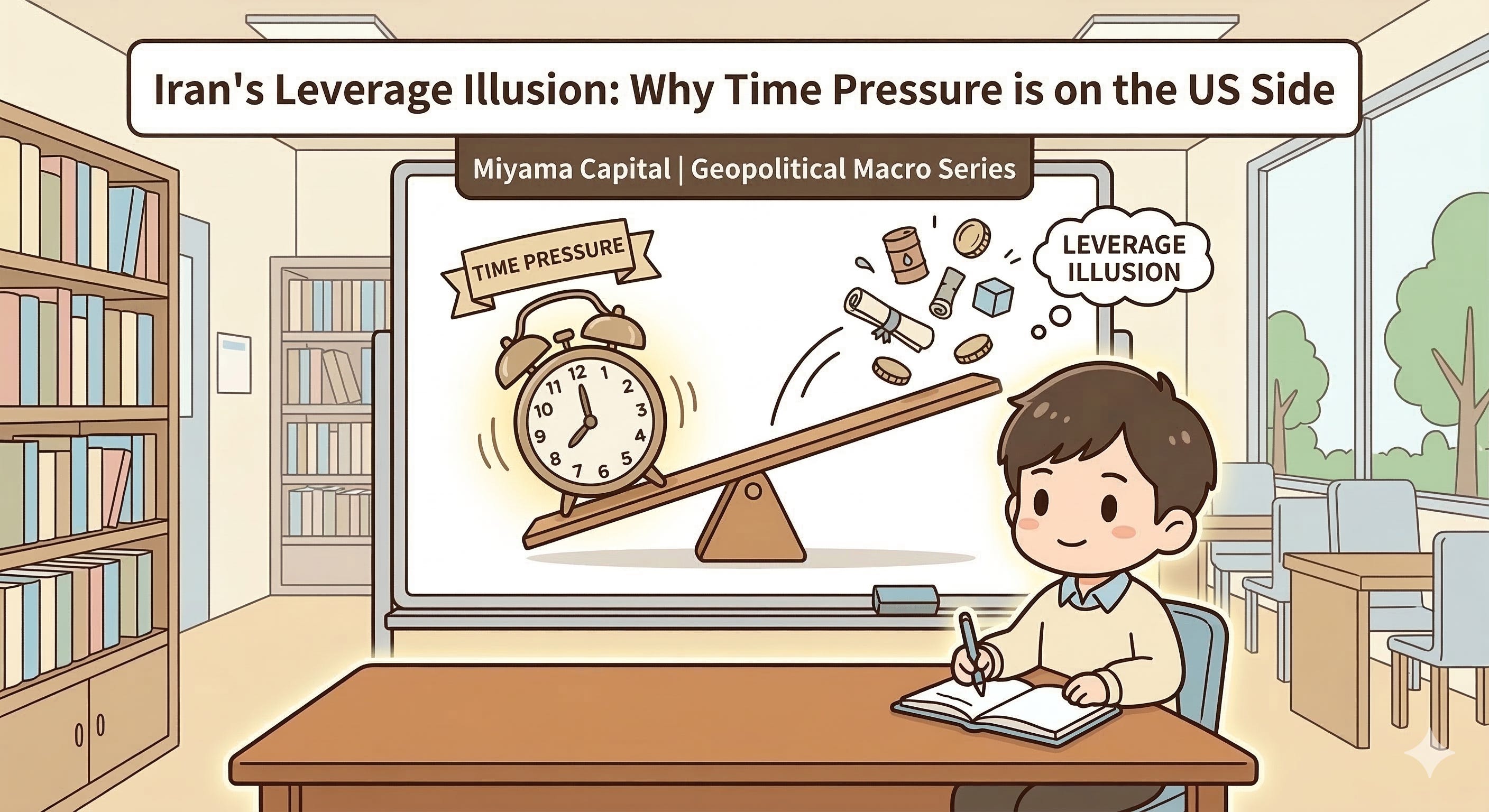
Miyama Capital | Geopolitical Macro Series
Key Takeaways:
Public discourse is stuck on an operational question: can Trump exit? The structural question beneath it matters more. What happens to Iran’s bargaining position when the U.S. walks away? The answer is total collapse.
Iran’s strategic logic rests on a false premise: that the U.S. needs to negotiate to end the conflict. Washington’s outside option is to declare victory and leave without a deal, and that option’s existence structurally empties every card Tehran holds.
The real time pressure falls on Iran, not the U.S. Tehran’s best (and possibly only) negotiation window is while American forces are still engaged. Once they leave, there is no counterparty.
Hormuz blockade leverage inverts after U.S. withdrawal. Wartime obstruction is internationally tolerable; peacetime blockade is pure cost borne entirely by Iran, punishing the partners Tehran needs most.
Watch List: U.S. strike frequency trajectory, Pezeshkian’s public tone, IAEA nuclear talks, Hormuz commercial tanker throughput, Iranian domestic protest scale. Invalidation triggers: U.S. mass casualties (50+) or nuclear escalation.
Everyone Is Asking the Wrong Question
From where I sit, the conversation has gone sideways.
In my previous analysis, I mapped five pressure lines converging toward late March: military timelines, oil price tolerance, political calendars, summit diplomacy, and Iran’s internal fractures. The conclusion was that the U.S. exit would take the form of gradual silence, not a negotiated settlement.
Since that piece was published on Day 14, Iran’s Foreign Minister Araghchi appeared on CBS and stated that Iran has no plans to recover enriched uranium from bombed sites, indicating that any future recovery would be conducted under IAEA supervision. He simultaneously denied that Tehran has sought talks or a ceasefire. This was the first substantive concession since the war began, and it is consistent with the framework laid out below.
Editor’s note (Day 14-16 developments): U.S. forces struck 90+ military targets on Kharg Island on Day 15 while deliberately sparing oil infrastructure. Trump warned that continued blockade would make oil facilities the next target. Brent crude closed at $103.14 on Day 14, up over 40% since the conflict began. The IEA announced a 400 million barrel SPR release (the largest in history), yet prices continued rising, confirming that the policy toolkit is insufficient to offset the supply shock. Trump publicly stated he is “not prepared to negotiate” and rejected mediation offers from multiple regional allies.
But almost everyone has stopped at the same point. Can he leave? Will Iran keep fighting? What about Hormuz? These are operational questions.
My interest is the structural question one level deeper: once the U.S. walks, what cards does Iran have left?
Iran’s entire strategic logic chain rests on one assumption. Block Hormuz. Oil spikes. American consumers feel pain. Political pressure forces Trump to the table. Then trade “reopening the strait” for security guarantees. Pezeshkian’s ceasefire conditions (recognition of rights, compensation, international guarantees against future aggression) are the product of exactly this logic.
But the leverage only works if the U.S. needs to negotiate. If Washington’s outside option is “walk away without a deal,” every card in Tehran’s hand is depreciating.
The U.S. Is Not an Ally. It Is the Platform.
Before modeling what happens when the U.S. leaves, one hard constraint must be established: American withdrawal likely marks this war’s practical expiration date.
This is not a question of willingness. It is a question of operational dependency.
Israel sits 1,500 to 2,000 km from Iranian targets. At that range, sustained strike tempo depends heavily on U.S. aerial refueling. Sustained long-range operations demand industrial-scale intelligence throughput (satellite, SIGINT, real-time targeting) that only the American military infrastructure can provide. Without these inputs, strike frequency and penetration depth collapse.
On the support side, U.S. bases in Bahrain, Qatar, the UAE, and Kuwait form the logistical backbone of the entire operation. Israel has zero ground support infrastructure in the Gulf. The suppression of Iranian air defenses (S-300 systems and successors) has, by most public accounts, relied heavily on U.S. Navy and Air Force assets. Once the U.S. stops, the residual threat to Israeli aircraft rises sharply.
The U.S. is the operational platform, not a supporting ally.
When the platform withdraws, Israel downgrades from full-spectrum strike capability to limited precision operations. The scale difference is categorical. Israeli behavior becomes predictable: maximize platform utilization within the 4-5 week U.S. window. Nuclear sites, command chain decapitation, missile production facilities, Hezbollah supply lines. Hit as deep as possible before the window closes. After that, transition to intermittent surveillance strikes, similar to the long-running campaign against targets in Syria.
Trump’s “4-5 weeks” statement serves a dual function. Domestically, it manages expectations. For Netanyahu, it is a signal: this is your window. Defense Secretary Hegseth’s Day 14 statement that strike volume was “the highest yet, ramping up and only up” follows the same logic. The window is closing. Everything hittable must be hit before it does.
The Third Option: Walk Away Without a Deal
Iran assumes a binary game: keep fighting, or negotiate.
Here is what the market is missing. The actual game has three options: keep fighting, negotiate, or strike hard and walk away.
Trump’s behavioral pattern makes the third option highly credible. Syria withdrawal. Afghanistan talks. The DPRK summits. “Big entrance, declare victory, exit” is his signature playbook. And the narrative material for mission-accomplished packaging is already in hand: according to U.S. claims, Khamenei is dead (a figure who ruled for over four decades); nuclear facilities are damaged; military infrastructure is destroyed at scale; Defense Secretary Hegseth stated that Iranian drone assaults are down 95% and missile attacks down 90% from their peak (DefenseScoop, March 13, 2026).
I want to be precise about what this article’s core argument requires and what it does not. It does not depend on the accuracy of any single wartime claim above. Remove the most contested items, and the structural logic still holds: as long as the U.S. retains the ability to withdraw unilaterally, Iran’s bargaining position depreciates. Game structure determines this, not battlefield reports.
Domestic political pressure reinforces the exit vector. U.S. military casualties are mounting. Oil above $100 hits consumers directly. February nonfarm payrolls came in at -92,000 (BLS Employment Situation, USDL-26-0367, March 6, 2026), the steepest decline in four months, dragged by a healthcare sector strike and federal workforce reductions. NBC polling shows 54% of voters disapprove of Trump’s handling of Iran (NBC News, approx. March 7). 2026 is a midterm election year.
Trump told Axios on Day 13: “practically nothing left to target” and “I’ll end the war any time I want.” He is simultaneously managing two narratives: “I am fighting” and “I can stop whenever I choose.” That contradiction is itself the preparatory move for declaring victory and walking.
This structurally empties Iran’s entire bargaining position.
The game Iran believes it is playing: The U.S. needs Iranian cooperation to end the conflict. Hormuz is leverage to bring Washington to the table. Time favors Iran.
The actual game: The U.S. can unilaterally cease fire and leave. Hormuz blockade becomes pure cost after withdrawal. Time favors Washington.
Once the U.S. Walks, Every Card Tehran Holds Depreciates
Let me walk through the cards one by one, starting with Hormuz.
During wartime, “a country under bombardment blocks a shipping lane” is internationally comprehensible. The UN Security Council passed Resolution 2817 condemning Iran’s attacks on neighboring states (13 votes in favor, China and Russia abstaining), but the narrative of retaliation still carries residual legitimacy.
The moment the U.S. withdraws, that narrative evaporates. Nobody is attacking Iran anymore, yet the strait remains blocked? Continued obstruction punishes Saudi Arabia, the UAE, Kuwait, India, Japan, South Korea. Every one of these is an economic partner or geopolitical relationship Iran needs. The framing shifts from self-defense to unilateral aggression against the international community. The coercive logic collapses. With the U.S. gone, there is no audience for the threat and no counterparty for negotiation. Continued blockade becomes pure cost, borne entirely by Iran, achieving no strategic objective.
Diplomatic isolation accelerates. The UNSC already has a condemnation resolution on record. Once the U.S. exits, the “resisting American aggression” narrative disappears, and the political cost for China and Russia to keep providing cover rises steeply. Iran attacked six Gulf neighbors during this conflict. The regional relationship damage is deep and long-lasting.
The China factor deserves special attention. Beijing needs Hormuz open to import non-Iranian Middle Eastern crude. Selective wartime disruption is tolerable. Sustained peacetime blockade directly harms Chinese interests. If Trump and Xi reach any understanding at their upcoming summit, China has direct incentive to pressure Tehran into compliance. Even Iran’s largest backer would push for the strait to reopen.
Then there is the precedent effect. Walking away without a deal establishes “we can come back anytime” as the default posture. Iran gets zero paper guarantees. Instead, the international consensus solidifies around the idea that Iran is a target of convenience whenever a U.S. administration needs one.
Addressing the counterargument: Can Iran continue the blockade?
Yes. Physically, it can. Residual fast-attack boats and coastal defense forces remain. The strait does not automatically become safe the day a ceasefire is declared. Analysts at Responsible Statecraft, The Federalist, and Columbia’s CGEP have all asked: if Trump declares victory, why would Iran stop threatening shipping?
They are right that Iran can continue. But the motivation evaporates.
The blockade’s purpose was to force the U.S. to the negotiating table. Once the U.S. leaves, the counterparty disappears. Who are you bargaining with now? Saudi Arabia? Japan? South Korea? These countries cannot offer security guarantees. Blocking them converts remaining partners into adversaries.
International suppression mechanisms activate without requiring military action. Naval escort convoys are nearly certain. The 1987-88 Operation Earnest Will is direct precedent, and this time the coalition extends beyond the U.S.: the UK, France, Japan, South Korea, and India all have direct shipping interests. Trump stated on Day 13 that the U.S. would “escort ships through the strait if necessary.” Multilateral convoy formation is close to automatic. Enhanced sanctions face lower resistance after a U.S. withdrawal because without the “American aggression” narrative, China and Russia absorb the full political cost of blocking resolutions.
Neither Beijing nor Moscow will endorse a peacetime blockade. China needs the strait open. Russia benefits from elevated oil prices short-term but will not confront the entire global shipping system for an aimless Iranian obstruction.
Iran can sustain a blockade. But this would be Iran bearing all costs alone, not exercising leverage. International isolation, sanctions escalation, and its own export shutdown, all for zero strategic return. The distance between can do and worth doing is the core argument of this article.
Iran’s Balance Sheet
Put bluntly, the P&L is lopsided.
Publicly reported losses to date: Supreme Leader Khamenei dead per U.S. claims (a four-decade political symbol; not independently confirmed). Successor Mojtaba’s status uncertain (conflicting reports from multiple parties; Defense Secretary Hegseth described him as “wounded, likely disfigured”; Iranian parliamentarians claim he survived two assassination attempts; Trump called him “damaged but probably alive”; none independently verifiable). Military infrastructure destroyed at scale. Iranian officials claim over 1,300 civilian deaths (source: Ambassador Iravani to the UN; single-source, unverified). UNHCR estimates up to 3.2 million displaced. Nuclear facility damage extent unclear. Attacks on six Gulf neighbors severely damaged regional relationships. Economy paralyzed. Oil exports interrupted.
Individual figures are debatable. The direction is not. Iran has absorbed structural, large-scale, largely irreversible damage.
What Iran might gain: if the U.S. sits down to negotiate, perhaps some framework emerges. An IAEA nuclear agreement. Partial sanctions relief. If the U.S. walks without negotiating: zero. Not even a piece of paper.
The asymmetry is stark. U.S. losses are manageable (military casualties, a temporary oil price spike, domestic political costs), and all can be narratively absorbed once “victory” is declared. Iran’s losses are structural and irreversible.
Iran’s Real Urgency: The Negotiation Window Is Closing
After a ceasefire, Iran faces more than a diplomatic predicament. It faces a domestic pressure cooker.
During wartime, nationalism suppresses internal dissent. “We are under attack, we must unite.” That logic holds while bombs fall. The moment they stop, the lid comes off.
People will demand answers. Over a thousand dead by official count. Millions displaced. The economy frozen. The Supreme Leader’s successor cannot appear in public. And what was gained? If the answer is “nothing,” the anger redirects toward the regime itself. The 2022 Mahsa Amini protests burned for months over a headscarf. The scale of grievance this time is categorically different.
The IRGC faces a resource allocation dilemma it cannot avoid. Maintaining a Hormuz blockade requires naval and coastal defense forces. Suppressing domestic unrest requires land-based security units. IRGC resources have been substantially depleted by the war. The choice becomes binary: sustain a blockade with no strategic objective, or preserve internal control. The answer should be obvious.
If reports about Mojtaba being incapacitated prove accurate, the legitimacy crisis compounds every other problem. A supreme leader who cannot protect himself cannot maintain naval blockade discipline or provincial commander loyalty.
Analyses that assume Iran will execute systematic post-ceasefire blockade operations treat Tehran as a rational unitary actor. The reality is a regime with a fragmenting command chain, a leader of uncertain capacity, and domestic unrest that could ignite at any moment. Holding the country together will consume all available bandwidth.
Araghchi’s CBS appearance on Day 16 fits precisely into this framework. His statement that Iran has no plans to recover enriched uranium, and that any recovery would occur under IAEA supervision, is not diplomatic posturing. It is the first visible signal that at least part of Tehran’s leadership recognizes the window is closing. The concession came while U.S. forces are still engaged. This is exactly when the framework predicts Tehran has maximum (and rapidly diminishing) incentive to offer something.
Iran’s best negotiation window is while the U.S. is still fighting. While American forces are engaged, Trump has incentive to accept a deal because it packages as a larger victory. Once the U.S. has left, Trump has zero incentive to return to the table. He already declared the win.
Pezeshkian’s timing in proposing ceasefire conditions was rational. He sensed the window closing. But the asking price was too high, built on a miscalculation of how weak Iran’s position actually is. IAEA Director General Grossi, pushing for a nuclear agreement, may be one of the few intermediaries who understands this structure. He knows that if a framework is not locked in while the U.S. is still present, nothing gets locked in at all.
Late March to early April is the critical window. Without a framework agreement inside it, Iran most likely walks away empty-handed.
⚠️ Risk framing for what follows. The market implications section below contains directional oil price ranges and allocator path options. These are analytical constructs, not trade recommendations. Every range has a scenario that breaks it. If any of the four invalidation scenarios in the Methodology section materializes, the analysis below requires immediate reassessment.
Market Implications: The Market Is Pricing Uncertainty, Not War
The market is currently pricing the duration of conflict uncertainty. If the “built-in expiration date” thesis is correct, the risk premium unwinds faster than consensus expects.
Note: The oil price ranges below are directional illustrations within an analytical framework (not price forecasts). Actual prices depend on the pace of geopolitical developments and market structure. The path framework in this section reflects my Day 14 base case; see our subsequent analysis for a refined two-stage scar premium model.
Pre-ceasefire, Brent trades in a high-volatility $95-105 range (approximately $103.14 as of Day 14; source: Investing.com, March 13, 2026). Following a ceasefire announcement, an event-driven pullback of $10-15 within one to two days would not be surprising. Three months post-ceasefire, stabilization in the $75-85 range is plausible: $10-15 above pre-war levels, reflecting a scar premium.
The scar premium has three structural supports. First, infrastructure repair takes time. Second, demand destruction hysteresis: the IEA’s March report is already quantifying demand losses in aviation, LPG, and petrochemicals; some of that demand does not return. Third, military exit runs ahead of political cleanup. Shipping lane normalization (route safety verification, insurance rate adjustments, shipowner confidence rebuilding) lags behind ceasefire announcements by weeks.
The EIA’s March Short-Term Energy Outlook projects Brent above $95 over the next two months, declining below $80 in Q3, and approaching $70 by year-end (EIA STEO, March 10, 2026). This forecast implicitly assumes conflict de-escalation within one to two months, broadly consistent with this article’s assessment.
Post-publication note (Day 16): As this article was being finalized for English publication, Iranian Foreign Minister Araghchi stated on CBS Face the Nation that Iran has no plans to recover its highly enriched uranium stockpile from bombed sites, and that any recovery would occur under IAEA supervision. Simultaneously, Trump claimed Iran is “ready to make a deal” but that terms remain unacceptable. Trump’s simultaneous claim suggests both sides may be constructing parallel narratives that permit de-escalation without either acknowledging the other’s framing. The structural logic outlined in this article, that Iran’s bargaining window is closing and that the pressure to concede originates from the threat of unilateral U.S. withdrawal rather than from negotiation, appears to be operating in real time. Araghchi’s Day 16 concession is consistent with this article’s Day 14 assessment that Tehran’s best window is while the U.S. remains engaged. This note also partially addresses Invalidation Scenario #3 below: Araghchi’s willingness to place enriched uranium under IAEA supervision moves in the opposite direction of nuclear escalation, reducing (though not eliminating) that tail risk.
Methodology
This article was originally published in Chinese on Day 14 (March 13, 2026). The English version incorporates developments through Day 16. The following five assessments are subject to post-hoc verification:
# Assessment Observation Window Metric 1 U.S. unilateral ceasefire or major strike reduction within 4-5 weeks March 28 to April 7 Strike frequency data 2 Iran obtains no formal security guarantee agreement 30 days post-ceasefire Official agreements 3 Oil stabilizes at $75-85 three months post-ceasefire Brent monthly average Brent front-month* 4 Hormuz gradually reopens within 2-4 weeks of ceasefire Commercial tanker throughput Recovery to 50%+ of pre-war baseline 5 Iran forced to accept a framework from weakness, or gets nothing By end of April Diplomatic outcomes
*Assessment #3 reflects Day 14 base case. A refined two-stage scar premium framework (months 1-3 vs. months 3-6) is developed in subsequent analysis in this series.
Ways these assessments could be wrong:
First, Iran inflicts mass U.S. casualties. Current numbers are manageable. If the figure exceeds 50, Trump’s calculus changes and declaring victory becomes politically untenable. Second, an IRGC internal coup produces more radical leadership that rejects all off-ramps. Third, nuclear escalation (e.g., announcement of weapons-grade uranium capability) changes the entire calculus. Fourth, China or Russia provides substantive military support; currently very low probability but nonzero.
Directional accuracy matters more than path prediction. I do not know what day a ceasefire will be announced. I cannot rule out escalation surprises. But the direction of structural forces is clear: all pressure lines point toward convergence, and Iran is the weakest party in this game.
Options and Trade-offs
For allocators, three paths.
Path A: Front-run the risk premium unwind. Begin designing vol-short entry conditions before a ceasefire signal appears. The cost: if escalation surprises occur (mass U.S. casualties, a nuclear event), a vol spike hits you directly. Suitable for allocators with high conviction on the geopolitical assessment and options execution capability.
Path B: Wait for confirmation. Adjust positions after a formal ceasefire announcement. The cost: the risk premium may unwind faster than you can react. An event-driven pullback could play out in one to two days. Suitable for allocators with larger exposures who need more confirmation before moving.
Path C: Do nothing. Acknowledge that you have no edge in geopolitical event trading and sit this one out. The cost: forgoing a potentially asymmetric opportunity, but preserving full attention for areas where you do have edge. This is not wrong. It is a choice with a known cost.
⚠️ This article is not a call to go long oil or short volatility. It is a game structure analysis, not trade advice. The numbers on the Prediction Scorecard are directional assessments, not precise forecasts. The paths above are framing devices for thinking about positioning, not actionable recommendations.
Disclaimer
This article reflects my personal investment philosophy. It is not investment advice. Make your own informed decisions.
Miyama Capital manages proprietary capital only and does not solicit external investors.
This memo represents the author’s personal views on macroeconomic conditions, interest rate environments, and asset allocation as of the date of writing. It does not constitute a solicitation, recommendation, or guarantee regarding the purchase or sale of any security, fund, bond, or other financial instrument. Investing involves risk; bond prices, interest rates, foreign exchange rates, and economic/policy conditions may materially affect asset values. Scenarios and instruments discussed may become inapplicable as market conditions change. Readers who make investment decisions based on this memo do so at their own risk, and the author accepts no liability for any gains or losses arising from the use or citation of this material.
Kuan, Founder & CIO, Miyama Capital
This is part of Miyama Capital’s ongoing geopolitical macro series analyzing the Iran conflict’s market transmission. Previous installments examined the game theory of convergence and exit structures through historical analogy.