

Executive Summary
Korea’s selloff was triggered by a parliamentary proposal, not enacted policy or law.
Under the narrow definition used here, no major economy currently runs a recurring universal mark-to-market tax on residents’ general holdings. The EU’s own 2026 study reaches the same finding for Europe.
The Netherlands is the closest pending case, but its 2028 regime is not yet in force, and its own legislators have already moved to replace it.
The distinction that matters is institution versus narrative: a live regime changes cash flows, a proposal moves sentiment.
Before sizing any reaction to a policy threat, verify the institutional level. Do not trade the headline.
My failure trigger is explicit and timestamped. If a major economy implements this structure and sustains it for several years without reversal, the zero-running-example premise fails. I am watching the Dutch upper-house vote and the 2028 replacement track, whether Korea’s proposal escalates from forum level to a government bill, and the EU’s broader tax direction. As of 26 June 2026.
Scope of this analysis
Throughout, “unrealized-gains tax” means a specific thing: a recurring regime that levies income tax on a resident’s general financial assets or holdings, assessed each year on the change in market value. It does not include exit taxes, net wealth taxes, asset-class-specific mark-to-market rules, fund look-through rules, or corporate and dealer accounting. Every “zero examples” and “does not yet exist” below holds under this narrow definition.
Korea’s “Black Tuesday”
Start with the day itself. In late June 2026, a proposal surfaced in Korea’s National Assembly to move the tax base toward a “net-worth-increase” theory, pulling unrealized appreciation into comprehensive income tax. The story spread, local equities reversed within hours, and the selloff was broad. Some traders called it “Black Tuesday.”
The level matters, and it governs everything that follows. This was a proposal floated at the forum and individual-legislator level, several steps short of government policy and many more short of law. What moved the market for those few hours was sentiment, not an institution.
I can understand the reaction. Nobody wants to be the first person taxed on a paper gain. But the feeling and the institution are separate questions, and only one of them changes your cash flows.
I checked, and the running count is zero
So I checked. Not the headlines, the actual state of the law.
The result is clean. Under the definition above, no European country runs this kind of regime. Europe has wealth taxes, exit taxes, and asset-specific rules, but none of those is the first category. The EU’s own study reaches the same conclusion directly: it finds no European country has implemented a recurring tax of this kind on unrealized capital gains (source: EU study on wealth taxation, published 15 April 2026). The independent check and the official finding land in the same place.
The US case that gets cited most is the Billionaire Minimum Income Tax. The Biden administration proposed it in the FY2025 Budget: a 25% minimum tax that would reach the unrealized gains of taxpayers worth more than $100 million. The Harris campaign continued to back the direction. It was never legislated. It stopped at a proposal and never became law (source: US FY2025 Budget proposal).
So what is the market afraid of? A shadow built from a headline and a proposal that never became law. Separate “someone proposed it” from “it is being legislated,” and the magnitude of the policy risk drops back into place. The object of the fear turns out to be a policy shadow still stuck at the proposal-and-test-the-wind stage.
Four things the market keeps merging
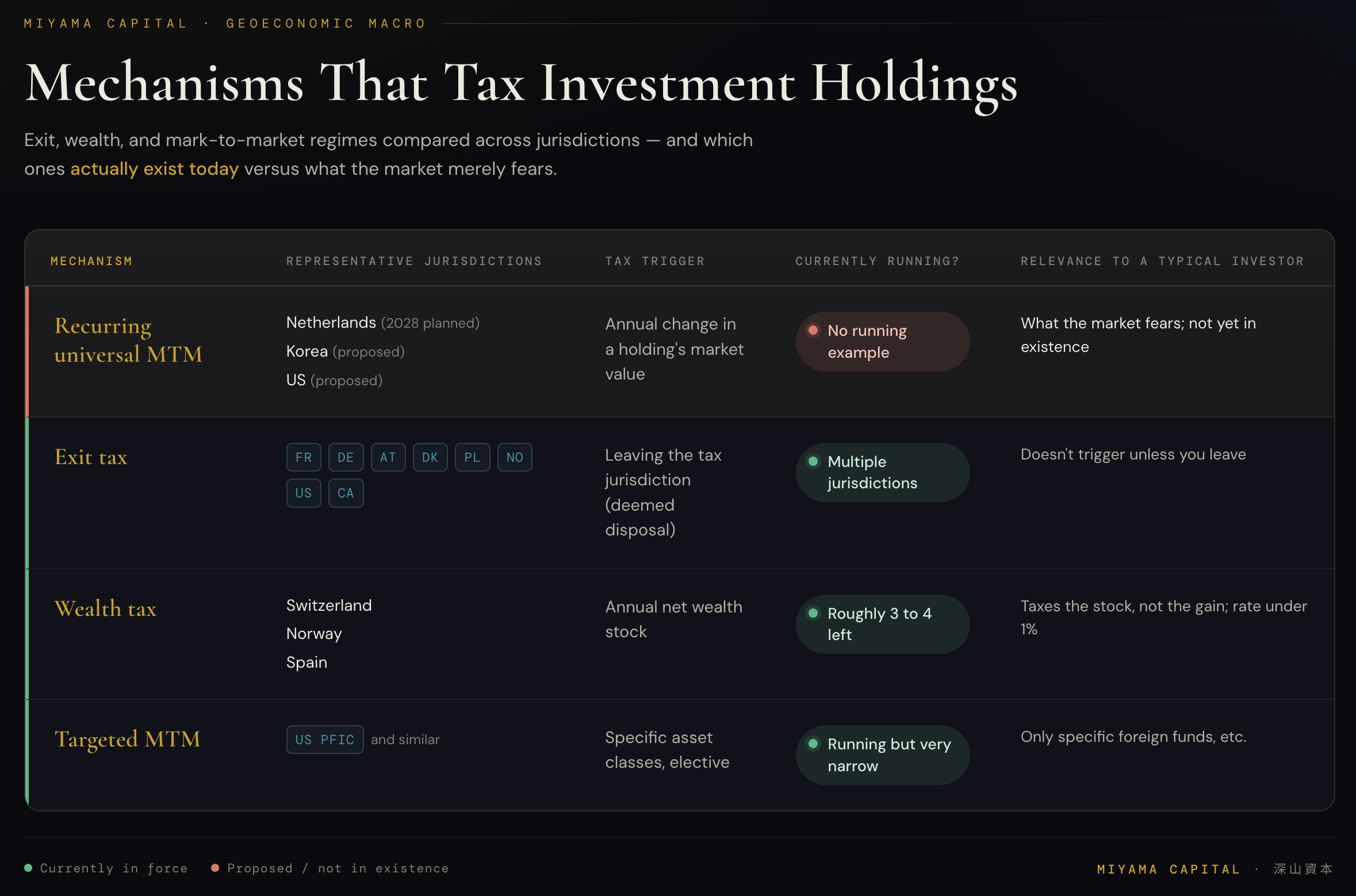
The market is blending four different things into one. Pull them apart and the panic deflates to its real size.
The one that matters is recurring universal mark-to-market: tax assessed every year on the change in an asset’s market value. This is the category the market actually fears, and it is the category with no running example anywhere. The Netherlands has it scheduled for 2028, Korea has it as a proposal, the US had it as a proposal. None of it is live.
The other three get mistaken for it constantly.
Exit taxes are common, but they tax leaving, not holding. France, Germany, Austria, Denmark, Poland, Norway, the US, and Canada all run one. The mechanism is a deemed disposal at the moment you move your tax residency out: you are treated as having sold once, and the accrued gain is settled. Stay put and nothing triggers. That is a different species from “taxed once a year while you hold.”
Wealth taxes have nearly disappeared from Europe. Switzerland, Norway, and Spain still keep a net wealth tax; most other countries either tax specific assets or have repealed the general version (source: Tax Foundation). They tax the stock, not the gain. Switzerland’s rate runs roughly 0.05% to 0.88% on total net wealth, which is nowhere near the same order of magnitude as the 36% rate on taxable return in the Dutch Box 3 design. Capital flight is most of the reason the general wealth tax got dismantled across the continent.
Targeted mark-to-market exists, but the scope is tiny. For a US taxpayer, rules such as PFIC (for certain foreign funds) exist as a matter of law, and they are elective rather than imposed on the general population.
This is not an idiosyncratic cut. It lines up with the EU study’s own taxonomy of wealth-related taxes: net wealth, recurring (unrealized) and realized capital gains, inheritance and gift, and exit. Of the four mechanisms above, only the first is what the market is panicking about, and the first has zero running examples.
The Netherlands: the closest pending case, and its own legislators want it gone
The Netherlands is the closest pending case, but it stays outside the cash-flow layer until the 2028 regime actually takes effect. What follows is limited to the bills and government documents currently public; it is not a prediction of the final 2028 system.
If you want the single closest thing to a recurring universal mark-to-market tax, only the Netherlands qualifies. It passed a design that taxes the applicable (taxable) return at 36% per year, rather than levying on all appreciation indiscriminately. The lower house, the Tweede Kamer, passed it on 12 February 2026 with 93 votes in favour, a clear majority of its 150 seats. It now awaits approval from the upper house, the Eerste Kamer, and is scheduled to take effect on 1 January 2028. Note those two words: scheduled to. It is not yet in force.
The more revealing question is why it grew into this shape. The regime did not start from policy conviction. It started from constitutional necessity. The Dutch Supreme Court struck down the old “deemed return” system (forfaitair rendement), which left a meaningful budget gap, and mark-to-market was the only thing the tax authority could actually build before 2028. The court forced this remedy into existence; nobody set out to design it.
Its political half-life is startlingly short. A parliamentary majority, including parties that voted for the bill, has already passed a motion requiring the government to table a realized-only alternative before the 2028 Budget Day. The new governing coalition committed in writing to converting this Box 3 regime into a pure capital gains tax. The State Secretary himself calls the current bill a “transitional step” (source: Netherlands 2026 coalition agreement). A tax that has not even taken effect, and its own legislators are already lined up to replace it.
There is a design detail that usually gets missed. Founders holding 5% or more fall into the Box 2 “substantial interest” regime, taxed only on dividends or on sale, and zero on paper gains. The Netherlands effectively built a dual track: highly liquid financial assets taxed annually at market value, real estate and startup equity taxed only at realization. For a paper-rich founder, that carve-out is the whole concern in miniature. A tax on unrealized equity could force a sale for no reason other than paying the bill, and the Dutch design concedes the point before it arises. It is hard to tax something you cannot sell on a gain that has not yet turned into cash.
What this means for a global allocator
Pull the lens back. For an allocator, the useful question is about levels, not jurisdictions: how serious is this policy threat, really?
A proposal and a running tax deserve different orders of reaction. Conflate them and your exposure gets pushed around by headlines, washed back and forth at the narrative layer. A live regime changes cash flows. A forum proposal does not.
The transmission chain for a policy threat runs like this: forum proposal → headline → market panic → short-term selling → [verify the institutional level] → calibrate the size of the response. What actually changes cash flows comes after the bracketed step, not from the proposal itself. Most people finish reacting at the selling step.
This does not mean the direction is absent. Court rulings and budget gaps are doing most of the work, and populist politics adds pressure from the side. Together they turn “tax the stock and the gain on capital” into a real directional pressure. That pressure still builds slowly and can be redirected, which is what separates it from a finished, copy-paste-able institution. One bends your cash flows over years. The other only moves this week’s sentiment.
First question: institution, or narrative?
From this single case, a portable piece of discipline falls out.
For any policy-threat macro event, ask one question before anything else. Is this the institution layer or the narrative layer? A running regime that changes cash flows, or a proposal that only moves sentiment? Answer that, and the size of your reaction sorts itself.
Mechanism over instinct, facts over feelings. When the market panics about something, the first move is not to sell with it. The first move is to confirm whether the thing even exists.
One reading treats every proposal as an accomplished institution. The cost is getting washed at the narrative layer, with every forum headline jolting your emotions and your exposure in turn. That reading suits exactly one kind of person: the short-term trader who lives off volatility itself. The opposite reading treats every proposal as noise and ignores it. The cost there is missing the real directional pressure building underneath, and waking up only once the institution has actually formed. That one suits people with simple asset structures and low cross-border exposure.
My own approach sits in the middle. I file proposals at the narrative layer and give them the corresponding, lower, order of reaction, while watching whether they escalate into institutions. The Dutch 2028 date is the key observation point. If it takes effect on schedule with no substitute, the directional pressure moves one step toward the institution layer. If a realized-only alternative stops it, that confirms once more how short the political half-life of this kind of tax really is.
Picking a reading is secondary. What matters is that before you react, you know whether you are facing an institution or a narrative.
Data as of 26 June 2026.
Disclaimer
This article reflects my personal investment philosophy. It is not investment advice. Make your own informed decisions.
Miyama Capital manages proprietary capital only and does not solicit external investors.
Legal Disclaimer
This memo represents the author’s personal views on macroeconomic conditions, interest rate environments, and asset allocation as of the date of writing. It does not constitute a solicitation, recommendation, or guarantee regarding the purchase or sale of any security, fund, bond, or other financial instrument. Investing involves risk; bond prices, interest rates, foreign exchange rates, and economic/policy conditions may materially affect asset values. Scenarios and instruments discussed may become inapplicable as market conditions change. Readers who make investment decisions based on this memo do so at their own risk, and the author accepts no liability for any gains or losses arising from the use or citation of this material.
Kuan H. Wang Founder & CIO, Miyama Capital