
People often tell me, “You’re just lucky. You missed the Financial Crisis. Your investments have been smooth sailing.”
They mean it as a compliment. I take it as a data point.
The most interesting thing about “luck” isn’t that it happens. It’s that the exact same event—a market crash, a recession, a tech boom—destroys one investor and makes another rich.
That is not luck. That is system design.
After years of engineering training and market survival, I have reached a conclusion: “Good luck” is just the visible output of hidden competence. “Bad luck” is usually the price of a flawed system.
The Formula for Luck
I do not deny Initial Luck. Being born in the US versus a war zone, or in a bull market versus a depression, changes your difficulty setting. That is the random seed we cannot choose.
But in the same market environment, why do some people consistently capture opportunities while others watch them slip away?
Here is the formula:
Result = Opportunity (Luck) × Conversion Rate (Skill)
Opportunity: The external event you can’t control (a cheap asset, a market crash, a sudden vacancy).
Conversion Rate: Your ability to execute. This is your capital, your credit lines, your network, and your mental state.
Strong players have a high Conversion Rate.
When a subway delay makes you late for an interview:
The Strong: Use their past reputation (credit) to turn it into a minor joke.
The Weak: Lose the job because they were already a borderline candidate.
When the market crashes:
The Strong: Have cash and mental clarity. They buy the bottom. To them, the crash is “good luck.”
The Weak: Are over-leveraged and panic-selling. To them, the crash is “bad luck.”
Case Study: The “Luck” of Buying Real Estate in Tokyo
Imagine a prime Tokyo apartment hits the market at 20% below market value.
Randomness: The listing time is random. Seeing it is partial luck.
High Conversion (Skill): The pro has a pre-approved loan, a “buy box” decision matrix (e.g., “If IRR > X%, buy immediately”), and a trusted broker. They sign the contract in 24 hours.
Low Conversion (Bad Luck): The amateur hesitates. They don’t have the cash ready. They worry about renovation costs. By the time they decide, it’s gone. They say, “Unlucky, I missed it.”
That wasn’t bad luck. That was bad preparation.
There is No Luck, Only Expected Value (EV)
In my philosophy, “luck” is a bug, not a feature. Investing is not gambling; it is a game of Expected Value (EV) and the Law of Large Numbers.
If you make positive EV decisions consistently over a long period, profit is a mathematical inevitability.
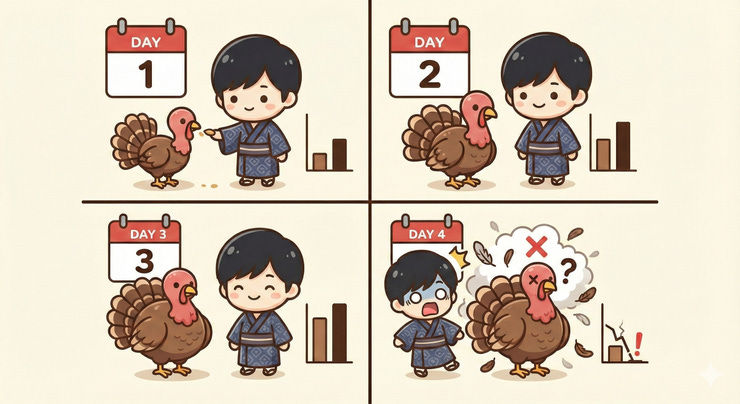
If you go bankrupt because a “once-in-a-lifetime” crash hit you right before retirement, that wasn’t bad luck. That was bad strategy. You were the turkey in Russell’s analogy: You were fed for 1,000 days and thought the farmer loved you, until Thanksgiving arrived. You ignored the tail risk.
The Art of Hedging: Ray Dalio’s Holy Grail
Novices say, “Hedging drags down performance.” Masters say, “Hedging allows me to survive long enough to win.”
I look for the Positive Carry Hedge.
Ray Dalio calls this the “Holy Grail of Investing”: Finding uncorrelated return streams.
Level 1 (The Novice): Buying Puts. You pay a premium for insurance. It works, but it bleeds your profit (Negative Carry).
Level 2 (The Pro): Portfolio Construction. You mix stocks, bonds, and trend-following strategies. You rely on diversification to smooth volatility.
Level 3 (The Master): Positive Carry Hedge. You find assets that are uncorrelated and have a positive expected return on their own. You structure your portfolio so that your “insurance” actually pays you while you wait.
Hedging isn’t about giving up returns. It’s about engineering a system where risk is managed at an acceptable cost.
The Last Line of Defense: The Hard Stop
Even the best models fail. We cannot predict everything. This is where I apply the engineer’s ultimate fail-safe: The Hard Stop.
No matter how perfect my thesis is, I set an absolute exit point.
If the price hits $X, I sell. No questions. No “let me think about it.”
The Math of the Hard Stop:
Without it: Your potential loss is infinite (zero).
With it: You artificially truncate the left tail of the distribution. You force a potential disaster to become a manageable cost.
How to design it:
Define your max pain point (% of capital).
Adjust position size based on volatility.
Execute mechanically. Do not let emotions vote.
The Boundary of Risk: Aliens and Game Theory
We should hedge against financial crises, wars, and inflation. In these scenarios, money still matters. Survivors get to buy assets cheap.
We do not hedge against “Aliens attacking Earth” or “Total Nuclear Annihilation.” Why? Game Theory. In those scenarios, the financial system collapses. Your bank account is zero. Your gold bars are irrelevant. Hedging for the apocalypse is expensive and useless.
My stance is pragmatic: Solve the risks you can quantify and manage. Accept the risks that end the game entirely.
Here is the translation and rewrite of your article, “God Does Not Play Dice” (上帝不擲骰子).
I have maintained the “Kuan” persona: direct, system-oriented, and focused on “engineering luck” rather than hoping for it. I’ve also included the SEO & Social Media Hooks at the end.
God Does Not Play Dice: Why “Luck” Is an Engineering Problem
By Kuan | Miyama Capital
People often tell me, “You’re just lucky. You missed the Financial Crisis. Your investments have been smooth sailing.”
They mean it as a compliment. I take it as a data point.
The most interesting thing about “luck” isn’t that it happens. It’s that the exact same event—a market crash, a recession, a tech boom—destroys one investor and makes another rich.
That is not luck. That is system design.
After years of engineering training and market survival, I have reached a conclusion: “Good luck” is just the visible output of hidden competence. “Bad luck” is usually the price of a flawed system.
The Formula for Luck
I do not deny Initial Luck. Being born in the US versus a war zone, or in a bull market versus a depression, changes your difficulty setting. That is the random seed we cannot choose.
But in the same market environment, why do some people consistently capture opportunities while others watch them slip away?
Here is the formula:
Result = Opportunity (Luck) × Conversion Rate (Skill)
Opportunity: The external event you can’t control (a cheap asset, a market crash, a sudden vacancy).
Conversion Rate: Your ability to execute. This is your capital, your credit lines, your network, and your mental state.
Strong players have a high Conversion Rate.
When a subway delay makes you late for an interview:
The Strong: Use their past reputation (credit) to turn it into a minor joke.
The Weak: Lose the job because they were already a borderline candidate.
When the market crashes:
The Strong: Have cash and mental clarity. They buy the bottom. To them, the crash is “good luck.”
The Weak: Are over-leveraged and panic-selling. To them, the crash is “bad luck.”
Case Study: The “Luck” of Buying Real Estate in Tokyo
Imagine a prime Tokyo apartment hits the market at 20% below market value.
Randomness: The listing time is random. Seeing it is partial luck.
High Conversion (Skill): The pro has a pre-approved loan, a “buy box” decision matrix (e.g., “If IRR > X%, buy immediately”), and a trusted broker. They sign the contract in 24 hours.
Low Conversion (Bad Luck): The amateur hesitates. They don’t have the cash ready. They worry about renovation costs. By the time they decide, it’s gone. They say, “Unlucky, I missed it.”
That wasn’t bad luck. That was bad preparation.
There is No Luck, Only Expected Value (EV)
In my philosophy, “luck” is a bug, not a feature. Investing is not gambling; it is a game of Expected Value (EV) and the Law of Large Numbers.
If you make positive EV decisions consistently over a long period, profit is a mathematical inevitability.
If you go bankrupt because a “once-in-a-lifetime” crash hit you right before retirement, that wasn’t bad luck. That was bad strategy. You were the turkey in Russell’s analogy: You were fed for 1,000 days and thought the farmer loved you, until Thanksgiving arrived. You ignored the tail risk.
The Art of Hedging: Ray Dalio’s Holy Grail
Novices say, “Hedging drags down performance.” Masters say, “Hedging allows me to survive long enough to win.”
I look for the Positive Carry Hedge.
Ray Dalio calls this the “Holy Grail of Investing”: Finding uncorrelated return streams.
Level 1 (The Novice): Buying Puts. You pay a premium for insurance. It works, but it bleeds your profit (Negative Carry).
Level 2 (The Pro): Portfolio Construction. You mix stocks, bonds, and trend-following strategies. You rely on diversification to smooth volatility.
Level 3 (The Master): Positive Carry Hedge. You find assets that are uncorrelated and have a positive expected return on their own. You structure your portfolio so that your “insurance” actually pays you while you wait.
Hedging isn’t about giving up returns. It’s about engineering a system where risk is managed at an acceptable cost.
The Last Line of Defense: The Hard Stop
Even the best models fail. We cannot predict everything. This is where I apply the engineer’s ultimate fail-safe: The Hard Stop.
No matter how perfect my thesis is, I set an absolute exit point.
If the price hits $X, I sell. No questions. No “let me think about it.”
The Math of the Hard Stop:
Without it: Your potential loss is infinite (zero).
With it: You artificially truncate the left tail of the distribution. You force a potential disaster to become a manageable cost.
How to design it:
Define your max pain point (% of capital).
Adjust position size based on volatility.
Execute mechanically. Do not let emotions vote.
The Boundary of Risk: Aliens and Game Theory
We should hedge against financial crises, wars, and inflation. In these scenarios, money still matters. Survivors get to buy assets cheap.
We do not hedge against “Aliens attacking Earth” or “Total Nuclear Annihilation.” Why? Game Theory. In those scenarios, the financial system collapses. Your bank account is zero. Your gold bars are irrelevant. Hedging for the apocalypse is expensive and useless.
My stance is pragmatic: Solve the risks you can quantify and manage. Accept the risks that end the game entirely.
Conclusion
Admitting luck exists keeps you humble. Blaming luck for failure keeps you poor.
This is the Miyama philosophy: Do not predict the future. Build a system that works regardless of the future.
Use Positive Carry Hedges. Use Hard Stops. Rely on discipline, not hope. When you stop blaming “bad luck,” you finally take control of the game.