
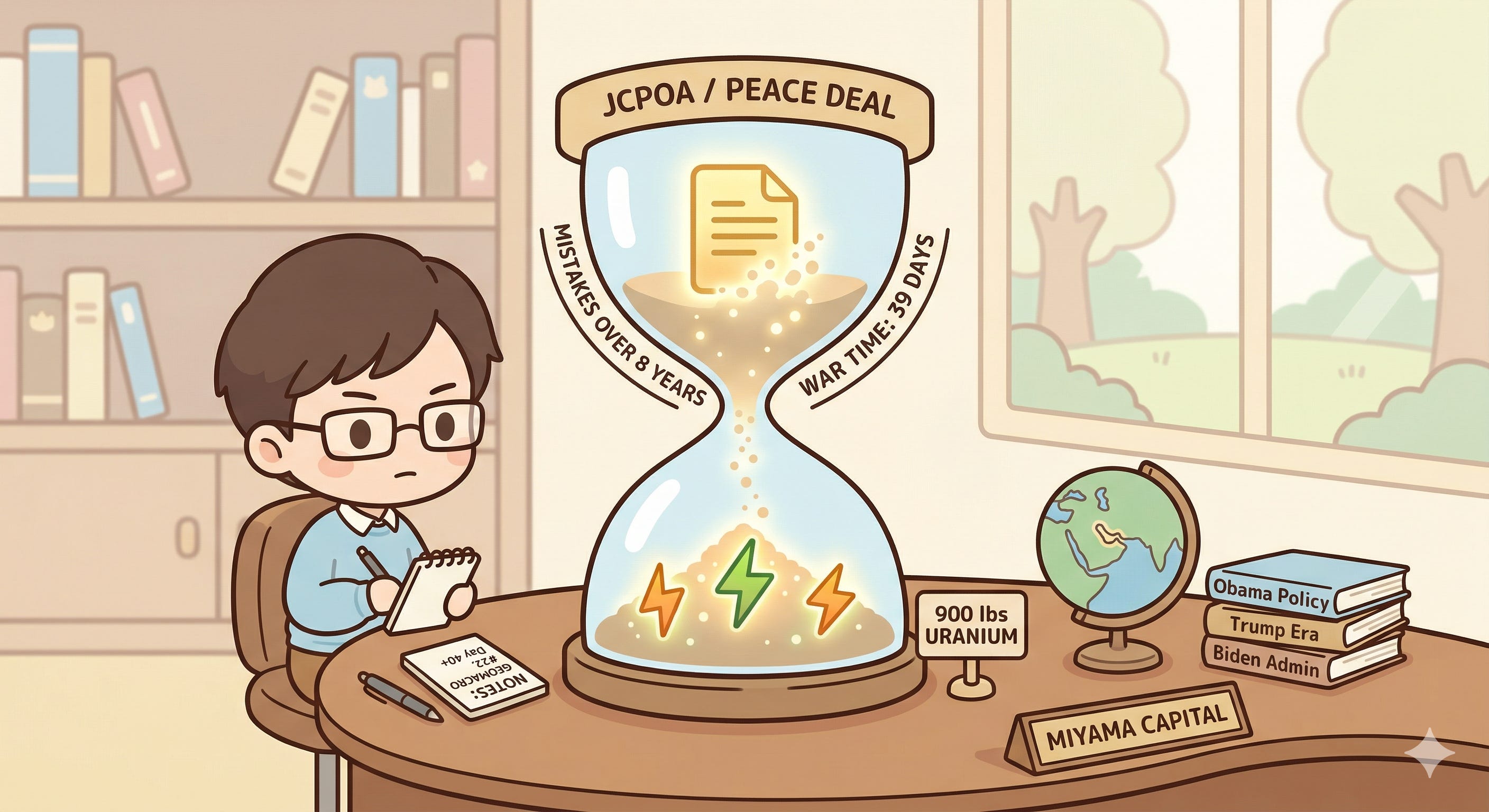
This analysis comes from a cross-asset macro practitioner managing proprietary capital. I have skin in the game. My predictions are timestamped, and my errors are corrected publicly. If I get something wrong, you will read about it in the next piece.
The Deal That Died in 24 Hours
On February 27, 2026, Oman’s Foreign Minister Badr Al-Busaidi went on CBS’s Face the Nation and announced what he called an unprecedented breakthrough. After three rounds of indirect talks in Geneva, Iran had agreed to never stockpile enriched uranium, downblend existing inventory to the lowest levels, convert it into fuel rods (making it irreversible), accept full IAEA inspections, and even permit American inspectors on-site.
This was better than the JCPOA. The 2015 deal allowed 300 kilograms of stockpile. The February 27 breakthrough was zero.
Twenty-four hours later, the U.S. and Israel struck Iran. Supreme Leader Ali Khamenei was killed in the opening salvo. Full-scale war began.
Forty-four days later, as I write this on April 13: approximately 900 pounds of highly enriched uranium remains in Iran. The Strait of Hormuz has become a toll booth charging $2 million per ship. Over 3,400 people are dead, including more than 1,600 civilians (per HRANA). Iran’s negotiating position has shifted from “I will never stockpile uranium” to “I demand the right to enrich.”
I want to trace how we got here, what the current situation actually is beneath the headlines, and where the cross-asset transmission leads from this point. The structure is chronological, then analytical, then forward-looking.
Three Presidents, One Enrichment Curve
Start with the JCPOA. It was not a good deal. But it worked.
From 2015 to 2018, the IAEA published over ten consecutive reports confirming full Iranian compliance. Enrichment stayed at 3.67%. Stockpiles remained below 300 kilograms, roughly 2% of pre-deal levels. Thousands of centrifuges were dismantled and stored under IAEA monitoring. The Arak heavy-water reactor core was filled with concrete.
The Strait of Hormuz was open. Free passage. Nobody died.
The real flaws were structural. Sunset clauses meant the core restrictions expired in 10 to 15 years rather than permanently. The deal ignored Iran’s ballistic missile program entirely. It left the proxy network (Hezbollah, Houthis, Hamas) untouched. And the IRGC, which controls an estimated 20 to 30 percent of Iran’s GDP, absorbed a portion of sanctions-relief revenue into military capabilities.
These were legitimate criticisms. Trump’s decision to withdraw in May 2018 had a defensible logic: the JCPOA addressed nuclear enrichment but not missiles, not proxies, not the IRGC’s economic empire. My assessment: the logic was sound, but the execution was catastrophic. He tore up the framework without replacing it with anything.
Between 2018 and 2020, Trump’s attention was consumed by the U.S.-China trade war. Maximum pressure sanctions were imposed, but there was no negotiating table behind them. Iran was left with pain and no exit ramp. In September 2019, Iranian drones and cruise missiles hit Saudi Aramco facilities, knocking 5% of global oil production offline. Trump did nothing. That was the first time the bluff was exposed.
In January 2020, the U.S. killed IRGC Quds Force commander Qasem Soleimani in a drone strike in Baghdad. This could have been a genuine inflection point: Iran’s most capable military leader eliminated, the IRGC temporarily destabilized. Two months later, COVID shut everything down. Then Trump lost the election.
During this period, Iran quietly enriched from 3.67% to 20%.
Biden gets the least scrutiny of the three, but in my reading, he deserves the worst grade. He attempted to rejoin the JCPOA through indirect talks in Vienna. Two years of negotiation produced nothing. Meanwhile, he relaxed sanctions enforcement without attaching conditions. Iranian oil exports recovered from roughly 500,000 barrels per day under Trump to approximately 1.5 to 2 million barrels per day (per EIA and shipping tracker data), mostly to China. Washington looked the other way because higher Iranian supply kept global oil prices lower, which helped with domestic inflation.
The result was the worst possible combination: Iran received revenue but faced no constraints. At least under the JCPOA, the IAEA had monitoring access. Under Biden, even that was gone.
The money funded missile stockpiles and proxy networks. The October 7, 2023 Hamas attack on Israel, the Red Sea crisis, the 2025 twelve-day war, and the current full-scale conflict all trace back along this funding chain.
Enrichment during Biden’s four years went from 20% to 60%.
If I had to issue grades: Obama built an imperfect framework, B-minus. Trump demolished the framework without a replacement, D. Biden had four years and a worsening problem, and did nothing, F. I expect this ranking will be controversial. Many analysts place the heaviest blame on Trump for toppling the first domino. From a strict causation standpoint, they have a point. But Biden is worse because Trump at least had a strategy, even if it was the wrong one. Biden had no strategy at all.
900 Pounds: The Only Variable That Matters
Approximately 900 pounds (roughly 408 kilograms) of uranium enriched to 60%, enough for an estimated 9 to 11 nuclear weapons with a breakout timeline measured in days. Senator Lindsey Graham cited IAEA data in an April 8 statement demanding that every ounce be removed from Iran under American control.
This is the single irreversible variable in the entire conflict. The Strait of Hormuz can reopen. The IRGC can rebuild. Infrastructure can be repaired. Nuclear weapons cannot be uninvented. Once Iran crosses that threshold, no amount of military force pushes it back.
The uranium is not in the ceasefire terms.
Trump demanded the strait reopen. He did not demand the uranium. Because the strait equals oil prices, and oil prices are his KPI. Uranium equals national security, which is not his KPI. He told AFP the uranium issue would be “dealt with perfectly.” No details. No timeline. No monitoring mechanism.
Iran’s ten-point counterproposal, meanwhile, demands the right to enrich. Graham wants every gram removed. These positions are not in the same universe.
Air strikes cannot retrieve material buried in underground facilities covered by bombed-out rubble. Retrieval requires ground forces. In the post-Iraq, post-Afghanistan era, no American president will deploy ground troops into Iran. Every adversary on the planet has learned the same lesson: bury the important things deep enough, wait for the bombs to stop, wait for the American electorate to lose patience, wait for the president to find an off-ramp. Then you are still standing.
My biggest concern about this war is whether the 900 pounds of uranium will ever leave Iran. I am not optimistic.
Islamabad: 21 Hours, Zero Agreement
The Islamabad talks lasted 21 hours. The distance between the two sides was enormous.
The American demand list read like an ultimatum: halt all enrichment, dismantle enrichment facilities, surrender the HEU, open the Strait of Hormuz, stop funding Hamas and Hezbollah (per NPR, April 12). Iran demanded war reparations, a Lebanon ceasefire, and unfreezing of overseas assets.
Vice President Vance left with a single sentence: “This is our final and best offer.”
Iranian Foreign Minister Araghchi’s response was measured and precise: the goalposts keep moving, and expecting resolution from a single session is unrealistic (per NPR, April 12). Mediators are already working to prevent a complete breakdown. CBS News reported on April 14 that Pakistan’s Prime Minister Sharif and Army Chief Field Marshal Asim Munir are pushing for a second round of talks before the ceasefire expires around April 22, and are awaiting responses from both sides (per CBS News, April 14). The door remains open, with intermediaries working to keep it that way.
Blockade, but of What?
Hours after talks collapsed, Trump posted on Truth Social: the U.S. Navy would “immediately” blockade “any and all Ships” entering or leaving the Strait of Hormuz.
Then CENTCOM issued its clarification.
The actual enforcement targets vessels entering or departing Iranian ports, including all Iranian ports on the Arabian Gulf and Gulf of Oman. Vessels transiting the strait to and from non-Iranian ports are unaffected (per CENTCOM statement, April 12). Two U.S. destroyers had already transited the strait. Mine-clearing operations were underway. Vice Admiral Brad Cooper announced new safe-passage corridors and escort procedures.
If you watch the military’s actions and ignore the president’s rhetoric, what the U.S. Navy is doing is reopening the strait for commercial traffic.
But Trump cannot say “I am helping everyone get through safely.” That sounds weak. So the operation is packaged as “blockading Iran’s ports.”
For MAGA voters: punishment. For markets and shipping companies: the strait is reopening, your ships can move.
The deployment is identical, but the political and market narratives are different.
TACO: A Structural Thesis, Not a Meme
TACO stands for Trump Always Chickens Out. I use this not as mockery but as a falsifiable structural proposition. Consider the pattern over the past six weeks:
The war’s first phase featured six consecutive threat-and-retreat cycles. March 21: threatened to strike power plants, did not follow through. March 26: said he would bomb Iran “back to the Stone Age,” did not follow through. April 1: said he would “blow up everything,” did not follow through. April 6: said Iran’s “whole civilization” would end “tonight,” then accepted a “workable” ceasefire proposal 90 minutes later. April 7: announced “Shootin’ Starts, bigger and better.” April 8: ceasefire.
Now, post-ceasefire: the Wall Street Journal reported on April 12 that the White House is “considering” resuming limited air strikes. The language matters. “Considering” is not “ordering.” Administration officials emphasized that Trump remains open to a diplomatic solution. This phrasing is consistent with all three previous escalation-then-retreat cycles.
Trump’s political survival requires low oil prices. Low oil prices require the strait to reopen. Reopening requires not escalating. Therefore, he cannot escalate. Therefore, every threat is a bluff. The bluff gets called. Which makes it even harder to escalate next time.
Multiple constraints tighten this loop simultaneously, but the binding one is oil. Average U.S. gasoline hit $4.12 per gallon as of April 12 (per AAA), up 38% since the war started. Brent crude opened above $103 on April 13 but settled at $99.36 by close (per Bloomberg). WTI followed the same pattern, spiking above $101 intraday before closing at $99.08. The intraday reversal is telling: the market priced in the blockade headline, then faded it within hours. Summer driving season will push prices higher regardless. Every day of elevated gasoline is a day of political bleeding, and House Democrats under Hakeem Jeffries are already linking every cent of price increase to the war ahead of November midterms.
Congress is compounding the pressure. The War Powers Act’s 60-day clock started February 28, with the deadline falling around April 29 (per NPR, April 10). Republican defections are already emerging: Rand Paul and Thomas Massie oppose the war outright, Paul co-signed a Democratic-led War Powers limitation bill, and Susan Collins demands congressional authorization for any ground troops or extension beyond 60 days. CSIS estimates the war has cost approximately $30 billion. When Congress returns from recess, Democrats plan forced votes in both chambers, compelling Republicans to go on the record in an election year.
The time window that remains is roughly two weeks.
The Art of the Deal, Violated by Its Author
In 1987, Trump published three core principles for negotiation. He violated all of them.
The most consequential: never threaten what you cannot do. Once you bluff and get caught, everything you say afterward loses weight. He threatened six times in Iran without follow-through. By the fourth cycle, the IRGC had incorporated his bluff pattern into their operational planning, reportedly codenamed “Operation Madman.”
He also wrote that the best deal happens when you have maximum leverage. Day 39 of the war was that moment. Israel’s 72-hour assassination campaign had shattered the IRGC command chain. Air defenses were destroyed. The pragmatist faction was fighting for control. From a position of maximum leverage, Trump accepted a proposal he called “workable,” with no uranium provisions, no permanent monitoring framework, and no clear enforcement mechanism.
The third principle was about credibility: make the other side believe you will walk away. Five deadline cycles without execution taught Iran a single lesson: he will not follow through.
Trump was the one who walked away, accepting a proposal he labeled “workable” without uranium provisions or a permanent monitoring framework.
Iran’s Optimal Strategy: Don’t Move
Six weeks of air strikes. The Supreme Leader killed. Nuclear facilities damaged. Over 3,400 dead.
And now a port blockade against a country that already has almost no exports. Marginal additional pain: close to zero.
Iran’s strategy is legible: do not provoke, do not cooperate, do not surrender. Wait. Every day that passes increases Trump’s political cost while Iran’s sunk costs are already paid.
The mine threat is likely more theater than substance. Six weeks of war produced very few actual ship strikes. The deterrence logic does not require widespread mining; it requires enough uncertainty that insurance companies refuse to underwrite passage. Pre-war daily transits exceeded 130 vessels. Post-ceasefire: approximately 17 (per Windward / Al Jazeera, April 13). The gap is driven by insurance premiums and war-risk pricing, not physical obstruction.
Iran’s countermove to the blockade was precise: threaten not American forces, but the ports of Gulf allies (Saudi Arabia, UAE, Bahrain). You blockade us, we ensure your partners cannot export either. The IRGC declared that any military vessel approaching the strait would constitute a ceasefire violation (per Fars News / Al Jazeera, April 13).
Simultaneously, Iranian Armed Forces issued a formal statement calling the U.S. blockade “illegal, equivalent to piracy” under international law (per Al Jazeera, April 13). This is a register shift: from military threats to legal-framework arguments aimed at the United Nations and the international community. Araghchi is heading to Berlin, Paris, and London. Iran is moving the battlefield from the Persian Gulf to the court of international opinion.
Iran benefits from delay because each additional day raises Washington’s political cost while Tehran’s sunk costs are already paid.
China, Russia: Cover Fire, Not Firepower
On April 7, China and Russia vetoed a Bahrain-sponsored UN Security Council resolution on Hormuz, 11 to 2 with 2 abstentions. The stated rationale: passing such a resolution while the U.S. threatens to annihilate a civilization sends the wrong signal (per Al Jazeera, April 7).
Iran has kept the strait open for Chinese, Russian, Indian, Iraqi, and Pakistani vessels through a controlled northern corridor. Chinese oil continues to flow.
Beijing’s calculation: strategic petroleum reserves and renewable energy investment provide short-term buffer. But a multi-month war would strain even Chinese reserves.
The critical escalation scenario would be U.S. forces intercepting a Chinese vessel. CENTCOM’s clarification (non-Iranian port traffic unaffected) was designed specifically to avoid this trigger.
This was confirmed within 24 hours. On April 14, a U.S.-sanctioned Chinese tanker (the Rich Starry, owned by Shanghai Xuanrun Shipping) transited the Strait of Hormuz despite the active blockade (per The National / Bloomberg / Reuters, April 14). The U.S. Navy did not intercept it. The implicit rule is now explicit: Chinese vessels pass. The blockade is selectively enforced, which makes it a pressure campaign with carefully drawn red lines designed to avoid the one escalation that would change the game entirely.
Trump’s separate warning that any country caught shipping weapons to Iran faces 50% tariffs (per Newsweek, April 12) is telling: tariffs, not military action. The escalation tool of choice against China is economic, not kinetic. That itself signals the desire to avoid a second front.
The unified China-Russia posture: verbal support, diplomatic blocking, zero military risk on Iran’s behalf.
Bloomberg columnist Javier Blas offered a sharper framing on April 14: the blockade’s real target is not Tehran but Beijing. Before the war, China purchased roughly 90% or more of Iran’s oil exports through a network of sanctioned tankers and shadow traders (per Bloomberg Opinion, April 14). By blockading Iranian ports, Trump is attempting to force China to pressure Iran back to the negotiating table. Whether Beijing cooperates or simply routes around the blockade through dark transits will determine whether the economic squeeze has any teeth.
Europe’s Third Path
The UK and France made separate announcements that deserve close attention.
UK Prime Minister Keir Starmer stated explicitly that the UK is “not endorsing” the U.S. blockade and will not be “entangled” in the Iran conflict (per CNBC, April 13). France’s President Macron announced that France and the UK will co-host a conference in the coming days with over 40 nations to establish a “strictly defensive, peaceful multinational mission” to restore freedom of navigation, operating independently of the warring parties (per Bloomberg / Reuters, April 13).
This is a third force for reopening the strait, one that depends on neither Trump’s coercion theater nor Iran’s cooperation. For Iran, the European initiative is exactly what Araghchi needs: a diplomatic channel that bypasses Washington. For markets, it is an additional vector for functional reopening.
The coalition is forming faster than expected. A senior NATO military official told CBS News on April 14 that the UK is leading planning efforts for a coalition of more than 40 nations to reopen the strait and protect freedom of navigation (per CBS News, April 14). The EU’s Kaja Kallas separately urged a global coalition to secure the strait (per The National, April 14). The planning has moved past announcements into operational coordination.
If the UK-France convoy materializes, the strait could reopen faster than my base case assumes.
Cross-Asset Transmission
The transmission channels split into two time horizons.
In the short term (one to four weeks): energy prices spike on headline risk but fade as TACO logic reasserts. The dollar strengthens on safe-haven flows; euro weakens on European energy dependence. Equity volatility rises. Treasury yields compress as flight-to-quality bids arrive. Credit spreads widen in energy-importing emerging markets.
In the medium term (one to six months): even after the strait functionally reopens, refinery capacity across the Gulf remains impaired. Iranian missiles damaged dozens of refineries, oil fields, and export terminals in Gulf states. Saudi Arabia confirmed that attacks reduced production capacity by 600,000 barrels per day and cut East-West Pipeline throughput by 700,000 bpd (per Saudi Press Agency). Crude may flow, but refined product shortages (diesel, gasoline, aviation fuel) persist through year-end. The “new normal” for oil is determined by refining capacity, not strait access.
The demand side is already cracking. The International Energy Agency reported on April 14 that it expects global oil demand to contract by 80,000 barrels per day for 2026 as a whole, a swing of 730,000 bpd from last month’s growth forecast (per IEA Oil Market Report, April 14). The Q2 decline alone is projected at 1.5 million bpd, the steepest quarterly drop since COVID-19. Demand destruction is no longer a forecast. It is happening. This is the other side of the oil equation that headline-driven analysis misses: prices can fall not because supply recovers, but because demand collapses under the weight of those same prices.
Goldman Sachs warned that if the strait remains shut for another month, Brent stays above $100 for the rest of 2026, with Q3 averaging $120 and Q4 at $115 (per Bloomberg / Yahoo Finance, April 11). JPMorgan flagged $120 as a scenario (per APAC Media, April 11). Wood Mackenzie estimated that sustained Brent above $100 drags global GDP growth to 1.7% (per OilPrice.com, April 11). EIA’s Short-Term Energy Outlook forecast Q2 Brent at $115 per barrel (April 7).
All of these projections assume continued closure. If TACO holds, the functional reopening timeline is shorter than consensus expects, and the gap between those forecasts and TACO-implied reality represents a potential mispricing.
Scenario Analysis
Base Case (55% probability). The blockade lasts one to three weeks, during which U.S. Navy escorts enable increasing non-Iranian commercial transits. Insurance war-risk premiums begin declining. Mediators produce some form of back-channel understanding before the ceasefire expires around April 22. Trump declares “mission accomplished” and pivots. Strait daily transits recover toward 50-plus. Brent settles in the mid-$80s to low $90s by late May.
Monitoring triggers: daily strait transits exceeding 50, insurance companies adjusting war-risk pricing downward, Iran-Europe talks producing joint statements.
Early validation: on April 14, three vessels transited the Strait of Hormuz despite the dual U.S.-Iran restrictions, including two U.S.-sanctioned tankers (per Al Jazeera / Reuters, April 14). Traffic is trickling, not flowing, but the direction is consistent with Base Case.
Risk Case (30% probability). The blockade drags beyond one month. Iran retaliates against Gulf state port infrastructure, creating a second supply disruption. Saudi pipeline capacity cannot compensate for terminal damage.
Monitoring triggers: Brent above $110 for two consecutive weeks, Saudi production cuts announced, U.S. gasoline above $4.50 per gallon, Congressional forced vote on War Powers producing Republican defections above five.
Tail Case (15% probability). Trump orders resumed air strikes on Iranian infrastructure, or CENTCOM expands the blockade to intercept non-Iranian-port traffic (triggering Chinese confrontation). TACO collapses. All de-escalation assumptions require immediate reassessment.
Monitoring triggers: new strike orders (not “considering” language), CENTCOM scope expansion to non-Iranian vessels, Chinese Foreign Ministry issuing maximum-severity warning.
Prediction Scorecard
Timestamped: April 13, 2026. Updated with April 14 developments.
Prediction 1: The blockade does not escalate to direct U.S.-Iran naval combat within 14 days. Confidence: 80%. Falsification: any exchange of fire between U.S. Navy and IRGC naval assets.
April 14 update: three vessels transited the strait on Day 1 of the blockade without incident. Direction consistent with prediction.
Prediction 2: Strait daily transits recover to 40-plus within 21 days under U.S. and/or European escort. Confidence: 65%. Falsification: daily transits remain below 25 on May 4.
Prediction 3: Trump does not resume air strikes on Iranian territory before the April 29 War Powers deadline. Confidence: 70%. Falsification: confirmed strike orders, not trial balloons or “considering” language.
April 14 update: U.S.-sanctioned Chinese tanker transited without interception. Pattern of restraint consistent with prediction.
Prediction 4: Brent crude is below $95 per barrel by May 15. Confidence: 55%. Falsification: Brent above $100 on May 15 close.
Prediction 5: No formal comprehensive deal emerges from this cycle. The outcome is an ambiguous, face-saving de-escalation with the uranium issue unresolved. Confidence: 75%. Falsification: signed agreement that includes verified uranium transfer provisions.
These are not investment recommendations. They are the framework laid open for scrutiny. If I am wrong, the correction runs in the next piece with full accounting.
Monitoring Dashboard
Key indicators to watch, in order of signal strength:
Strait daily vessel transits (Windward / MarineTraffic data). Oil: Brent front-month versus back-month spread as a real-time read on whether the market prices temporary disruption or structural shortage. U.S. gasoline retail average (AAA daily). Congressional vote counts on War Powers resolutions. Insurance market: Lloyd’s and P&I club war-risk premium adjustments. European convoy: timeline from Macron-Starmer conference to first escort deployment. Back-channel signals: any Oman, Qatar, or Turkish mediator statements indicating progress. Iran rhetoric register: military threats versus international-law framing (the latter signals diplomatic pivot, the former signals entrenchment).
The Allocator’s Options
The default response is to sit tight and let TACO unfold. Maintain existing exposure, accept short-term headline volatility, and let de-escalation do the work. The risk is having no hedge if TACO fails. This works for allocators with disciplined stop-losses and manageable position sizes.
For those with the instrument capability, the headline spike itself is a tactical window: dollar strength, energy dislocation, compressed timeframe. The cost is that TACO gets priced in faster than you expect. The window may already be closing.
The third option is tail insurance. Use options to cap downside from the 15% scenario where Trump actually follows through. Time decay eats the premium if TACO holds, but for large positions that cannot absorb tail-risk impact, the cost is worth paying.
Which option you choose matters less than knowing what you are giving up by choosing it.
The Deeper Consequence
The market is pricing in TACO. On April 13, the S&P 500 opened down on the blockade headline, reversed through the session, and closed up 1.02% at 6,886 (per Bloomberg). Brent crude spiked above $103 at the open and settled below $100 by close. Trump told reporters Iran “still wanted to make a deal.” The market faded the fear in real time, and the oil reversal reinforced the pattern: headline escalation, intraday de-pricing, close near pre-announcement levels.
My estimate is that the market is right on the short-term direction and wrong on the medium-term structure.
The short-term trade is TACO: de-escalation, strait reopens, oil settles. Fine.
The medium-term problem is the 900 pounds of uranium, the structural degradation of American deterrence credibility, and the precedent this sets for the Taiwan Strait.
Every adversary is studying the same playbook. Six consecutive threats without follow-through. A president whose KPI is the gasoline price, not strategic credibility. A Congress that cannot agree on war authorization. Precision munitions and interceptor stockpiles depleted (per CSIS estimates, 1 to 3 years to replenish), which were earmarked for Taiwan contingency planning, for Ukraine’s front lines, and for Indo-Pacific forward deployment.
The Trump-Xi summit expected in mid-May is the most consequential downstream event from this war. Trump arrives in Beijing needing Chinese cooperation on Iran. Xi’s leverage is ten times what it was before February 28. The likely concession vector: military sales delays, reduced Taiwan Strait patrol frequency, rhetorical de-escalation. Each one individually is not “selling out Taiwan.” Collectively, it is structural retreat.
This war’s deepest consequence may not land in the Middle East. It may land in the Taiwan Strait.
Originally drafted April 13, 2026. Updated April 14 with blockade Day 1 observations.
Disclaimer
This article reflects my personal investment philosophy. It is not investment advice. Make your own informed decisions.
Miyama Capital manages proprietary capital only and does not solicit external investors.
This memo represents the author’s personal views on macroeconomic conditions, interest rate environments, and asset allocation as of the date of writing. It does not constitute a solicitation, recommendation, or guarantee regarding the purchase or sale of any security, fund, bond, or other financial instrument. Investing involves risk; bond prices, interest rates, foreign exchange rates, and economic/policy conditions may materially affect asset values. Scenarios and instruments discussed may become inapplicable as market conditions change. Readers who make investment decisions based on this memo do so at their own risk, and the author accepts no liability for any gains or losses arising from the use or citation of this material.
Kuan H. Wang Founder & CIO, Miyama Capital