

Miyama Capital Geopolitical Macro Series Kuan H. Wang, Founder & CIO
The market spent the weekend debating whether Trump will strike Iran’s power plants. Brent crude closed Friday at $112.19 (source: CNN, 2026-03-22), a wartime high. Goldman Sachs’s latest published note suggests elevated oil prices could persist through 2027.
The key variable is what happens after the 48 hours expire. Strike or no strike, the answer points the same direction. He leaves.
This memo traces the evidence: destruction-sufficiency logic driving the ultimatum, Iran’s own language confirming exit as the structural endpoint, and the positioning implications across scenarios. The core analytical variable is post-deadline exit sequencing.
Where the Military Checklist Stands
Quick status sync. According to Trump’s own “destruction list” posted on Truth Social (March 20) and corroborated by open-source military reporting, US strikes have hit Iranian nuclear facilities, naval fleet (reportedly reduced to near zero per Pentagon briefings), air force bases, air defense systems, and missile launch sites. US forces struck Kharg Island, Iran’s largest oil export terminal. Unconfirmed reports have raised the possibility that Khamenei is dead. If accurate, this removes the single actor with authority to negotiate a formal ceasefire, which reinforces the structural argument for exit-by-destruction rather than exit-by-negotiation.
High-value military targets are largely exhausted. That is why power plants are next. They are the largest remaining civilian infrastructure target, and striking them serves a political function: completing the destruction checklist to a length that supports a victory narrative. The transition from military logic to political logic happens at exactly this point.
Two Signals, One Logic
Friday’s “winding down” language and Saturday’s 48-hour ultimatum look contradictory on the surface. They are two faces of the same exit logic, aimed at two different audiences.
“Winding down” is the domestic message. CNN polling (published 2026-03-22) puts opposition to military action at 60%, up from 56% earlier in the conflict. 68% say the administration has not clearly stated war objectives. 92% want the conflict ended as soon as possible. The Pentagon has requested $200 billion in supplemental war funding (reported by The Times of Israel, 2026-03-22), and the request faces strong Congressional pushback. Treasury Secretary Bessent ruled out war taxes in a public broadcast. These numbers form a fiscal and political wall.
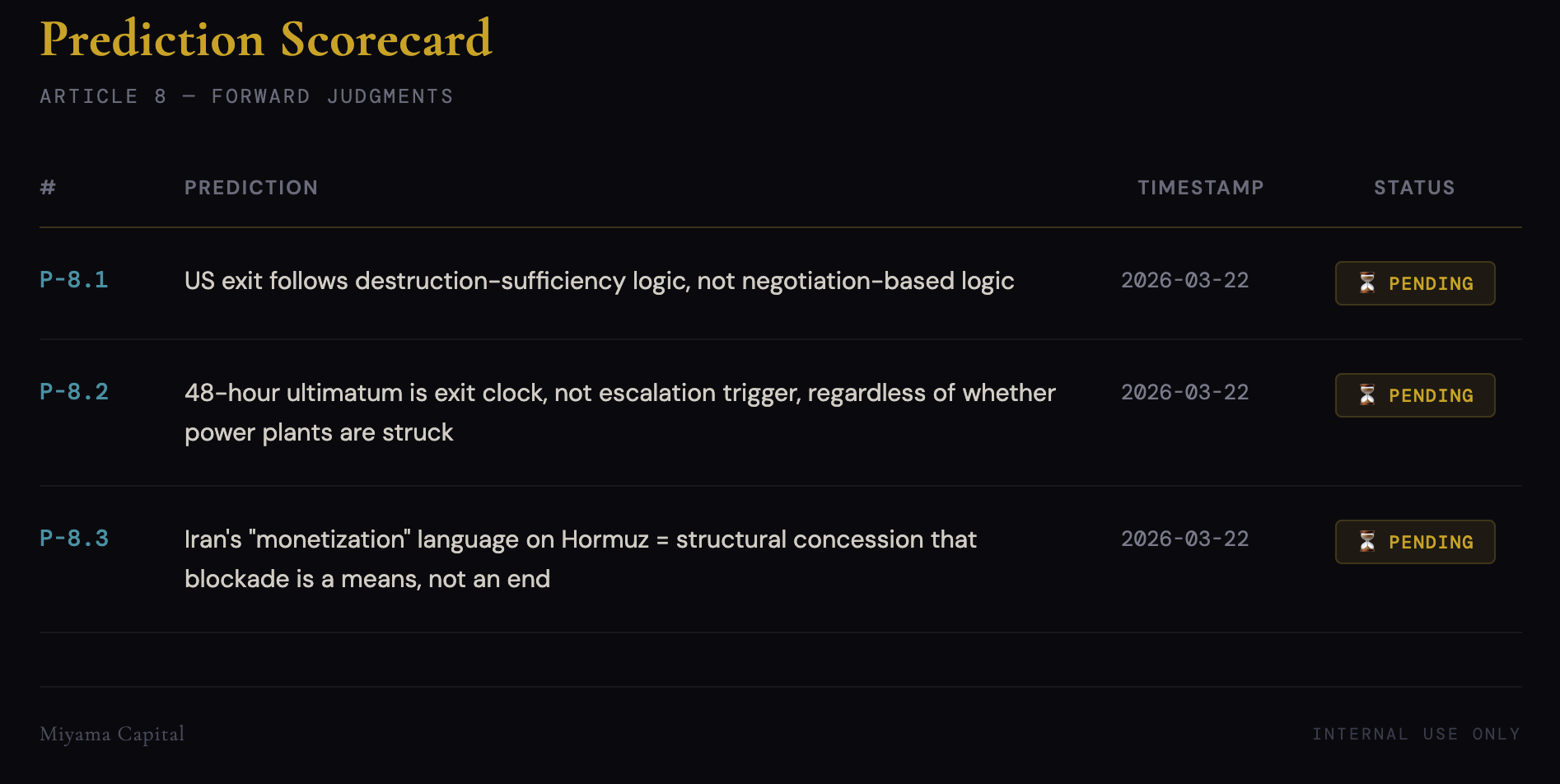
The 48-hour ultimatum is the external message, the last item on a destruction checklist. The operational logic: destroy enough of Iran’s military infrastructure to declare victory, then leave. Whether the power plants get hit determines the completeness of that checklist. The direction stays the same either way.
A third signal has gone largely unnoticed. On the same day as the “winding down” post, the White House lifted maritime sanctions on Iranian crude exports (reported across Reuters, CNN, and AP on 2026-03-20). If the strategic intent were prolonged maximum pressure, you tighten the sanctions noose. You do not loosen it. Removing oil sanctions while threatening power plants is incoherent under an escalation framework. Under an exit framework, it is entirely consistent: pre-building the economic normalization path that makes departure politically viable. Off-ramp construction, running in parallel with the final military checkpoint.
The 48-hour clock functions as an exit timer. Deadlines signal finish lines.
What “Monetization” Tells You
The single most important word from this weekend: monetization.
CNN sources (2026-03-22) report that Tehran is advancing plans to “monetize” its control of the Strait of Hormuz. Iranian military officials simultaneously announced that a strike on power plants would trigger “indefinite, complete blockade” of the strait.
These two statements contradict each other.
If your strategic posture is “blockade forever, no matter what,” you do not use the word “monetize.” Monetization implies a price, and a price implies a transaction with an end state. The word choice reveals the internal calculus: Iran’s remaining decision-makers are treating Hormuz as a tradable asset, not a final stand.
This directly validates the framework from Article 7 (”The Hormuz Illusion”). The blockade threat is a bargaining chip. The question Tehran is answering internally: what can we extract from Hormuz leverage before that leverage expires?
Hormuz leverage is a depreciating asset. Every week the US draws down military presence, the credible threat window narrows. Alternative shipping routes, strategic reserve releases, LNG rerouting agreements: each one erodes Iran’s leverage further. A rational actor holding a depreciating asset sells before it reaches zero. The “monetization” language suggests Tehran has begun that process.
Meanwhile, Iranian missiles struck Dimona and Arad over the weekend (source: Al Jazeera, 2026-03-22), injuring nearly 100 people. Dimona sits adjacent to Israel’s nuclear research center. Netanyahu called it “a very difficult night in the fight for our future.” Severe strikes, yes. But severity and strategic rationality coexist here. Iran demonstrates capability (hitting targets near Dimona) while signaling willingness to deal (monetizing Hormuz). Parallel tracks: raise the perceived cost of continued conflict to improve exit terms.
The distinction that matters for pricing: irrational actors produce tail risk that cannot be modeled. Rational actors produce tail risk that can.
[Pre-publication update, March 22 evening] Hours after this memo was drafted, Iranian Foreign Minister Araghchi stated publicly that the Strait of Hormuz “is not closed,” attributing the halt in traffic to insurers’ risk assessments rather than Iranian policy. Iran’s representative to the International Maritime Organization said separately that the strait remains open to all except Tehran’s “enemies.” Within 24 hours, Iran’s own officials walked the position back from “indefinite full closure” to “not closed.” Iranian statements are eroding the blockade narrative in real time.
Scenario Map After the Deadline
Inventory the evidence chain from this weekend. Friday: “winding down” language. Saturday: 48-hour ultimatum. Same day: sanctions on Iranian crude lifted. Iran responds with “monetization” language on Hormuz while its missiles hit Israeli cities near nuclear facilities. CNN polling at 60% opposition, 92% demanding rapid conclusion. Congressional resistance to $200 billion in supplemental funding. And Bessent ruling out war taxes.
Each data point, read in isolation, supports a different headline. Read as a system, they converge on one structural conclusion: the US is building an exit, and both sides know it. The remaining question is choreography.
The 48-hour deadline creates three possible outcomes. All three point the same way. The probabilities and price ranges below are working assumptions for framework purposes, not price forecasts or trade instructions.
Scenario 1: Strike, declare victory, exit (base case, ~55% probability). Trump completes the destruction checklist, holds a press conference, begins withdrawal. Watch for “victory” or “accomplished” language on Truth Social within 24 hours of the strike, and whether allied nations begin taking over patrol duties. Hormuz risk reprices rapidly as the blockade leverage evaporates without US presence to react against. Brent could spike above $115 on the strike itself, then retrace to the $105-110 range within a week as the exit narrative takes hold. This is the fastest path to normalization and the cleanest for markets.
Scenario 2: Bluff, declare victory, exit (~30% probability). Trump decides existing damage is sufficient for a “mission accomplished” narrative and skips the final checkpoint. Watch for conditional language before the 48-hour deadline (”Iran has learned its lesson”) and accelerated diplomatic handoff to allies. Normalization happens faster, but a bluff weakens the credibility premium attached to future US military threats. Short-term volatility comes from narrative confusion, not fundamental deterioration.
Scenario 3: Partial strike plus simultaneous winding down (~15% probability). Some power infrastructure hit, but combined with public statements about drawing down operations. Oil stays elevated longer because the market cannot cleanly categorize the signal. Watch for the scale of any Iranian retaliation against Saudi or UAE targets (symbolic versus large-scale), any signs of US ground troop mobilization, and whether Trump’s team begins using “ground operation” language. If this scenario materializes, the exit timeline stretches from days to weeks, and short-term risk premiums climb further. This is the scenario where the framework may need recalibration on timing, though the directional thesis holds.
Across scenarios, the variable is speed. The direction is fixed.
Monday’s session will be pulled between two forces: exit narrative (structurally favorable for risk assets outside energy) versus 48-hour escalation risk (elevated short-term vol). The medium-term convergence across all scenarios is the more durable signal.
Invalidation Conditions
Four conditions invalidate the exit thesis.
1. Iran retaliates against Gulf state core infrastructure. A major strike on Saudi Aramco facilities or UAE ports would fundamentally change the game. It would pull Gulf states into the conflict as principals rather than bystanders, creating alliance obligations that make US withdrawal politically impossible. The exit clock resets to zero. Watch for any targeting beyond Israel; strikes on Gulf economic infrastructure are the clearest escalation signal available.
2. The US commits ground forces or announces extended occupation objectives. The current air campaign is structurally compatible with exit. Air campaigns have defined end points; ground operations create their own inertia. Any ground commitment, even “temporary” or “advisory,” signals a political calculus fundamentally different from what the polling data supports. This is the single most important variable to monitor in the next 72 hours.
3. A third-party actor opens a second front. If Hezbollah or the Houthis trigger a conflict that changes US domestic opinion from “end this quickly” to “we have no choice but to stay,” the exit thesis collapses. The 92% of Americans who want rapid conclusion would need to be presented with a threat so direct that the political calculus flips. This is the least likely but highest-impact invalidation condition.
4. The 48 hours expire with neither a strike nor any winding-down follow-through. If Trump lets the deadline pass without acting on the ultimatum and without advancing the exit narrative, the timeline assumption underlying this framework needs to be extended. The directional thesis (exit) may still hold, but the speed variable changes materially. This is the softest invalidation: it does not break the framework, but it forces recalibration.
Falsifiable conditions, timestamped. We record what we believe and what would prove us wrong.
Watch List
Five indicators to monitor over the coming week:
Trump’s post-strike rhetoric. Tone and keyword selection on Truth Social within 24 hours of any power plant strike. “Victory,” “accomplished,” and “coming home” language confirms the exit thesis. “Phase two” or “expanded objectives” language challenges it.
Hormuz actual transit status. Shipping data and AIS signals through the strait. Rhetoric is cheap; actual blockade execution is expensive and observable in real time.
Iranian retaliation against Saudi/UAE. Symbolic missile strikes (intercepted, low-damage) are noise. Large-scale strikes on Aramco facilities or Dubai/Abu Dhabi ports are a framework-breaking signal.
Congressional vote on the $200B supplemental. If the funding passes, the political constraint on extended operations loosens. If it stalls or fails, the exit clock accelerates.
Brent duration above $115. Time spent above $115 is a proxy for how long the market assigns meaningful probability to sustained conflict. A rapid retreat below $110 signals the market is pricing exit. Persistence above $115 beyond 5-7 trading days signals the market disagrees with this framework.
Prediction Scorecard
Allocator Decision Framework
Disclaimer: The following framework is presented for analytical purposes only. It does not constitute investment advice, a recommendation to buy or sell any security, or a solicitation of any kind. Miyama Capital is a proprietary investment vehicle and does not manage external capital.
Three ways books are likely positioned into the deadline.
Posture A: Hold through the noise. The directional thesis is supported by converging evidence. Short-term volatility reflects path uncertainty, not directional uncertainty. Exposure cost: if the tail case materializes, the drawdown runs deeper than current vol implies. This posture assumes a 2-to-3-week holding horizon and tolerance for elevated intraday swings.
Posture B: Trim into the deadline, re-load on confirmation. You are paying an insurance premium by giving up potential snap-back upside. Exposure cost: if the base case resolves quickly, you re-enter at worse levels. This posture fits books approaching a rebalancing window or running elevated leverage into the event.
Posture C: Flat, wait for data. Not wrong, but not free. If the exit narrative accelerates within 48 hours, you are underweight at the moment when conviction should be highest. This posture fits books already light on geopolitically sensitive names.
We are running Posture A. The structural evidence for exit is strong enough to hold through path uncertainty. That reflects our book; yours may call for a different posture.
For any path, three stress tests deserve immediate attention. First: how fast does the energy tail risk premium decay once exit becomes consensus? Brent at $112.19 implicitly prices sustained conflict or permanent Hormuz disruption. If the blockade is a bargaining chip, that premium is mispriced. Second: a bluff scenario (Scenario 2) creates a credibility discount on future US military threats that propagates far beyond the Middle East. Taiwan Strait pricing, South China Sea shipping insurance, NATO deterrence assumptions in Baltic equities all rely on “the US follows through.” Third: Scenario 3 produces the longest tail of ambiguity. Consumer discretionary and transport names with energy cost pass-through exposure remain vulnerable until physical drawdown is confirmed by logistics data, not press conferences.
The common thread: assume exit as the base case and ask “what does exit break in my portfolio?” If you are still building scenarios around prolonged US engagement, the evidence chain from this weekend suggests you are solving for the wrong variable.
Disclaimer
This article reflects my personal investment philosophy. It is not investment advice. Make your own informed decisions.
Miyama Capital manages proprietary capital only and does not solicit external investors.
This memo represents the author’s personal views on macroeconomic conditions, interest rate environments, and asset allocation as of the date of writing. It does not constitute a solicitation, recommendation, or guarantee regarding the purchase or sale of any security, fund, bond, or other financial instrument. Investing involves risk; bond prices, interest rates, foreign exchange rates, and economic/policy conditions may materially affect asset values. Scenarios and instruments discussed may become inapplicable as market conditions change. Readers who make investment decisions based on this memo do so at their own risk, and the author accepts no liability for any gains or losses arising from the use or citation of this material.
Kuan H. Wang Founder & CIO, Miyama Capital