
Key Takeaways:
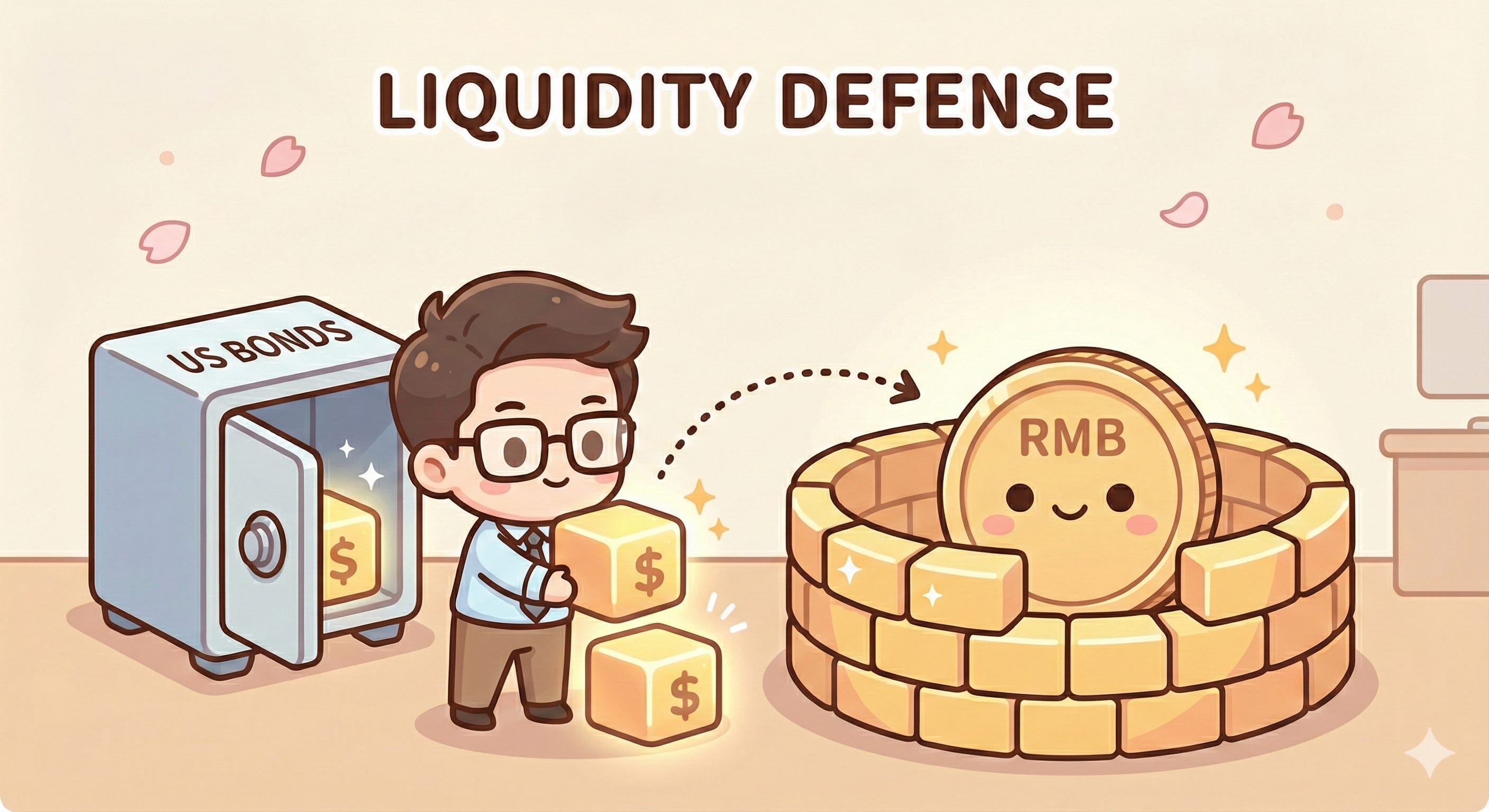
China’s drawdown of U.S. Treasuries is primarily a balance-sheet constraint problem, not a geopolitical weapon. The PBoC needs dollar cash to defend the yuan, and Treasuries are its most liquid dollar asset.
The real risk sits downstream: as the central bank absorbs dollar liquidity for FX defense, enterprises that earn in renminbi but owe in dollars face a tightening squeeze on refinancing.
The “de-Treasuries ≠ de-dollar” distinction matters. China’s total dollar-denominated assets have remained relatively stable even as Treasury holdings fell by nearly half from their 2013 peak.
Three variables determine whether this transmission chain accelerates or breaks: the Fed’s rate path, the DXY, and offshore dollar funding costs. Monitor all three before forming a view.
The parallel to 1997 Asian crisis mechanics is structural: currency depreciation and dollar-debt expansion, followed by liquidity drain. Capital controls slow the process but do not eliminate it.
The market is having the wrong debate.
On February 9, 2026, Bloomberg reported that Chinese regulators issued administrative guidance to large commercial banks, directing them to limit new purchases of U.S. Treasuries and to gradually reduce positions at banks with high exposure. The reaction was predictable: geopolitical retaliation, de-dollarization, weaponization. Social media ran with the narrative.
The decisive question is whether China needs to sell Treasuries. That single word changes the analytical frame entirely. A strategic seller controls timing and pace. A forced seller creates a transmission chain that ends somewhere far from the Treasury market itself: at the balance sheet of every Chinese enterprise that earns renminbi and owes dollars.
This article maps that transmission chain.
The Decade-Long Drawdown
As of November 2025, China held approximately $683 billion in U.S. Treasuries, the lowest level since 2009. The peak was around $1.3 trillion near 2013. That is roughly a 50% reduction over a decade. (Source: U.S. Treasury TIC report, November 2025 data, released January 15, 2026.)
The pace has not been uniform. Trade war escalation in 2018 triggered one acceleration. The Fed hiking cycle in 2022 triggered another. By the second half of 2025, the decline was nearly continuous on a monthly basis.
But here is the distinction that most commentary misses: selling Treasuries and exiting the dollar are structurally different operations.
China’s official foreign exchange reserves stood at $3.399 trillion as of January 2026, holding above $3.3 trillion for consecutive months, near the upper end of recent ranges. Gold reserves continued their accumulation trend, reaching 74.19 million troy ounces by end of January. (Source: SAFE foreign reserves announcement, February 7, 2026; CEIC.)
The more precise framing: China is de-Treasurifying, not de-dollarizing. Dollar assets have not disappeared. They have migrated from Treasuries toward agency debt, offshore custodial accounts, and other dollar-denominated instruments that are harder to attribute precisely in TIC data. Brad Setser’s analysis at the Council on Foreign Relations tracks this reallocation clearly. (Source: Brad Setser, “China’s Treasury Holdings Keep Falling, But Its Dollar Assets Haven’t,” CFR Follow the Money, January 2026.)
This distinction matters because it changes what you should be watching next.
Why “Weaponization” Is the Wrong Frame
The Central Bank Needs Dollar Cash
The primary driver is more likely the yuan exchange rate than geopolitics.
Over the past two years, the renminbi has faced sustained depreciation pressure against the dollar. When that pressure intensifies, the PBoC or state-owned banks need to intervene by deploying dollar reserves into the FX market. Treasuries are the most liquid dollar asset on the balance sheet.
Sell Treasuries. Convert to dollar cash. Deploy on the FX defense line.
Setser’s CFR analysis noted that by late 2025, state-owned banks had executed single-month dollar purchases in the hundreds-of-billions range, a scale difficult to explain as normal commercial activity. His characterization: “backdoor intervention” aimed at stabilizing the yuan. (Source: Setser, CFR Follow the Money, December 2025.)
What the market reads as offense is largely defense. The PBoC is not wielding Treasuries as a weapon against the U.S. It is burning them as ammunition to hold its own currency line.
Usable Reserves Are Smaller Than the Headline
$3.399 trillion sounds like a deep war chest. It is not.
The number that matters is the usable portion: reserves net of obligatory allocations, long-term policy commitments, and assets locked in illiquid positions. The freely deployable dollar pool is likely 60% to 70% of headline reserves.
That pool must simultaneously cover FX intervention and strategic imports (energy, semiconductors, food). On top of that, maturing foreign-currency debt service draws from the same finite reserve. Treasuries, being the most liquid slice, get drawn first.
De-dollarization Exists, But the Pace Is Slow
The strategic intent is real. BRICS local-currency settlement initiatives, CIPS expansion, central bank gold accumulation. These are long-duration positioning moves. But the timeline is far longer than social media implies.
Renminbi’s share of global payments oscillated between 2% and 4% by end of 2025, depending on whether intra-eurozone clearing is excluded. The dollar remained in the 47% to 50% range. (Source: SWIFT RMB Tracker, December 2025.) Reserve currency displacement requires deep capital markets, predictable rule of law, and substantially greater capital account openness. None of those conditions are close to being met.
The fair characterization: China’s Treasury drawdown is a compound of passive and active motives. The passive component, defending the exchange rate and preserving liquidity, is severely underpriced by the market.
The Transmission Mechanism
Most commentary stops mid-chain. The second half, where defaults happen, gets almost no attention.
The Chain
Fed holds rates at restrictive levels → dollar strengthens → renminbi faces depreciation pressure → PBoC sells Treasuries for dollar cash to defend the exchange rate → domestic usable dollar liquidity contracts → enterprise FX conversion becomes harder and more expensive → companies with outstanding dollar debt face refinancing difficulty → default risk rises.
Most market commentary stops at the first half of this chain (central bank sells Treasuries). Very few follow it to the second half (enterprise dollar-debt defaults).
Historical Parallel
The underlying structure is not unfamiliar. The 1997 Asian financial crisis followed a recognizably similar logic at the corporate level: domestic currency depreciates and dollar-denominated liabilities expand in local-currency terms. Liquidity then drains from the system. The critical difference: China has capital controls as a buffer and absolute reserve levels far exceeding 1997-era Thailand or Indonesia. This makes the current situation more like chronic attrition than acute shock. But the currency mismatch pressure itself is structurally identical.
A Simplified Illustration
The following is a stylized example to illustrate the dual pressure of exchange rate and interest rate shifts. It does not represent any specific company.
Consider a Chinese enterprise that borrowed $100 million in 2021 at a USD/CNY rate of approximately 6.4. In renminbi terms, the obligation was roughly ¥640 million.
By late 2025, the rate had moved to approximately 7.3. The same $100 million obligation now costs approximately ¥730 million to retire. Exchange rate movement alone expanded the debt burden by roughly 15%.
Layer on interest rates. Refinancing in 2021 might have priced at 2% to 3%. The current environment prices at 5% to 7%. Interest expense has more than doubled.
For any enterprise with renminbi revenue and dollar liabilities, this is a compounding squeeze.
The Crueler Version: Having Renminbi Does Not Mean You Can Buy Dollars
Even companies with sufficient renminbi on hand may not be able to convert.
When the central bank’s priority is exchange rate stability, dollar allocation is rationed. National-priority uses, strategic material imports, critical equipment procurement, state-sector obligations, get served first. Private enterprises queue behind them.
This is the crowding-out effect. State-level dollar demand compresses the FX conversion window available to private companies. You may have cash on your balance sheet. You may not be able to buy the dollars you need, or you can only buy them at significantly worse terms. At that point, default risk is no longer about willingness to pay. It is about ability to pay.
Who Is Exposed
Real estate developers. The offshore dollar-debt crisis in Chinese property is old news, but it is far from resolved. Default and restructuring rates on Chinese real estate offshore dollar bonds remain at extreme levels. Even developers previously considered to have stronger safety margins, like Vanke, have been forced to dispose of overseas assets (including GLP equity stakes) to manage maturity pressure. The question is not whether prices fall further. It is how long the remaining non-defaulted developers can survive under tightening dollar constraints.
LGFV offshore dollar bonds. Maturing offshore dollar bonds from local government financing vehicles are projected to decline in 2026 versus the prior year (CSPI Ratings estimates approximately $3.5 billion in scale), but refinancing conditions remain severe. The market has long assumed implicit local government guarantees. Under fiscal strain, the credibility of that implicit guarantee is eroding. Refinancing costs cluster in the 5% to 7% range, uncomfortable for platforms with thin cash flows. Fitch has flagged narrowing funding channels as adding to LGFV liquidity pressure.
Capital-intensive industries. Airlines, infrastructure equipment manufacturers, and ocean shipping share a common exposure: equipment procurement, leasing, and energy settlement are heavily dollar-denominated. When FX conversion costs rise 10% to 15%, single-year financial costs can amplify to levels that are difficult to absorb. Currency mismatch means your operating business can be performing well, but if your liability currency diverges from your revenue currency, you sit at the tail end of the risk distribution.
Scenario Framework
The following thresholds and ranges are illustrative values for framework purposes. Actual interpretation requires adjustment based on prevailing dollar volatility, policy cadence, and funding costs at the time of assessment. These are heuristic weights for attention allocation, not probabilistic forecasts or point predictions.
Scenario A (weight: ~40%). The Fed initiates rate cuts in the first half of 2026 and the dollar index retreats meaningfully (approximately 8%). Observation points: fed funds rate path pricing, DXY, offshore dollar funding costs. Operating implication: downweight the “central bank forced to burn dollar reserves” thesis; reduce the attention allocation to enterprise dollar-liquidity stress.
Scenario B (weight: ~35%). The more ambiguous middle path. The PBoC has a deep toolkit for managing exchange rate volatility within a controlled band, roughly 6.9 to 7.1, through mid-price fixing, countercyclical adjustment factors, and direct offshore market operations. If this holds, the Treasury-to-cash conversion pace slows. But slower does not mean stopped. Watch the mid-price versus CNH deviation and cross-currency basis spreads for early signals. The operating implication: tail-risk dollar constraints on enterprises remain in play even if the headline FX story looks manageable.
Scenario C (weight: ~25%). China deploys fiscal stimulus exceeding market expectations (illustrative: special government bonds exceeding ¥3 trillion) and domestic demand recovers. Observation points: fiscal deployment cadence, credit expansion, enterprise cash flow improvement signals. Operating implication: enterprise-level pressure eases, but currency mismatch as a structural vulnerability is not resolved.
These scenarios are not mutually exclusive. Partial elements of multiple scenarios can materialize simultaneously. The weights are tools for distributing analytical attention, not bets on outcomes. The point is not to predict the right script. It is to keep your framework updatable as the indicators move.
Cross-Asset Stress Points
Where does the pressure surface first? Following the transmission logic downstream:
Asia high-yield dollar bonds (particularly Chinese offshore). This is the front line. Rising refinancing costs plus FX conversion difficulty put widening pressure on credit spreads. Watch iTraxx Asia ex-Japan HY and individual issuer CDS levels.
The dollar index itself is both cause and consequence. If DXY remains elevated, the transmission chain does not self-correct. If the Fed pivots dovish and the dollar weakens, the transmission weakens materially. This is the single most important variable in the framework.
Renminbi-denominated assets (A-shares, HK-listed China exposure) face indirect pressure. Not because fundamentals deteriorate directly, but because exchange rate expectations and capital flow dynamics reduce foreign allocators’ willingness to maintain exposure.
The U.S. Treasury curve may paradoxically benefit. If China rotates out of Treasuries and into shorter-duration or agency debt, long-end selling pressure could be less than the market expects. However, if PBoC liquidation concentrates in intermediate maturities, that segment of the curve would feel it first.
Commodities. Energy imports are inelastic dollar-denominated demand. FX pressure amplifies import costs, but the direct transmission to international crude prices is limited.
These are not directional trade recommendations. They are a framework-level ordering of stress points. Actual outcomes depend on prevailing market liquidity and investor positioning at the time.
Back to the Framework
From Miyama’s perspective, the current environment looks more like a “dollar liquidity contraction” overlaid with “Asian deleveraging” combination.
The signature features of this regime: the Fed holding rates at restrictive levels, the dollar biased strong, Asian foreign-currency debt pressure accumulating. Historical analogs with similar characteristics include 1997, 2013, and 2018. Duration varied each time, but the common thread is that pressure release tends to be nonlinear. It is gradual until a threshold, then it accelerates. EM credit spreads in 2018 behaved exactly this way: months of slow grind, then a Q3 blowout.
The dollar is the anchor variable. Track DXY first, then map the Fed’s policy direction and offshore funding costs as second-order drivers. The combination determines whether the regime gradually eases or continues to tighten.
Reading China’s Treasury sell-off correctly requires looking past the U.S.-China headline narrative. Track the yuan exchange rate, the usable structure of foreign exchange reserves, and enterprise-level dollar debt pressure. The interaction of these three variables is the real story.
How much of your portfolio is being slowly eroded by the “central bank burns Treasuries to defend the exchange rate → enterprise dollar shortage” transmission chain? Have you built sufficient firewall around that exposure?
Options and Costs
Path A: Survival first
Prioritize identifying and reducing structural exposure to the “renminbi revenue, dollar liability” mismatch, especially positions in Chinese offshore high-yield dollar bonds and names heavily dependent on offshore dollar refinancing. The cost: if a policy reversal arrives (rapid Fed cuts or aggressive Chinese stimulus), you miss a portion of the recovery. Suited for mandates with strict risk constraints and zero tolerance for tail outcomes.
Path B: Stay in, but build firewalls
Stop treating the directional call as the decisive factor. Treat the constraint as the core variable instead. Retain only exposures that can survive a dollar contraction: shorter duration, stronger dollar revenue coverage, higher credit quality. Make “refinancing viability” the first-order filter. The cost: you may sacrifice some carry or nominal yield. Suited for mandates that require continuous allocation but can adjust dynamically.
Path C: Bet on the transmission breaking
Weight toward “Fed pivot” or “China policy surprise” scripts, maintaining or increasing risk-asset exposure to capture the repair trade. The cost: if you are wrong, tail losses arrive quickly, and the market may not offer you orderly liquidity to exit. Suited for mandates with high risk tolerance and explicit stop-loss or de-risking rules already in place.
No path is unconditionally correct. The choice depends on your time horizon, capacity for attention, and risk tolerance.
(Disclaimer Option B)
Disclaimer
This article reflects my personal investment philosophy. It is not investment advice. Make your own informed decisions.
Miyama Capital manages proprietary capital only and does not solicit external investors.
Kuan, Founder & CIO Miyama Capital