

Executive Summary
Reframe: “Buy, Borrow, Die” isn’t a tax hack—it’s balance sheet engineering to keep long-duration assets compounding while sourcing liquidity via controlled leverage (CFO mindset, not a trade).
Core intuition: Wealth can compound exponentially, while lifetime spending is typically sub-linear and capped. If compounding persists, you can meet cash needs without systematically realizing gains.
True risk variable: The strategy lives or dies by financing survivability, not return forecasts. The key control is LTV (loan-to-value)—because drawdowns + higher rates can trigger margin pressure and forced selling.
Implementation principles: Use durable, liquid collateral (broad index exposure over single-name concentration), delay borrowing until you’ve built an equity cushion, and treat leverage as a governed utility, not a maximization target.
Governance rulebook: Define LTV bands + buffers (e.g., “normal / caution / delever”) and maintain a 12–24 month liquidity reserve to reduce the probability of forced selling across stress regimes.
Most people explain Buy, Borrow, Die (BBD) as a rich-person trick: never sell appreciated stock, borrow against it, and let heirs inherit with a stepped-up basis.
That framing is incomplete.
In my portfolio notes, I treat BBD as a lifetime balance sheet strategy—a way to keep compounding uninterrupted, make withdrawals controllable, and reduce the probability of being forced to sell during stress.
This is not about finding a “best” strategy. It’s about turning a vague lifestyle idea into a policy framework: what variables matter, what can break, and what rules keep the system survivable.
A pre-read warning: know your tax status (US Person)
BBD is “portable” in concept, but the implementation is extremely tax-status dependent. If you’re a US taxpayer, the main economic motivation is often the deferral of realized capital gains and the potential step-up at death.
One specific landmine worth flagging: for US Persons, “tax-optimizing” by holding certain non-US funds/ETFs can create PFIC complexity and punitive outcomes (often requiring Form 8621 reporting).
The core idea: manage your life like a CFO manages a company
BBD is not a portfolio tactic. It’s a balance sheet operating model:
Assets: what you own, and how you maintain durable long-term exposure
Liabilities: when you borrow, how much, for how long, and whether financing is renewable
Cash flow waterfall: dividends, income, borrowing capacity, contingency liquidity
Risk rules: LTV caps, when to stop borrowing, when to delever, how much cash buffer to keep
Tax timing: turning “realized income” into a controllable variable instead of an emergency reaction
The key reframing is simple: the enemy is not drawdown. The enemy is forced selling—usually caused by fragile financing structure, not by volatility itself.
The math that makes BBD viable: exponential assets vs sub-linear spending
BBD works (when it works) because it’s built on a structural divergence between two curves:
Assets compound exponentially
Spending grows sub-linearly and hits practical ceilings
Even wealthy consumption has “price caps”:
Housing (primary residence): You can buy a nicer home, but once you’re in a prime neighborhood with strong security/privacy, marginal utility drops fast. Owning a $8–15M primary often “solves” the problem; going from $15M → $40M is mostly aesthetics, taxes, staffing, and complexity—not a proportional lifestyle upgrade.
Travel: Business/first-class becomes the default, and then you hit a time/route ceiling. You can’t fly “more than always.” Private jet hours can scale, but most people settle into a stable cadence (e.g., a few international trips + a handful of domestic legs), not an ever-accelerating schedule.
Cars / transportation: Once you’re in the “reliable + comfortable + safe” tier (e.g., a high-end SUV + a sports car), additional vehicles add storage/maintenance/insurance friction. The category saturates.
Dining and entertainment: There’s a hard bandwidth limit: you can only eat so many Michelin meals per week before it stops being pleasurable. Same for concerts, shows, and events.
Education for kids: Private school + top-tier enrichment has a ceiling. Even “buying more” can backfire (over-scheduling, pressure). Spending tends to stabilize after a certain quality threshold.
Once your annual asset growth persistently exceeds your annual spending ceiling, you hit something I call financial escape velocity—your wealth can keep expanding even while you draw liquidity from it.
This is not prediction. It’s just curve management.
The real risk variable: LTV and financing renewability
The operating equation is:
LTV = cumulative debt (spending + interest) / total asset value
In the framework, the long-run intuition is:
the denominator can expand aggressively via compounding,
while the numerator grows slower because spending has ceilings,
so LTV can stabilize or even fall—but not immediately.
The psychologically hard part is that LTV often has a three-stage path:
early years: LTV may rise (discipline required)
middle years: LTV plateaus
later years: LTV can decline naturally, even with continued borrowing
This is why most “BBD content” fails: people talk about the asset story and skip the liability survivability story.
The risk-control section most people skip: simulation, not storytelling
If BBD is balance sheet engineering, then you don’t “argue” it—you stress test it.
The right way to discuss Borrow is not “rates are low” or “my broker offers X.” It’s:
What happens if rates spike and stay elevated?
What happens if equity drops 30–50% early in the plan?
What happens if volatility clusters (sideways + violent swings)?
What if you have a multi-year period where returns are flat, but interest accrues?
A practical simulation framework (conceptual)
You model a few regimes and track the LTV trajectory:
Base case: normal growth, normal rates
Drawdown shock: early -30% / -50% with slow recovery
Rates shock: funding costs +300–500 bps for multiple years
Combo stress: drawdown + rates + volatility clustering
Then you evaluate:
max LTV reached
how quickly buffers are consumed
probability of hitting forced-delever triggers
how much “time” you buy with hedges and cash buffers
The output you want isn’t a precise forecast. It’s a go/no-go map: “Under which regimes does this system break?”
That’s the missing chart in most BBD discourse: not performance curves, but survivability curves.
The LTV Endgame and Risk Control
Using the math model above, we can re-examine the long-run path of LTV (loan-to-value):
LTV = cumulative debt (living expenses + interest) / total asset value
Denominator (assets): thanks to compounding, the asset base becomes very large after ~20 years.
Numerator (debt): even if you borrow each year to fund your life—and even upgrade your lifestyle (a bigger house, business-class flights)—the amount you borrow remains small relative to the growth of the asset base, due to the “price ceiling” effect discussed earlier.
This widening divergence between wealth growth and consumption growth can be visualized in the chart below.
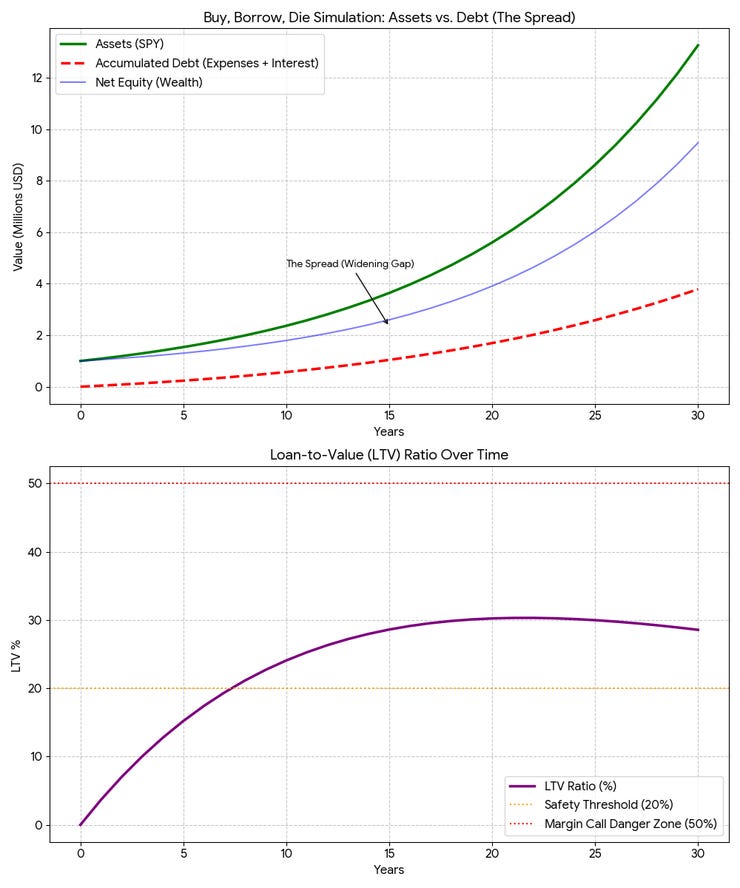
This is a 30-year simulation with the following parameters:
Starting principal: $1,000,000 (SPY)
Initial annual spending: $40,000 (the “4% rule”)
Spending inflation: 3% per year
SPY annualized return: 9% (conservative assumption)
Borrowing rate (Box/Margin): 5% (conservative assumption, assuming a higher-rate environment)
[Top chart: Divergence between asset and liability growth]
The green line (assets) rises exponentially. The red line (liabilities) also grows—because each year you borrow new living expenses and interest capitalizes into the balance—but it grows far more slowly than the assets. The large gap between the two is your net worth, expanding from $1 million to nearly $9.5 million.
[Bottom chart: LTV trajectory (the critical risk points)]
Focus on the purple line. LTV does not decline from day one. Instead, it typically moves through three stages:
The Pain Phase (years 0–10): LTV rises slowly. You need the discipline to watch debt accumulate while keeping spending tightly controlled.
The Inflection Phase (years 10–20): LTV stops rising. Psychological pressure begins to ease.
The Harvest Phase (after year 20): LTV begins to decline naturally. You can spend more freely—even accelerate borrowing—while LTV remains stable.
I use a 5% borrowing rate to show that even under an unfavorable scenario, the strategy can still work. In reality, outcomes will vary depending on how low a borrowing rate you can obtain.
A hidden advantage: structural discipline
There’s a behavioral edge here that rarely gets discussed.
When most of your wealth is locked in long-duration exposure and your lifestyle liquidity is sourced through borrowing, you’re forced to treat spending as an explicit LTV decision rather than an impulse. The structure itself becomes a governor.
In other words: your balance sheet enforces self-control.
Advanced layer 1: Active hedging (not for returns— for survivability)
If you borrow against volatile collateral, the job of hedging is not “alpha.” It’s reducing tail risk around financing constraints.
A useful mental model:
Your portfolio can survive drawdowns.
Your financing terms might not.
So hedging is about keeping the system away from “margin spiral” territory: drawdown → higher LTV → lender pressure → forced selling → worse drawdown.
What “active hedging” means in a BBD context
Hedges are state-dependent, not always-on
You hedge more when LTV is creeping up or volatility regime shifts
You hedge to buy time, not to “win”
Tools can include (conceptually): protective puts, collars, dynamic de-risking rules, or volatility overlays. The correct tool is less important than the engineering objective:
Prevent a temporary market shock from becoming a permanent balance sheet impairment.
Advanced layer 2: Tax-loss harvesting (TLH) as an embedded stabilizer
Public BBD narratives often over-index on “never sell.” That’s too blunt.
A more robust approach treats tax as a control surface:
In down markets, you can realize losses via tax-loss harvesting (where permitted)
You maintain exposure through carefully managed substitutions (respecting wash-sale rules, fund similarity, and holding-period considerations)
You use harvested losses to offset future gains, reduce taxable income in certain cases, and increase flexibility in later rebalancing
TLH is not about beating the market. It’s about improving after-tax system resilience—especially when you need to rebalance or delever without taking a full tax hit.
Think of TLH as turning drawdowns into a form of “tax inventory” that you can deploy later.
Governance: don’t maximize leverage—engineer fault tolerance
A robust BBD policy is boring on purpose.
Example governance rulebook (illustrative bands):
0–20% LTV (normal): borrowing allowed for planned liquidity; no leverage optimization
20–25% (caution): stop adding leverage; increase buffer; consider hedging overlays
25–30% (risk control): delever actions begin; prioritize multi-quarter liquidity runway
And the most underappreciated parameter:
A 12–24 month cash (or near-cash) buffer is not “cash drag.”
It’s the insurance premium against forced selling.
Implementation: what to own, and how to finance
Why broad index exposure (SPY / QQQ)?
The largest lifetime risk isn’t a crash. It’s terminal impairment—the asset going to zero.
If you intend to “Buy & Borrow” for decades, concentrated single-name risk is a single point of failure. Broad, liquid index ETFs reduce that failure mode and typically offer better collateral treatment.
Borrowing tools (layered by complexity)
At a high level, financing can be layered:
Margin loans (simple, flexible—but margin-call sensitive)
Box spreads (potentially cheaper, but execution/tax/broker-rule sensitive)
Real-estate cash-out refi (often the most psychologically stable form of leverage if structured conservatively)
Deep ITM LEAPS as “embedded leverage” with no margin call (but with theta/roll risk)
At larger scales, there are institutional variants (Lombard lending, TRS, PVF, exchange funds), but those are beyond a public memo.
Risk control: treat “Borrow” as a delayed phase, not a simultaneous switch
A common mistake is to run BBD as if it’s one continuous action: buy assets and borrow immediately.
I separate it into two phases:
Buy (deployment): build durable exposure during windows where risk premium is elevated
Borrow (liquidity extraction): start later, at lower LTV, once you have a meaningful buffer
Case Study | 2020 as a Deployment Template
A. Buying: Window-Based Deployment (Don’t Try to Catch the Bottom)
A window-based deployment strategy is not about buying the absolute low. It is about deploying capital during periods when the risk premium has expanded dramatically. Because no one knows where the true bottom is, we don’t guess. Instead, we build the position over a defined time window.
“Risk premium expansion,” in plain English, is when the market is in extreme fear—prices are being sold down irrationally, and assets are clearly mispriced. In those moments, expected long-term returns are typically the highest. Using the 2020 COVID “circuit breaker” period as an example, the deployment logic looks like this:
Anchor the core holdings
Start by choosing the assets you’re willing to own for life—think SPY/QQQ, not a single stock that could go to zero. As long as US productive capacity and institutional strength remain intact, broad indices have historically recovered given enough time.Deploy within a window (not a single all-in bet)
The goal isn’t “buy the bottom.” The goal is to buy within a relatively cheap regime. You might set an initial plan like a 12–24 month deployment window, then dynamically adjust the pace based on how severe market stress becomes.The Acceleration Rule (the execution edge)
This is the operational key. It’s not simple dollar-cost averaging. It’s pyramiding—increasing deployment intensity as drawdowns deepen:Normal market conditions: buy at the baseline pace (e.g., 1 unit of capital per month)
10–15% drawdown (fear building): accelerate (e.g., 2 units per month)
20–30% drawdown (crash regime): deploy aggressively (e.g., 4 units per month, potentially drawing from your liquidity buffer)
Why does this matter for BBD?
Because the cheaper you build the position during the Buy phase, the lower your long-term cost basis. A lower cost basis is not about bragging rights—it’s about future safety margin. When you eventually enter the Borrow phase, a stronger equity cushion means you can borrow with far less LTV fragility.
Every dollar you were able to deploy cheaply in 2020 is, in effect, a moat built for 2030—so you can sleep at night without worrying about an LTV blow-up.
B. Borrowing: Start Late—Don’t Borrow Before You’ve Built the Cushion
The essence of “Borrow” is that you are shifting risk from market volatility to financing sustainability. That means you should not begin borrowing until you have:
sufficient embedded capital gains as a buffer, and
evidence that the macro regime is moving from crisis toward repair
If you start borrowing during peak volatility—like early 2020—then a double-dip scenario can cause LTV to spike rapidly, forcing deleveraging at the worst possible time.
In other words: Borrow should be lagged.
You don’t borrow “while you’re building the floor.” You borrow after the floor is built—and after you’ve raised the ceiling.
A three-tier LTV governance policy
A concrete set of rules (example bands):
0–20% (normal): spending/working capital allowed, no leverage-maximizing
20–25% (caution): stop adding leverage; service interest via cash flow where possible
25–30% (risk control): delever and deploy a 12–24 month cash buffer to avoid forced selling in bad tape
These are not “optimal” numbers. They are fault-tolerance parameters.
Closing: time is the biggest lever, but respect the first decade
BBD is like rolling a snowball: later-stage compounding can dominate. But the first 10–20 years are where the strategy is most fragile—rates, drawdowns, and rising LTV can collide.
My simplified definition:
Buy: build long-duration, lifetime-hold exposure
Borrow: start late, keep LTV low, hold buffers—make forced selling a low-probability event
Die: treat estate and tax pathway as part of the design, not a last-minute patch
Most conversations about Buy, Borrow, Die (BBD) stop at the asset side: Which ETF? How to add? How to rebalance? That’s necessary—but it’s not the strategy.
The real BBD is not “a portfolio.” It’s a balance sheet operating system. If you only talk about Buy, treat Borrow as a footnote, and postpone Die to “later,” you end up mislabeling BBD as a leverage-up tactic. It can look sophisticated on paper, but in practice it’s often more fragile than a simpler plan.
Disclaimer
This memo is for educational discussion and internal-style research notes. It is not investment, legal, or tax advice. Rules and tax regimes change, and outcomes depend on individual facts and jurisdiction. Consult qualified professionals before implementing leverage or tax planning.
Kuan, Founder of Miyama Capital