
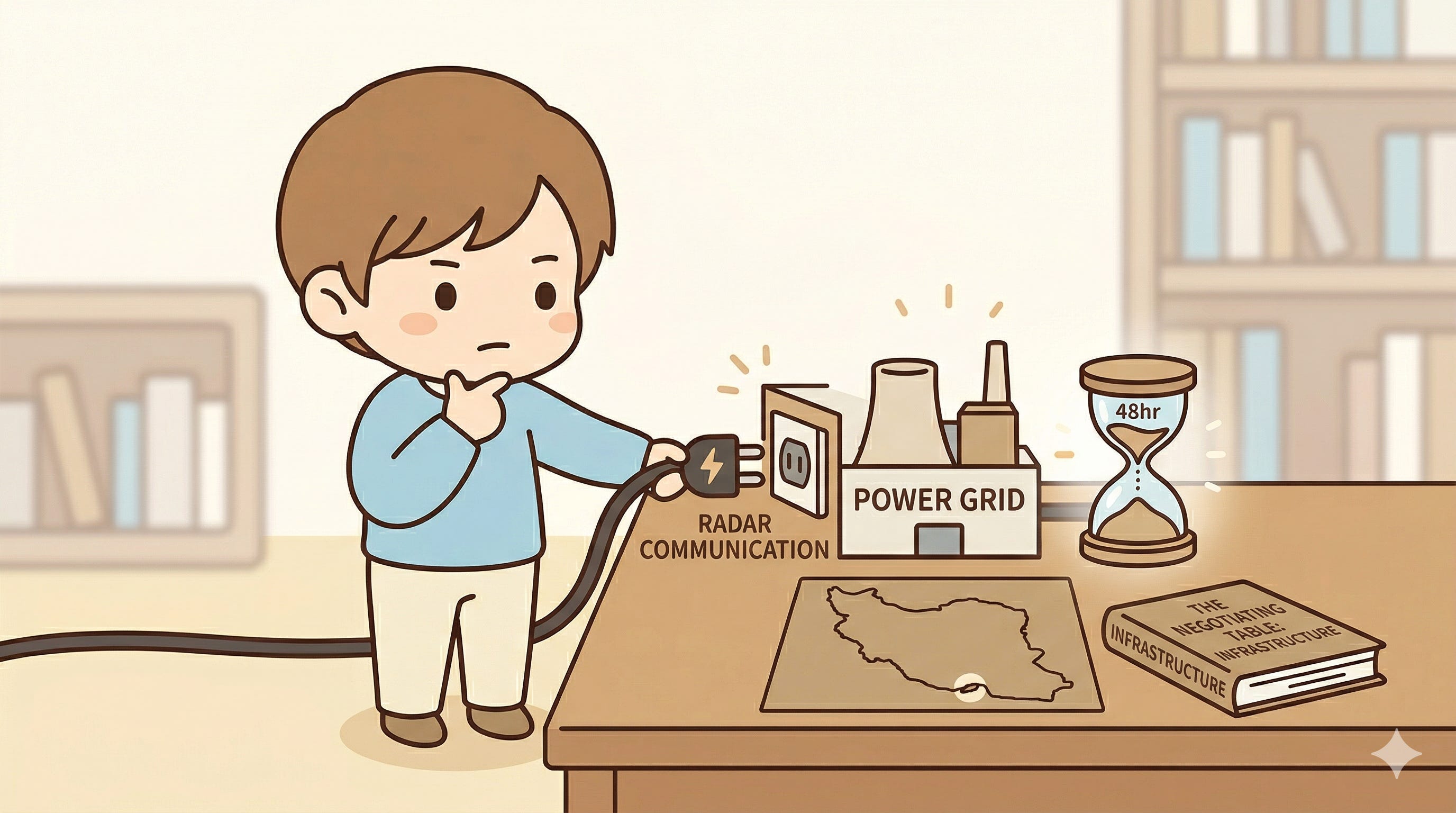
Miyama Capital | Geopolitical Macro Series Day 36 (2026-04-04)
Every analyst covering the Iran conflict is asking when the war ends. Wrong question.
The right question: when does Iran lose the ability to fight, and does it matter whether they agree to stop?
This is Day 36 of Miyama Capital’s real-time coverage of the Iran war. Here is what the last 48 hours have changed, and what April 6 means for your portfolio.
The Coercion Ladder
Before any analysis, look at the sequence. The escalation pattern tells you more than any single headline.
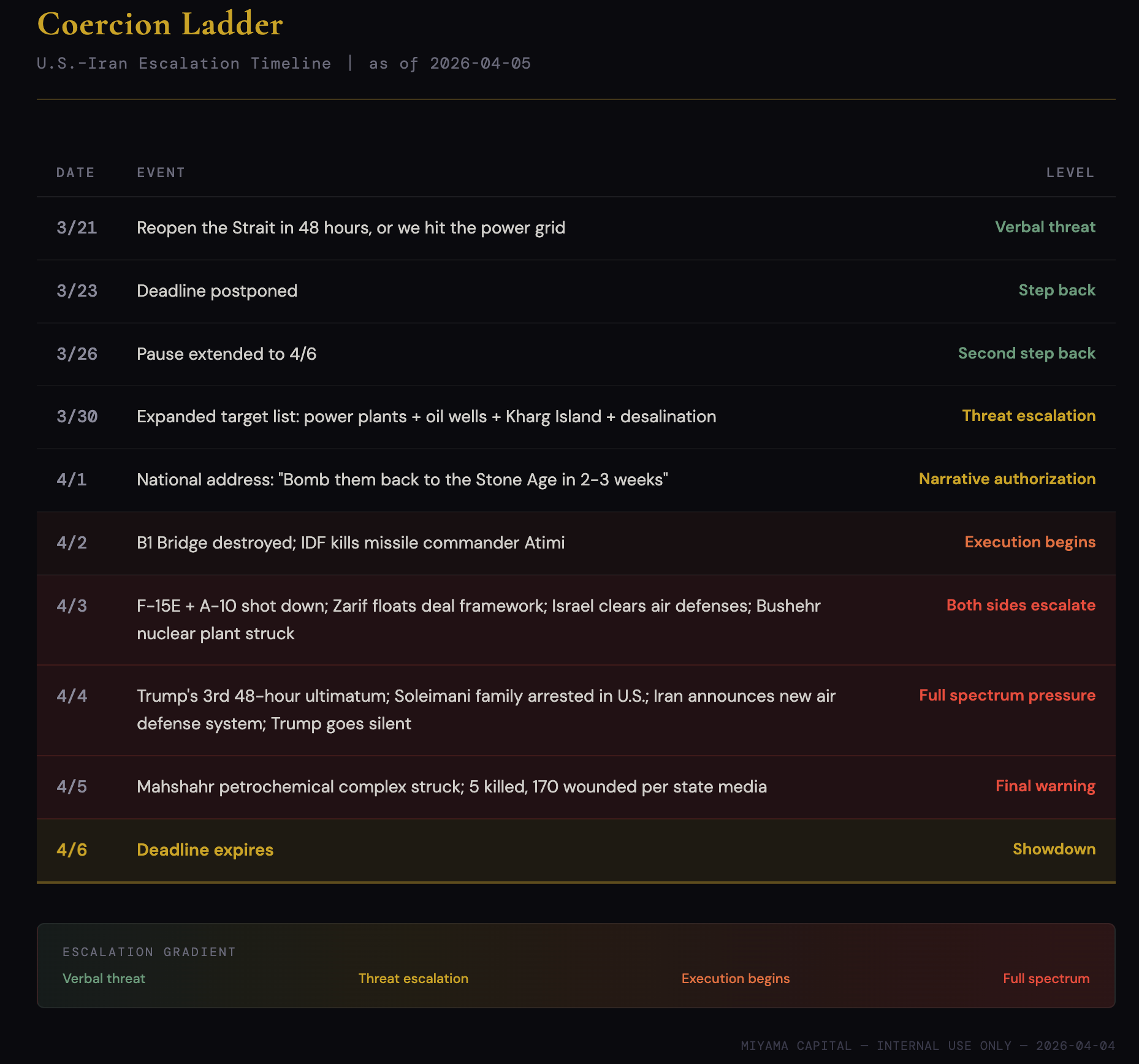
Three ultimatums. Each one heavier than the last. The first postponement was covered by “very productive conversations.” The second by “Iran gave us ships.” A third postponement with no military action would collapse Trump’s deterrence credibility, not just with Iran but with allies and markets simultaneously.
Notice the escalation grammar: transportation infrastructure (bridge) to military infrastructure (air defenses) to economic infrastructure (petrochemical complex) to civilian infrastructure (power grid). Each step moves toward a higher pain threshold. The Mahshahr strike on April 5, 24 hours before deadline expiry, is the final signal before execution. The pattern is identical to April 1 (national address) followed by April 2 (bridge destroyed). Signal first, then action.
The F-15 Changed the Speed, Not the Direction
On April 3, the U.S. lost two aircraft in a single day. An F-15E Strike Eagle took a hit to its tail section, most likely from a mobile short-range infrared SAM fired from a concealed mountain position rather than an S-300 class system. An A-10 was hit the same day. Two Black Hawk search-and-rescue helicopters also took fire.
Three days earlier, Trump was saying “they have no air defenses, they have nothing.” Three days later, an F-15 and an A-10 are down over Iranian airspace and a pilot is missing.
Bloomberg’s analysis stops at “invincibility pierced, Trump weakened.” Their logic: pressure leads to retreat.
My judgment is the opposite.
A cornered Trump does not become cautious. He becomes aggressive. Pressure does not change direction; it changes speed. The F-15 shoot-down, GOP anxiety about midterm elections, approval rating cracks: these are accelerants, not brakes. Trump’s political calculus is clear. Dragging this out only makes it worse. His only exit is a fast, violent conclusion that buries the bad news under a decisive victory headline.
I expect April 6 to be harder, not softer.
The Pilot Is the Biggest Wildcard
As of filing (late evening ET, April 4), the pilot has been missing for over 30 hours.
The probability structure has shifted. If the pilot were alive and mobile, U.S. forces should have located him by now. Downed pilots carry PRC-112 survival radio beacons. Satellites and drones monitor those frequencies around the clock. Last night was the optimal rescue window: darkness, night-vision advantage. If the beacon had transmitted, the location would have been fixed within hours.
Thirty hours without contact means the beacon is likely damaged, or the pilot can no longer operate it.
Iran has not found the pilot either. If they had captured a live American aviator, the propaganda value would be too great to resist broadcasting immediately.
The pilot’s final status determines subsequent tempo. Confirmed killed in action: strike intensity on power infrastructure increases, search-and-rescue pressure lifts, and the overall convergence timeline compresses. Confirmed rescued: cleanest scenario, power grid strikes proceed as planned. Confirmed captured: all probabilities reset, the conflict transforms from limited strikes to a hostage crisis, and special operations probability jumps above 60%.
But regardless of the pilot’s fate, the logic for striking power infrastructure on April 6 holds. The F-15 shoot-down actually reinforces the military necessity of cutting electricity. Iran’s air defenses still have capability. The most efficient countermeasure is killing the power so their radars cannot activate.
The Five-Layer Infrastructure Trap
This is the section that matters most for understanding what April 6 actually looks like operationally.
The past week’s military operations look like a series of disconnected events if you read the headlines one at a time. Pull back and the pattern becomes visible. This is a designed, layered operational doctrine.
First, cut the supply lines. The B1 Bridge was destroyed on April 2, severing southwestern Iran’s most critical overland logistics route. IRGC air defense missiles, fuel, and spare parts now travel by alternate roads at double the time and cost.
Second, force movement into the open. With the bridge gone, supply convoys must reroute. Rerouting means exposure to satellite and drone surveillance. Stay still and supplies do not arrive. Move and your coordinates get locked.
The third layer is what makes this architecture lethal. Wait for Iran to send combat engineers to repair the bridge, wait for them to concentrate equipment and personnel around the damaged site, then strike again. This does not merely destroy the bridge. It destroys the capacity to rebuild it.
Fourth, decapitate the command chain. On April 2, Israel killed missile commander Atimi in a precision strike on a command node. Without the commander, the missile batteries underneath are muscle without a brain.
The fifth layer is the master key. The first four layers strip the IRGC’s organized capability one piece at a time. The last layer pulls the plug. Without electricity, the integrated air defense network degrades into isolated units fighting alone. Radars cannot power up. Communications cut out. The command structure goes from a network to a collection of islands.
Stone Age is not rhetoric. It is a five-layer operational doctrine. It does not matter how the IRGC responds: dig in, disperse, retreat into tunnels. The outcome is the same. Capability goes to zero. The only variable is time.
And the F-15 shoot-down accelerated the timeline. Iranian air defenses firing is equivalent to broadcasting their coordinates. Israel revisited and cleared those positions within 24 hours. If they were willing to hit Bushehr, conventional power plants will not give them pause.
Seven Pressure Dimensions, All Simultaneous
As of late April 4, seven pressure vectors are operating at the same time, and each one reinforces the others.
Military strikes and infrastructure destruction have been continuous for 35 days. Bridge, air defenses, nuclear plant, petrochemical complex. IRGC ground capability shrinks every 24 hours. The five-layer infrastructure trap turns every attempt at repair and every act of retaliation into a new point of exposure.
Iran’s own retaliation is self-defeating. Striking Gulf state infrastructure (Kuwaiti refineries, UAE’s Habshan gas facility, desalination plants) produces the opposite of the intended political effect. Each strike pushes the Gulf states closer to the U.S. The GCC has already requested UN authorization for the use of force. The UAE is reportedly preparing to assist the U.S. in forcibly reopening the Strait. Every Iranian “retaliation” recruits allies for the other side. The announcement of a “new air defense system” follows the same logic: whether real or propaganda packaging, it gives Trump additional justification for hitting the power grid. The IRGC is now in a position where every action is wrong. Do nothing and capability erodes. Act and you accelerate your own political isolation and military exposure.
Financial strangulation is tightening. A U.S. court has ordered Iran to pay $53 billion in damages. Iranian overseas assets are nearly entirely frozen. The Strait toll booth was Iran’s last revenue source, and the Oman bypass route is now actively undercutting that model.
The domestic economy is buckling under rolling power instability, supply shortages, and currency depreciation. IRGC rank and file and their families bear the same pressure as everyone else.
Personal-level coercion is now explicit. The arrest of Soleimani’s family members in the United States is a signal aimed at IRGC senior leadership: your relatives are within our reach. Not just you on the battlefield. Your nieces, your grandchildren, the ones living comfortably in the West. Many IRGC senior leaders have family with assets and residency rights in Western countries. This is an open secret. The Soleimani arrest is the demonstration case.
Narrative authorization was completed on April 1 with the national address. If the F-15 pilot is confirmed killed, the script is already written: “the 14th martyr.” Retaliation narrative, prepackaged.
The reinforcement loop is clear. Military strikes worsen the economy. A worsening economy lowers the will to resist. Lower resistance makes military objectives easier to achieve. Iran’s retaliatory strikes alienate potential allies, which makes the next round of military strikes face less international friction. This is a compounding cycle, and it is accelerating every 24 hours.
Why Iran Will Not Accept a Deal Before April 6
This is the most important analytical correction in this assessment, and the section where my view diverges most sharply from the Western media consensus. In previous analysis, I assigned a 30-35% probability to Iranian softening. I am revising that down to 10-15%.
Four structural reasons.
The IRGC is not a rational actor in the conventional sense. Its survival is synonymous with the resistance narrative. Accepting a deal equals admitting resistance has failed, which equals the IRGC losing its reason to exist. For the IRGC’s institutional logic, national destruction is a lower cost than organizational dissolution. If they were rational in the way markets assume, the conflict would not have reached this point.
No one has the authority to say yes. Pezeshkian wants to negotiate but has no real power. Mojtaba is new to the role and effectively hostage to the IRGC’s agenda. Zarif published a specific deal framework on April 3 (enrichment downgrade, Chinese and Russian participation, mutual representative offices) but holds no government position. There is no single person who can sign on behalf of “Iran.”
Accepting a deal while being bombed is politically identical to surrender in Iranian political culture. Even if Zarif packages it as “declaring victory,” the IRGC will call him a traitor.
The F-15 shoot-down hardened the hawks. “We can still fight.” “Negotiating now wastes this victory.” State media is running the F-15 wreckage footage on a continuous loop.
My revised endgame logic: the conflict does not require Iran to “accept” anything. It requires Iran to lose the capacity to resist.
Power plants destroyed. Command structure collapses. The Strait blockade dissolves automatically because blockades require coordination, coordination requires communication, and communication requires electricity. Trump unilaterally declares mission accomplished. No Iranian signature required.
Zarif’s deal framework is for afterward. Not April 6. Mid-April or May, after the IRGC has spent two weeks in the dark and organized resistance has degraded into sporadic harassment. That is when Pezeshkian gets the political space to say “we have resisted enough; now we talk.”
The Strait Is Already Reopening
The Strait of Hormuz is not reopening like a switch. It is reopening like a gradient.
The physical bypass is operational. Two supertankers and one LNG carrier transited via the Oman bypass route, carrying approximately 4 million barrels of crude. They routed around the Qeshm-Larak island gap, bypassing Iranian checkpoints entirely, with zero transit through Iranian-controlled waters.
Commercial fleet follow-through is confirmed. CMA CGM (France), Mitsui O.S.K. Lines (Japan), and Philippine-flagged vessels have all transited successfully. The growth curve in transit volume is exponential, not linear. Every ship that passes safely is actuarial data for the next one.
I expect the inflection point in transit volume to come immediately after April 6. If the power grid is hit and IRGC coordination capability collapses, Iran’s Strait checkpoints degrade from systematic blockade to sporadic harassment. At that stage, insurance premiums drop rapidly and commercial fleets accelerate their return.
Qeshm Island: The Physical Key to the Strait
The F-15 went down near Qeshm Island, which is the geographic center of the entire conflict.
Qeshm is the largest island in the Persian Gulf: roughly 1,500 square kilometers, population approximately 150,000, located just 22 kilometers from Iran’s Bandar Abbas port. Beneath the island is an extensive tunnel network where the IRGC has concealed anti-ship missiles, mines, unmanned underwater vehicles, fast attack boats, and coastal defense installations. Iran has reportedly forced all Strait-transiting vessels through the narrow Khuran Channel between Qeshm and the mainland, turning the island into a physical chokepoint.
Controlling Qeshm means controlling the Strait. But the most likely scenario is not occupation. It is precision strikes that permanently disable the island’s military infrastructure. No allied nation is willing to co-occupy, the island has 150,000 civilians, and Trump does not want a second Iraq. Destruction is sufficient.
Israel began clearing Qeshm-area air defenses on April 3. If the April 6 power grid strikes are accompanied by large-scale SEAD operations in that zone, my estimate is that Qeshm’s military capability could reach zero within 72 hours.
Macron Is Competing for Postwar Design Authority
Most analysts are overlooking this, but it matters for the post-April 6 order.
In his Seoul address, Macron called for a coalition of middle powers, proposing a deconfliction mechanism and a postwar Strait escort framework. He is designing a postwar maritime security architecture that does not include the United States.
For Trump, this means time pressure is not coming only from domestic politics. Europe is already competing for design authority over the postwar settlement. If Trump takes too long, someone else defines the terms. He needs to declare victory before Macron’s framework solidifies.
One more vector pointing toward accelerated convergence.
Scenario Analysis for April 6
My base case is a power grid strike. I assign this approximately 80-85% probability, assuming Trump’s third deadline expires without substantive softening from Iran and IRGC resistance capability persists. The indicators to watch on April 5-6 include new military deployment activity, preemptive Iranian grid dispersal measures, and signals through the Zarif channel. Operationally, a power grid strike collapses the command structure within 72 hours, the Strait blockade degrades automatically, and Trump declares mission accomplished unilaterally. Market reaction follows a sell-then-buy pattern: panic pricing followed by a switch to convergence expectations. Brent could spike to the $115-120 range on the day of strikes, then retrace within a week.
The alternative I am least confident about is Iranian softening, which I put at roughly 10-15%. This would require Iran to transmit a substantive concession signal through a back channel before April 6. The indicators would be diplomatic envoy movement via Oman or Pakistan, Pezeshkian making public statements that diverge from IRGC messaging, or new activity on Zarif’s social media. In this case, Trump announces “deal is close,” postpones the deadline a third time but with substantive progress as cover, and markets rally immediately. But the IRGC’s institutional logic makes this scenario unlikely.
The tail risk is pilot capture, at approximately 5%. If Iran announces it has captured the American pilot and broadcasts the footage, the conflict transforms from limited strikes into a hostage crisis and special operations probability jumps above 60%. As of late April 4, with the pilot missing for over 30 hours and no Iranian announcement, this probability is low but not excludable.
The critical judgment across all three scenarios: the medium-term outcome in every case is convergence. More disruption in the short term, but the endgame moves closer regardless of which path unfolds. The base case is sell-then-buy. The softening case is an immediate rally. The capture case is a sharp drawdown followed by a violent recovery over several weeks.
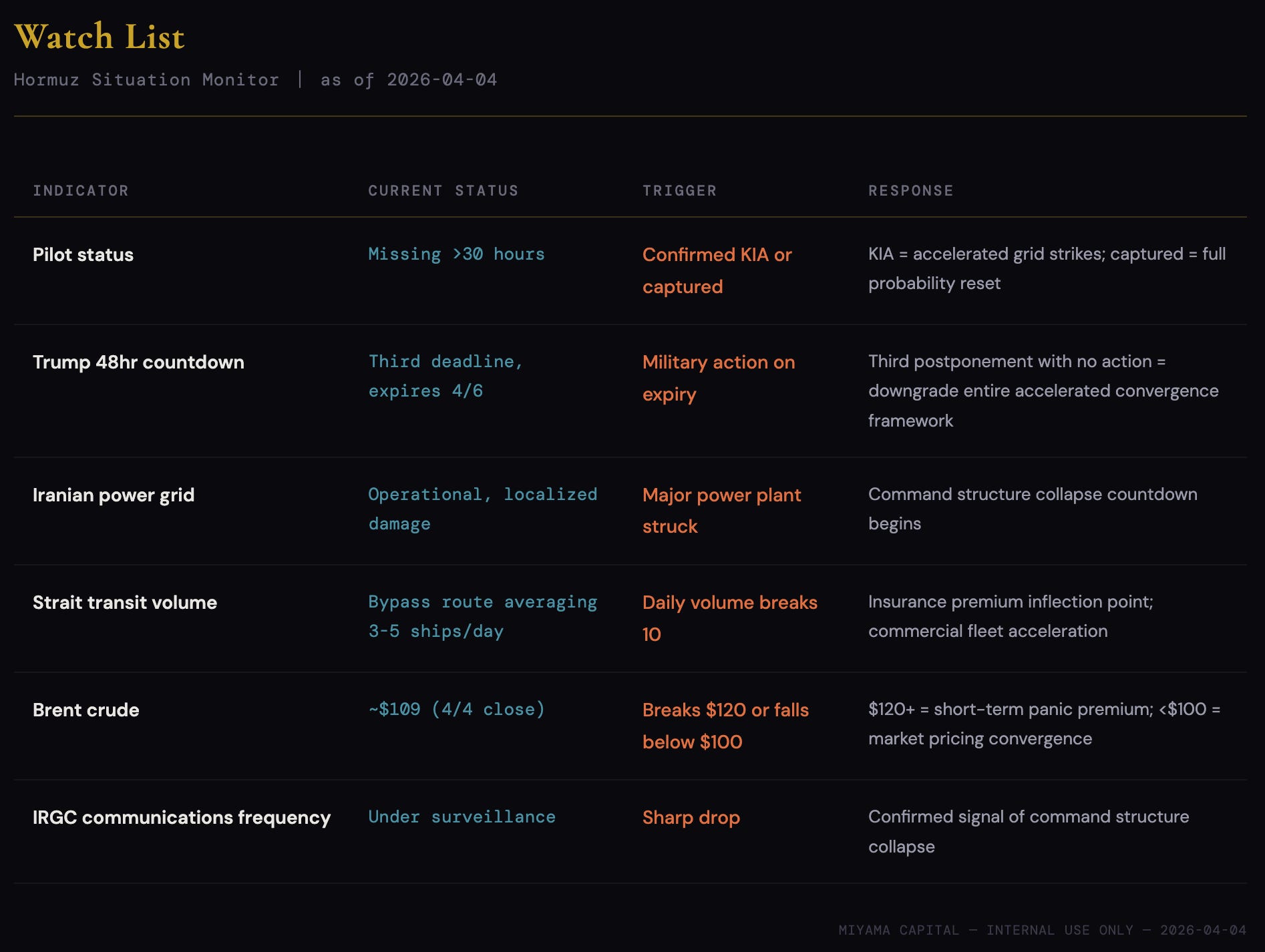
Watch List
What This Means for Your Portfolio
If you have long equity exposure heading into April 6, the decision framework comes down to how much volatility you can absorb and how much optionality you can afford to lose.
Maintaining positions with hedges in place is the most common approach for allocators who already have functioning risk frameworks. Keep existing long exposure, cover with SPX puts or ES shorts as insurance. The cost is time value and slippage on the hedges. The benefit is staying positioned for the post-convergence recovery without needing to re-enter.
Reducing exposure and waiting for clarity is the conservative path. Lower total positioning, redeploy after the April 6 outcome is visible. The risk here is missing a fast snap-back, especially in the softening scenario where the rally will move before most allocators can react. This suits portfolios where exposure is already stretched or liquidity buffer is thin. Allocators with very long time horizons and small position sizes relative to total assets may not need to act at all, but that requires the psychological capacity to absorb the full swing on April 6 and the day after without reacting.
Do not make large directional bets before April 6. The most dangerous trade is getting shaken out in the final convulsion and missing the reversal. Which approach you choose matters less than knowing what you are giving up by choosing it.
Assumption Failure Triggers
Two conditions would require a fundamental revision of this analysis.
First, if Trump postpones the deadline a third time with no substantive military action, the entire accelerated convergence framework that has guided this analysis requires a downgrade. I am flagging this in advance so readers can evaluate the framework against reality in real time.
Second, if Iran initiates and signs a formal ceasefire with its command structure still intact after April 6, the capacity-collapse thesis requires revision. That would mean the endgame is negotiated surrender, not operational failure, and the timeline and market implications would change substantially.
The quietest 48 hours will be followed by the loudest day. April 6.
Disclaimer
This article reflects my personal investment philosophy. It is not investment advice. Make your own informed decisions.
Miyama Capital manages proprietary capital only and does not solicit external investors.
This memo represents the author’s personal views on macroeconomic conditions, interest rate environments, and asset allocation as of the date of writing. It does not constitute a solicitation, recommendation, or guarantee regarding the purchase or sale of any security, fund, bond, or other financial instrument. Investing involves risk; bond prices, interest rates, foreign exchange rates, and economic/policy conditions may materially affect asset values. Scenarios and instruments discussed may become inapplicable as market conditions change. Readers who make investment decisions based on this memo do so at their own risk, and the author accepts no liability for any gains or losses arising from the use or citation of this material.
Kuan H. Wang Founder & CIO, Miyama Capital